
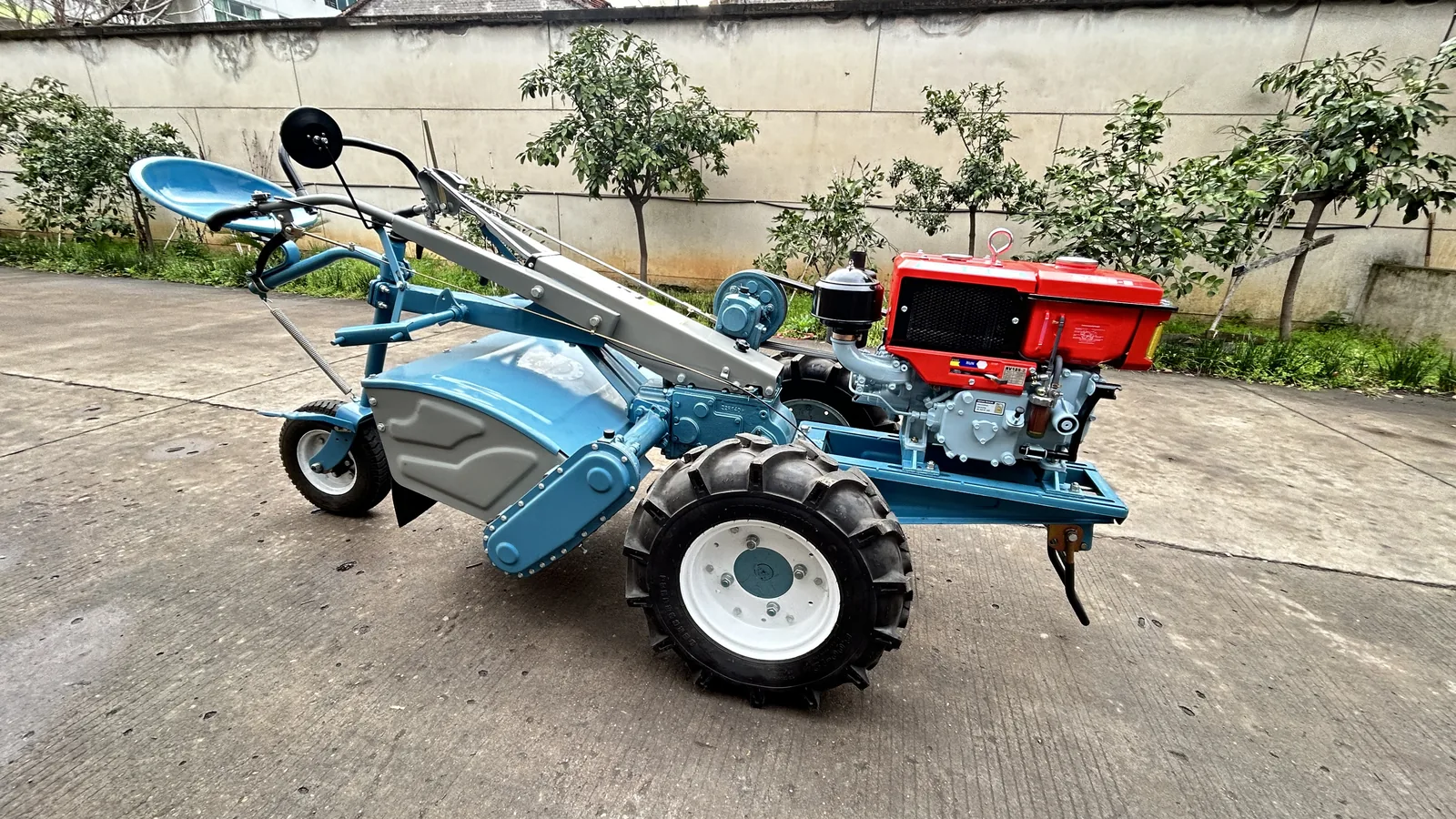
The name on the quotation is not the same business as the machine
A power tiller manufacturer, an exporter and a local dealer are three different businesses, and the same machine passes through all three — so the first question to settle is not which machine, but which link you are actually buying from. Distributors who skip that question end up comparing a factory quotation with a dealer quotation as if the two covered the same thing, when they cover different work, documents and risk.
If you are importing to stock and resell, the roles in front of you are usually these:
- The manufacturer builds the machine: the platform, the engine pairing, the rotary arrangement, the wheel set.
- The exporter moves it across the border: booking, consolidation, packing, the documents that clear customs.
- The importer or distributor — that is you — takes title, holds stock and carries the line in a territory.
- The local dealer sells and services it in front of your own customers, and often becomes the face of the product.
Each link controls a different slice of the order, and each one can only promise what it actually controls. Work along the chain in that order and the questions sharpen quickly; work backwards from a price and every layer sounds interchangeable.
This is the practical half of evaluating a power tiller manufacturer for distributor supply. The evidence side — what a quotation should contain, what a specification sheet should show — is covered there; here the question is simply who does what.
The rule for the whole article: the machine is the same object at every link, but the seller is not. Ask what the seller controls, then ask for that in writing. A promise about something the seller does not control is not a commitment — it is a hope with a letterhead.
What a manufacturer controls — and what it cannot decide for you
The factory end of the chain decides everything that is built into the machine. That is a narrow list, but nothing later in the chain can change it: engine pairing and starting method, rotary arrangement and blade count, wheel spacing, implements packed with the unit, and the packing form itself.
It helps to know what the two SUNTEC platforms document, because this is the part of the order no trader can renegotiate for you.
The M80 chassis is the lighter platform in the 7–10 hp engine class: 179 kg without engine, 6 forward and 2 reverse travel positions, and a rotary arrangement that documents 480 mm with 14 blades as standard and 600 mm with 16 blades as the maximum.
The heavier GN12 / Super 12 platform sits in the 12.5 hp class and documents 470 kg without engine with the same 6 forward and 2 reverse positions. Its working width is the detail worth watching: the specification table published for these platforms records the 600 mm configuration, while the confirmed public range is 480 or 600 mm — exactly the kind of item that has to be pinned down line by line before it reaches a quotation.

What a manufacturer cannot decide for you is everything downstream: how the machine is serviced in your market, whether spare parts sit on a shelf nearby, how much local demand exists, or what your customers will pay. Those belong to the later links, and a factory that answers those questions confidently without a partner in your market is describing an intention, not a service.
What to ask for: the structural facts of each candidate platform — weight without engine, working width options, blade arrangements, travel speeds — each with the document it comes from. Ask which implements are packed with each unit and which have to be sourced separately in your market, because that split belongs in the configuration list, not in a later conversation. SUNTEC's product range sets out both platforms side by side if you want to compare the two before the conversation.
If the answer is vague: "it depends on the configuration" is acceptable only when the configuration options follow. Without them, nobody has described the machine you are about to order.
What an exporter adds — and what you are paying that layer for
The moment goods leave the factory for another country, a second business usually appears between you and the production line. It may be a dedicated trading company, or the factory's own export desk — the work is similar, but the accountability differs, and that difference is worth a question.
This layer handles the parts of the order that have nothing to do with engineering:
- Consolidation and booking — the machine may travel with other goods, in a shared or dedicated container.
- Packing and crating — the packing specification for your configuration, and what each crate contains.
- The documents that travel with the goods — among them the commercial invoice, which is a required document for export and import clearance and is used by customs in the buyer's country to assess duties; the U.S. International Trade Administration's explanation of the commercial invoice lists what it has to carry.
- The term of sale — who pays for what, and where cost and risk pass from seller to buyer. That boundary is what the ICC's Incoterms 2020 rules define, and agreeing a term you have not read is agreeing to an argument later.

The useful test is not what the exporter says it does, but whose name sits on the paper. Ask which entity issues the invoice, which entity signs the contract of sale, and which entity answers when a pallet arrives short. If the answers point to three companies, you are buying through an intermediary layer — fine, as long as you know that is what you are buying.
There is a second reason to ask: that layer's margin is earned on services you can list, and the same power tiller procurement guide that structures a quotation shows whether it adds handling you need or just a step.
What to ask for: the packing specification for your configuration, an expected count per container for that configuration, the term of sale in writing, and the named issuer of each shipping document.
If the answer is vague: the configuration is probably not frozen yet, and the packing plan is the first place it shows.
What a local dealer does in your market — and why it is not your rival
At the far end sits the business your own customers walk into. In most export markets this link is simply called the dealer: the business near the buyer that sells, assembles and services machines.
That is the work this layer owns:
- In-market stock — a machine the customer can look at and take away this week rather than next quarter.
- Assembly and pre-delivery checks — units arriving crated are assembled, fuelled, adjusted and tested locally.
- Service and spare parts — the mechanic, the wear-parts shelf, and the person who answers the phone in the customer's own language.
- The relationship — demonstration, financing conversations, trade-in habits, and the local reputation that decides whether the next customer buys the same machine.
For a distributor, this link is not a competitor to be cut out. It is the layer that decides whether the machine you imported looks supported or abandoned. A market with no service habit needs the importing side to build one deliberately — documentation, assembly drawings, a parts route and a reachable contact — which is why the supplier's service model for overseas distributors is worth reading before you design your own.
One distinction is worth keeping clean, because buyers mix the two words constantly. A dealer sells and services in a local area, usually to the end user. A distributor holds stock, buys in volume, and carries the line across a territory — and is often the one who appoints or supplies dealers beneath it. You can be both in a small market, but the responsibilities are not the same, and the questions you ask a supplier change depending on which one you intend to be.
What to ask for: how a wear part gets from the supplier to a field mechanic, who is trained to do the work, and what documentation your dealers will receive in the language they work in.
If the answer is vague: you are being sold a machine rather than a supply relationship, and the service gap will land on your own balance sheet.
The same machine, three suppliers: what changes for you
Read the chain as a division of control rather than a list of companies. The table below is the version worth keeping next to a quotation while you negotiate.
Link | Controls | Can put in writing | Cannot promise |
|---|---|---|---|
Manufacturer | Platform, engine pairing, rotary arrangement, wheel set, packing form | Platform structural facts, configuration list, the document each fact comes from | Local service, in-market stock, demand in your market |
Exporter / trading company | Booking, consolidation, packing execution, shipping documents, term of sale | Packing specification, issuer of each document, term of sale, dispatch arrangement | Engineering changes, after-sales service in your market |
Importer / distributor (you) | Title, stock, territory, pricing to dealers, service build-out | Your own delivery and service commitments to dealers | Anything the factory has not frozen in the configuration |
Local dealer | Local sales, assembly, service, parts for the end user | Delivery dates, service response, parts availability locally | Configuration, shipping terms, factory decisions |
The point of the table is that the middle two rows are where orders go wrong: the exporter can promise a schedule but not a specification, and you can promise service only as far as your parts and training reach. Every column is checkable, which is what makes the questions worth asking before the first container rather than after it — and the gap between what the table says each link can put in writing and what you have actually received is the list worth asking the supplier to answer in writing before you commit to a quantity.
How to tell which one you are actually talking to
Businesses describe themselves by the role that sounds best. Test identity with four questions that only one role can answer comfortably.
- "Which entity issues the invoice and signs the contract of sale?" A factory that also exports will name itself. If the answering company is different from the manufacturer on the nameplate, you are buying through an intermediary — which may still be the right choice, but the responsibility for the goods sits with whoever signed.
- "Can you change the configuration, or only quote it?" Only the production side can change an engine pairing or a blade count. An intermediary that says yes without a confirmation from the factory is guessing.
- "Where do spare parts ship from, and who pays the freight?" This separates a genuine local presence from a forwarding address. The official U.S. export guidance on sales channels is blunt about the same idea from the exporter's side: an agent, distributor, wholesaler and export intermediary are different arrangements with different responsibilities, and the partner you choose determines who does what in the market.
- "Whose document explains the machine?" The specification sheet, the packing list, and the manual your mechanics will use should each have a named owner. A document described as forthcoming should be treated as absent until it arrives.
The answers map onto the chain neatly:
What you hear | What it usually means | What to do next |
|---|---|---|
"We build it, we ship it, we invoice it" | Factory with its own export operation | Ask for the configuration list and the packing specification in the same document |
"We work with several factories" | Trading company or export intermediary | Ask which factory, and who signs the warranty and service commitments in your market |
"We import and hold stock in your region" | Importer or regional distributor | Ask about territory, exclusivity and how your order is prioritised against their own stock sales |
"We sell and service locally" | Dealer | Ask who supplies them, and whether you can buy from the same source directly |
None of these is a better or worse business in the abstract. The one that fits depends on whether you need production control, logistics, or local service most — and on how much of that work you intend to do yourself.
What stays the same whoever supplies it
The roles differ; the machine does not. Two facts hold regardless of which link signs the paperwork.
The platform still has to fit the field. Working weight and power class decide how a machine behaves in a market. A lighter platform in the 7–10 hp class suits repeated work in smaller, tighter or mixed plots; a heavier 12.5 hp-class machine suits sustained cultivation and traction work. The field-first logic behind that choice is set out in power tiller selection by field conditions, and it is a decision no dealer or exporter can make on your behalf, because only you know the plots your customers work.

The specification sheet still has to be read the same way. Working width, blade count, engine reference, starting method, travel speeds and wheel spacing are the fields that decide what arrives. Power tiller specifications explained walks through which of those fields carry weight and which mislead. And when a customer's complaint turns out not to be a failed part but the wrong class of machine for the job, the conversation is the same one that separates a power tiller from a rear-tine tiller.
Put the three questions in writing before the first order
Role clarity is cheap and role assumption is expensive. Before you place an order, write three sentences into the enquiry itself:
- Which link is the seller, named on the contract and the invoice.
- Which parts of the machine are frozen in the configuration, item by item, with the document each one comes from.
- Which parts of the service are promised, and by whom, once the machine is in your market.
If those three sentences cannot be written into the order documents, the order is not ready to place — however good the machine is.
Everything else — quantity, packing form, the term of sale, the documents that travel with the goods — is easier to agree once those three are fixed, because each later question has a clear owner. If you want those answers set against a specific market rather than in the abstract, put your market, workload and intended configuration in writing and work through the chain from the top.