
A power tiller datasheet is the document that turns a machine into something you can quote, pack, ship and service. If it lists an engine and a working width and stops there, it is a sales sheet. If it fixes the engine, the drive path, the working dimensions with their measurement conditions, the weights, the packing dimensions, the wheel options, the compliance documents and the spare-part numbering, it becomes a procurement document — the one you can take to your freight forwarder, your customs broker and your after-sales desk without a second round of questions.
The search results for "power tiller datasheet" are almost all raw documents: an owner's manual behind a login wall, an OEM manual PDF, a specification table from a mower manufacturer, one 378-word blog post. None of them tells you what the document you are about to receive should contain. That gap is the subject here — field by field, with the fields that most often go missing and the procurement mistakes each one causes.
Why a datasheet is a procurement document, not a brochure
Five different people inside your business will read this sheet, and each of them needs a different field group to be complete.
Colleague | What they need from the datasheet | What happens when it is missing |
|---|---|---|
Purchasing | The exact configuration being quoted, so two suppliers can be compared line for line | Quotes look comparable and are not |
Freight forwarder | Net weight, gross weight, packed dimensions, units per container | Freight is estimated, then re-rated |
Customs broker | Engine type, emission documentation, HS classification, origin | Clearance stalls on a document request |
Workshop / service | Drive path, adjustment points, wear items, part numbers | First repair waits on the factory |
Sales / dealer network | Working width, depth and implement options per configuration | Wrong configuration sold into the market |
That table is the reason the document matters more than the machine brochure. A brochure is written to make the machine interesting; a datasheet is written to make it specifiable. Treat it that way and you ask for different things.
If you are still deciding whether a supplier is worth this level of paperwork, the qualification work belongs one step earlier — the distributor procurement guides collect that groundwork for distributors and project buyers. Once a supplier is shortlisted, the datasheet is the instrument you use on them.
Power tiller, walking tractor, hand tractor — one machine, three names
The first field is the name itself, and it is the one buyers most often skip.
"Power tiller", "walking tractor", "hand tractor" and "two-wheel tractor" are the same two-wheeled, single-axle machine with a handlebar, sold under different names by market: walking tractor in Europe and North America, power tiller or hand tractor across South and Southeast Asia, and further variants in Arabic, Turkish and Vietnamese trade. The FAO's sustainable mechanization guidance frames power sources, implements and the delivery system as one package, which is exactly how a two-wheel platform is bought — the machine is only useful with the implements and service behind it.
The practical consequence for a datasheet is that it must name the platform the way the factory names it, with the model designation used on the nameplate, the invoice and the packing list. If the sheet says "12 hp walking tractor" and the crate says GN12, you have a documentation mismatch before the machine has even moved. Ask for the model designation, the platform family, and the configuration code if the factory uses one.
Engine and drivetrain fields
Almost every power tiller spec sheet gives an engine and a horsepower number. Very few give enough to compare engines across suppliers, and that is where the confusion starts. Four things must be separated:
- Rated versus maximum output. A "9 hp" engine may be 9 hp at maximum output at a stated speed and lower continuous. Ask for both, and ask at which rpm.
- Horsepower and kilowatt. Dual listing should be on the sheet, not calculated by you. The same machine quoted in hp in one market and kW in another is a recurring source of mismatch.
- Displacement, cooling and fuel. Cubic capacity, air- or water-cooled, and diesel or petrol. Public listings in this category contradict themselves on fuel type surprisingly often, so the sheet must state it explicitly, not leave it to a product title.
- The engine-to-chassis boundary. On this class of machine the engine is frequently a separately specified item fitted to a platform. The datasheet must say which engine is quoted, whether alternatives exist, and which numbers describe the chassis alone.
Then the drivetrain, which is where a datasheet either becomes useful or stays ornamental. The worked example below is SUNTEC's own published M80 reference, and it illustrates the level of detail worth asking for:
Datasheet field | Complete way to state it (M80 published example) |
|---|---|
Engine configuration | Compatible range 7–10 hp; quoted engine model and start method confirmed per order |
Engine reference | RT90DI diesel, 487 cc, 9 hp (6.62 kW) maximum at 2,400 rpm, 8 hp continuous, 10 L tank |
Power path | Engine to main shaft: two V-belts; main shaft to wheel axle: gears; gearbox to blade shaft: chain |
Gearbox | Material stated (aluminium on the M80 chassis; the GN12 platform uses an iron gearbox) |
Travel speeds | 6 forward / 2 reverse, with the gears intended for tillage versus transport identified |
Rotary speeds | Four rotary-speed selections, two of them adjusted through an auxiliary sprocket |
Clutches | Main clutch dry multi-plate; claw-type steering clutch; inner-expansion brake |
Dimensions | Overall 2,050 × 710 × 1,235 mm, measured with the stated configuration |
Chassis weight | 179 kg without engine |
That table is worth more than a paragraph of adjectives. Belt, gear and chain are three different maintenance regimes; a service manager reading "chain drive to the blade shaft" plans differently from one reading "direct drive". If your datasheet does not distinguish them, you cannot judge the service load in your market.
Use the datasheet to check the numbers, and use a separate reading of the numbers to check the configuration — the two exercises are different, and reading power tiller specifications covers the second one.
Power take-off, transmission and gear selection
Gear counts are the most over-quoted and least informative number on a two-wheel tractor sheet. "6 forward / 2 reverse" tells you how many selections exist. It does not tell you the working speed, the transport speed, or which selection is meant for rotary tillage.
Ask for:
- Which gears are intended for which job — tillage, transport, and the reverse used in a turn.
- Whether forward speeds are stated as km/h. Ratios alone are not usable; a speed range in km/h with the wheel size it was measured on is.
- How reverse is engaged and used. On two-wheel machines reverse matters at the headland and at the trailer, and the operating procedure should be in writing, not learned on arrival.
- The output the machine can drive. On a walking tractor, the rear output that carries the rotary tiller is the primary drive interface; if a separate PTO or drive shaft for a trailer, pump or other implement is offered, the sheet must state its type, speed, spline or shaft detail, rotation direction and engagement method. Where a machine is quoted without such an output, say so on the sheet rather than leaving the field blank — a blank gets read as "present".
- The drivetrain components that wear — belt part numbers, chain size and pitch, clutch type — because these determine what your workshop stocks in year two.
A datasheet with ratios and rpm but no km/h is not unusable, it is uncomparable. Two suppliers can both print "6F/2R" and offer very different field behaviour.
Working width and tilling depth
Two numbers, and four common ways to get them wrong.
Width belongs to a configuration, not a model. The published chassis references for this class of machine carry a standard rotary configuration and a maximum one — 480 mm with 14 blades standard and 600 mm with 16 blades available on the M80, and a 480 / 600 mm public range on the GN-series platform, where the factory's own reference table records the 600 mm configuration with 18 or 24 blades. A sheet that says "working width: 600 mm" without saying whether that is the standard or the maximum build is quoting its best case as its normal case.
State whether the dimension is the tiller or the machine. Working width is the cultivated strip. Overall width is what has to pass through the gate and sit on the trailer. On a two-wheel tractor with a tiller fitted and the wheels set wide, those differ.
Depth is a range with soil behind it. A depth figure depends on soil, moisture, blade condition and pass count. Ask for the range and the conditions it was established under, not a single number.
Then check it against the field. Working width is the point where the datasheet and agronomy meet: the strip has to match bed width, row spacing and the narrowest access point on the farm. The field conditions guide sets out how to build that brief before you compare sheets at all.

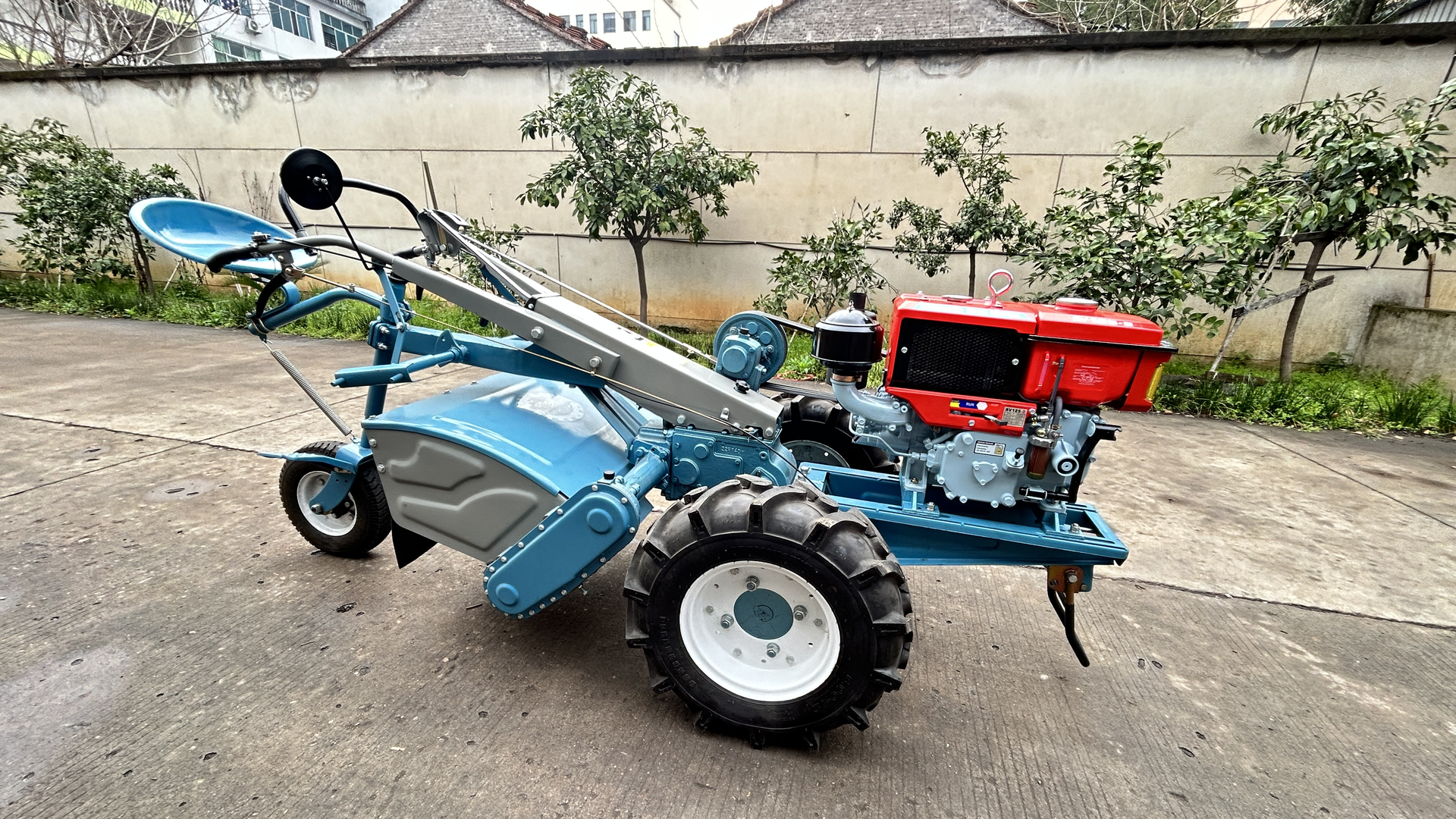
A wider tiller on a narrow chassis is a different machine, not a bigger one. The photograph above is the reason the width field and the configuration field have to be read together.
Weight, dimensions and export packing
This is the group that decides whether the order makes money, and it is the group that public spec sheets leave out most often. Only one of the pages reviewed while preparing this article gave both net and gross weight; the same page was the only one to give a packed carton dimension.
Ask for five distinct weights and dimensions, by name:
- Chassis weight without engine — the number that lets you compare platform strength. The published figures in this class are 179 kg for the M80 chassis and 470 kg for the GN-series structure.
- Complete operating weight with the quoted engine, wheels and accessories fitted.
- Net and gross weight per unit as packed, plus the number of units per crate or pallet if it is more than one.
- Machine dimensions and packed dimensions, in the same units. Overall machine dimensions for the GN-series structure are 2,950 × 980 × 1,240 mm with 210 mm minimum ground clearance; those are machine dimensions, and they are not the crate.
- Container loading. Units per 20 ft and per 40 ft high cube, with the packing method that produces the figure. The published GN-series chassis reference records 50 units per 40HQ with the engine included. A container figure without the packing method is a number you cannot check against a quotation.
Two smaller fields belong in the same block because they change the freight line: whether the machine ships assembled or with the handlebar, wheels or implements crated separately, and whether the crate is fumigated timber with a marked certificate. Both are standard questions from a forwarder, and both are usually absent from a datasheet. The third field in this block is the price basis: FOB, EXW and CIF produce different landed numbers from the same crate, so the trade term belongs on the sheet alongside the packing figures, defined as the ICC Incoterms rules define it rather than as shorthand in an email.
Engine pairing, starting method, implement set, packaging and commercial terms are all confirmed in the quotation for the configuration you ask about; a reference table is not a stock list. Read the published GN-series platform reference as the format to expect, then demand the same fields for your own configuration.

Tyre and wheel options
The wheel set is the field that quietly changes what a machine is good for, and it is usually compressed into one word: "pneumatic". Ask for the specification, not the category.
- Tyre size and construction. The M80 chassis is documented on 5–12 tyres — size and rim in one notation. If a supplier writes only "pneumatic tyres", the sheet cannot be compared with one that writes 5–12.
- Tread pattern and ply rating for the intended ground: agricultural lug for traction, and whether a turf or ribbed alternative is offered.
- Adjustable wheel tread. Several settings mean the machine can be narrowed for row work and widened for stability. The M80 chassis adjusts between 390 mm and 780 mm; the GN-series platform documents five tread settings. A sheet that omits the tread range hides how much of the row-crop market the machine can actually serve.
- Alternative wheels. Steel-wheel assemblies and anti-skid wheels are documented wheel options on the GN-series platform, and paddy is one of the field conditions that platform is published for. Dual wheels change the width and the load. These are options, and options belong on the datasheet with their own weights and dimensions.
The published M80 platform reference is a useful comparison point when you are asking for wheel detail: it documents the tyre notation, the adjustable tread range and the chassis weight in one place, which is the shape a datasheet reply should take.

Ask for the wheel set on the sheet to match the wheel set on the order; a substitution at packing time changes the working width, the tread setting and the transport weight at once.
Safety, certification and compliance fields
Here the datasheet has to answer a question you cannot answer yourself: which approvals does this exact machine carry, for which market, and can you see the evidence?
Ask for these fields, and ask for them as documents with identifiers rather than as adjectives:
- Emission stage of the quoted engine, with the regulation it is certified to and the engine family or approval reference. For the United States that means the applicable EPA tier for nonroad diesel engines used in agricultural equipment; the EPA publishes the standards for nonroad compression-ignition engines in heavy equipment. An engine that is compliant for one market is not automatically compliant for another, so the field must name the market.
- CE marking and the declaration of conformity, where the machine is destined for the EU. Machinery is currently governed by Directive 2006/42/EC, and Regulation (EU) 2023/1230 replaces it — the Directive is repealed with effect from 20 January 2027, with transitional provision for machines placed on the market before that date. A quotation that does not say which regime the machine is built to leaves you to find out at the border.
- Certificate identification: issuing body, certificate number, the model designations it covers, and its validity dates. A claim of certification with no certificate number is not a field, it is a sentence.
- Noise and vibration values, with the measurement standard and the position they were measured at, if your market requires them.
- Guards and safety devices fitted as standard — blade guards, belt and chain covers, the emergency stop or clutch arrangement, and the safety pictograms applied to the machine. If a market requires a specific guard, it has to be on the sheet, not negotiated after the order.
- Pre-shipment inspection and test records you can ask for as a condition of the order.
Ask for every document with a number on it. A certificate you cannot identify — no number, no issuer, no model list — will not satisfy a customs broker or a dealer's tender, and it is the field buyers most often accept in good faith.
Spare-part identification
The last field group decides what happens in year three, and it is the one left out most consistently: none of the pages reviewed here offered a part number or an exploded view tied to an item list.
What belongs on the sheet:
- Part numbers for the wear items — rotary blades, blade bolts, belts, chain and sprockets, clutch plates, seals and filters — each with the quantity per machine so you can build a service kit.
- An exploded view of the assemblies, with item numbers that match the parts list. A diagram without matching numbers costs your workshop a phone call per repair.
- The numbering logic, if the factory uses one, and the platform the number belongs to. A part number that silently changes between platform generations is worse than none.
- The change history for wear parts, so a dealer can tell whether the machine on the floor and the machine in the crate use the same blade.
- Which parts are platform-specific and which are shared across the configurations you stock, because that is what decides your stock depth.
Parts and service planning sits after the purchase, and the spare-parts identification and technical support route is where those fields are actually used: a parts request that names the platform, the installed location and the required quantity is what turns a part number on the datasheet into a delivered part.
The fields that are usually missing — and the mistakes they cause
These are the omissions that show up repeatedly in public power tiller specification listings, and what each one does to an order.
Missing field | The procurement mistake it causes |
|---|---|
Fuel type, stated explicitly on the sheet | Engine specified as one fuel in the properties block and the other in the specification text; the wrong spare-parts set and fuel system arrive |
Whether a working-width figure is standard or maximum build | Two suppliers quoted "the same width" are quoting different machines; landed cost per hectare is wrong |
Units, and which dimension is which | Working width given in feet in one line and centimetres in another, on the same page; site measurement and order no longer agree |
Speed and rpm values that contradict each other | A single sheet listing a rotation speed of thousands of rpm next to a blade speed of a couple of hundred, with no indication which is the engine |
Net weight separate from gross and from shipping weight | Freight quoted on the machine weight, then re-rated when the crates are weighed |
Packed dimensions and units per container, with the packing method | Container plan built on an assumption; one shipment's freight difference erases the margin |
Certificate number, issuer and model coverage | Compliance filed as a claim; tender or clearance blocked until the factory produces the document |
Part numbers for wear items | First repair waits on the factory, and the dealer's reputation absorbs the delay |
Measurement conditions or tolerance | The delivered machine "does not match the sheet" and neither side can prove what the sheet meant |
Emission stage of the supplied engine | Machines built to one market's standard shipped into another, with no remedial path |
HS classification not stated | The customs broker cannot pre-classify, so the declaration waits on a document request |
Price basis (EXW, FOB or CIF) left implicit | Two "cheaper" quotes are compared on different terms; the margin is decided by arithmetic nobody did |
Customs classification is a field the supplier can supply and the buyer cannot invent: the Harmonized System code the goods will be declared under, from the World Customs Organization nomenclature, together with the engine description the code depends on. Ask for it on the sheet; do not leave it to be resolved after the container is booked.
A number without its condition is not a specification. "Weight 179 kg" without "without engine", "width 600 mm" without "maximum build", "speed 2,400 rpm" without "at the engine" — each one is a sentence you cannot enforce when the crate is opened.
One pattern runs through nearly every row above, and it is the cheapest thing to fix in your own request: state the condition in the same line as the number. Weight, and whether the engine is included. Width, and whether it is the standard or the maximum build. Speed, and the point it was measured at. A supplier who is asked for the pair will usually give you both; a supplier asked for a single number has no reason to volunteer the one that makes it smaller.
The power tiller RFQ checklist is the companion to this list on the other side of the same conversation — what to put in the request that comes back with the datasheet.
Datasheet checklist for distributors
Work down this table for each supplier and each configuration. An empty cell is a question to send back in writing, not a rounding error.
# | Field to request | Why it matters | What a complete answer looks like |
|---|---|---|---|
1 | Model designation and platform family | Ties the sheet to the nameplate, invoice and packing list | Model code plus configuration reference |
2 | Configuration quoted (standard or optional build) | Compares quotes that otherwise look identical | Named build with the options listed |
3 | Engine model and fuel type | Determines the parts set and the fuel system | Model, fuel, cooling, displacement in cc |
4 | Maximum output at stated rpm | The comparable power figure | hp and kW, both at a stated rpm |
5 | Continuous output | Distinguishes slogging work from peak claims | Continuous rating at a stated rpm |
6 | Starting method | Changes the operator requirement and the parts | Recoil, electric or both |
7 | Fuel tank capacity | Field endurance per fill | Capacity in litres |
8 | Gearbox type and construction material | Drivetrain integrity and service regime | Type and material stated |
9 | Travel gears, and which is for what | Working versus transport use | Gear count plus the intended use of each |
10 | Forward speeds in km/h, with wheel size | The only comparable speed figure | Speeds on the stated wheel set |
11 | Power path, stage by stage | Belt, gear and chain imply different maintenance | Engine-to-chassis path described |
12 | Clutch types (main and steering) | Wear parts and adjustment points | Type of each clutch |
13 | Drive output for implements | Decides what the machine can drive | Type, speed, shaft detail, engagement |
14 | Standard working width | The configuration you are actually buying | Width plus blade count |
15 | Maximum working width | The ceiling if conditions change | Width plus blade count |
16 | Tilling depth range and its conditions | Depth is soil-dependent, not a constant | Range with the conditions stated |
17 | Overall machine dimensions | Access, transport and storage | L × W × H in stated units |
18 | Chassis weight without engine | Comparable platform mass | Weight, with the measurement basis |
19 | Complete operating weight | Traction, handling and transport | Weight with engine, wheels, implements |
20 | Net and gross weight as packed | The freight calculation | Both, per unit and per crate |
21 | Packed dimensions and packing method | Booking space and handling | Crate dimensions in the same units |
22 | Units per 20 ft and 40HQ | Container plan and landed cost | Figures with the packing method behind them |
23 | Shipping condition (assembled / partly crated) | Changes volume and assembly labour | What ships fitted and what does not |
24 | Tyre size, construction and ply | The comparable wheel spec | Size and rim notation, e.g. 5–12 |
25 | Wheel tread settings | Row work and stability | The range or the setting list |
26 | Alternative wheel sets | Paddy, turf or dual use | Each option with its own dimensions |
27 | Engine emission stage and market | Admission, registration and resale | Stage plus the regulation and reference |
28 | CE marking and declaration of conformity | EU market access | Regime named, DoC available |
29 | Certificate numbers, issuers, covered models, validity | Turns a claim into a document | All four identifiers complete |
30 | Noise and vibration values, with standard | Market requirement where applicable | Value plus the measurement standard |
31 | Guards and safety devices fitted | Compliance and operator safety | Itemised, marked standard or optional |
32 | Wear-part numbers, quantities and diagram reference | Whether you can re-order without the factory | Numbers tied to an item list |
33 | Pre-shipment inspection or test report | Acceptance evidence before payment | Report type you can request |
34 | Measurement conditions or tolerance note | Makes the numbers enforceable | Basis stated for weight and dimensions |
35 | HS classification and the engine description behind it | Pre-classification and duty calculation | Code plus the description it rests on |
36 | Shipping mark, crate marking and documentation set | Clearance and receipt | Packing list, invoice data, origin |
37 | Price basis named as a trade term | Two quotes are only comparable on the same term | EXW, FOB or CIF stated on the quotation |
38 | Warranty terms and what they cover | Decides who pays for the first failure, and where the work is done | Term, coverage, who performs the work, from the seller |
39 | Fuel consumption at a stated load | The operating cost your dealer's customer will quote back at you | L/h or g/hp·h with the load and rpm it was measured at |
Two rules make the table work. Send it as a numbered list so the reply comes back numbered, and keep the signed or stamped version with the order — a datasheet that arrives as a chat message has no standing when the container is opened.
Request the M80 or GN12 datasheet
Send the configuration you are working towards — market, primary task, field condition, target working width, engine preference and approximate annual volume — and the platform datasheet comes back with the fields above filled in for your build, plus the weight, packing and container figures for the configuration being quoted.
Start with the datasheet and configuration request. If the field list is new to you, send the checklist from the previous section as it stands; the parts you leave blank are exactly the parts the supplier should be filling in, and the numbered reply becomes the first annex to your order.