
Power tiller vs rear-tine tiller: they are not two versions of one machine
A rear-tine tiller and a power tiller belong to different equipment classes. A rear-tine tiller is either a self-propelled garden rototiller or a tiller implement; a power tiller — also sold as a walking tractor, two-wheel tractor or hand tractor — is the machine that a tiller implement mounts on. Choose by the work and the operator, not by the name.
One disclosure before the comparison, because it decides how you should read the rest: this article is published by SUNTEC, which manufactures two-wheel tractors and power tillers. We sell one side of this comparison, so the sections that follow mark plainly where the other class is the better purchase, and where neither class is the right answer.
If you are quoting for a dealer network, the first useful question is not "which is better" but "which of these two names does my customer actually mean". That question has a short answer and a long tail of confusions behind it. Once the names are straight, the distributor buying guide for power tillers is where the platform families get sorted against markets and field conditions.

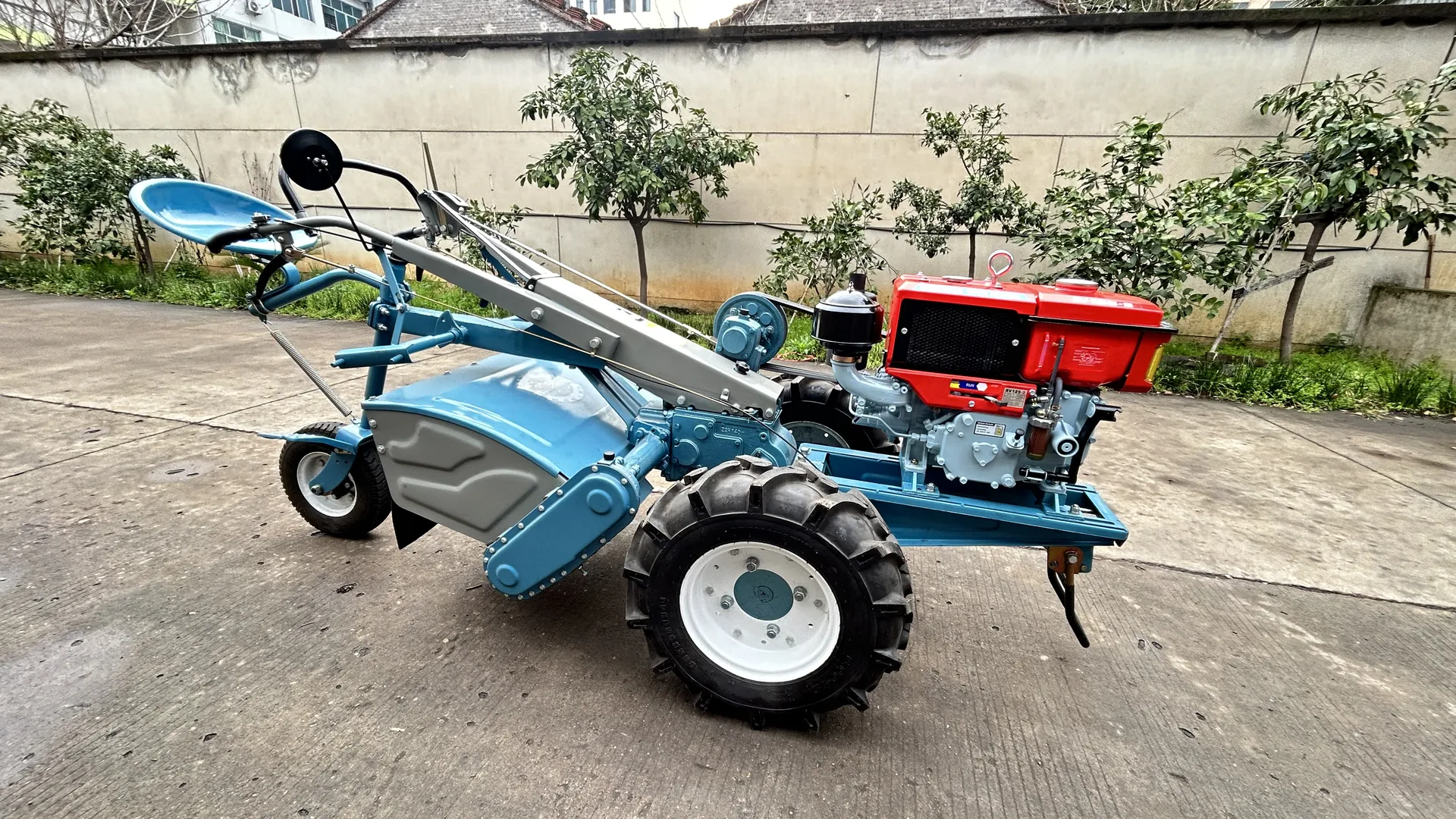
The class this article is about, as it is actually supplied: a two-wheel tractor with a rear rotary tiller mounted on it. The tiller is the attachment; the tractor is the machine.
The names collide because two markets use them differently
In North American retail, "rear tine tiller" almost always means a complete, self-propelled rototiller: an engine, two powered wheels, a set of tines mounted at the rear, and a depth stake or lever — the machine a homeowner or market gardener buys at a garden centre. In the two-wheel tractor trade, the identical phrase means the attachment: a rear-tine tiller that bolts onto a tractor's implement mount and is driven by the tractor's engine through a PTO or a dedicated clutch.
Two-wheel tractor suppliers market the same phrase as an implement line — BCS America lists rear-tine tillers as attachments for its tractors, and Earth Tools groups them under soil-working implements alongside power harrows and rotary ploughs.
That is why the "versus" in most real buying conversations falls apart. One name points at a machine, the other at a part of a machine. Comparing a trailer with a truck is closer to the truth than comparing two trailers.
Both readings are legitimate; they simply belong to different businesses. A distributor importing two-wheel tractors will sell rear-tine tillers as one line item inside a much longer implement list. A retailer selling garden equipment sells rear-tine tillers as the product itself. Neither is confused — they are answering different customers.
What a rear-tine tiller actually is
A rear-tine tiller is a tillage machine whose tines sit behind the wheels: the engine drives the wheels forward and the tines rotate into the soil, so the machine pulls itself through the ground while an operator walks behind it.
The placement of the tines is the whole design argument. On a front-tine tiller, the engine weight sits over the tines and the machine drags itself forward on the tines themselves; it mixes soil well in already-worked ground. On a rear-tine machine, powered wheels carry the weight and set the pace while the tines turn at their own speed, which is why rear-tine units handle breaking new ground, sod and compacted or clay-heavy plots better than front-tine machines of similar size — and why they are heavier and cost more. Mid-tine designs sit between the two. In North America these machines are sold through garden and farm-equipment retail channels, and extension safety guidance treats rototillers and two-wheeled tractors together as common equipment on small farms and gardens — which is also why the safety rules for the two are written as one set.
What rear-tine tillage does not fix: wet, sticky clay smears under the tines whatever their position, rocky ground damages the drive, and on terraced or narrow plots a walk-behind machine with a wide tiller simply does not fit the working width available.
Tine rotation is the axis the garden-tiller segment competes on: standard-rotating tines turn forward with travel, counter-rotating tines turn against it for a finer finish at a higher power demand, and dual-direction machines offer both. BCS, on the page cited above, quotes 20 tine rotations per wheel revolution with a 10:1 ratio available in second gear as its differentiator. On the two-wheel tractor side the tiller is a driven implement, so its rotation, tine speed and depth follow the implement's own design rather than the chassis.
The same two-wheel machine has four names
"Power tiller", "walking tractor", "two-wheel tractor" and "hand tractor" are four market names for one product class: an engine, two wheels and a frame with an implement mount, controlled by an operator walking behind it. Which name is used depends on the market, not on the machine. Sub-Saharan and South Asian buyers tend to say power tiller or hand tractor; North American small-farm suppliers tend to say two-wheel tractor or walk-behind tractor.
This matters commercially in two ways. First, when you build a keyword or catalogue structure, these four names should not become four near-duplicate pages — they describe one class of machine, and splitting them only splits your own relevance. Second, the four-name muddle is exactly what makes buyers ask for "a rear tine tiller" when what they need is a tractor plus a tiller implement.
Structurally, the class is simple: an engine, a wheeled chassis, and interchangeable implements. It comes with no implements as standard; the tiller is an attachment you spec separately, and each manufacturer's implements fit only that manufacturer's system.
Where the names really overlap: "rotary tiller" is an implement, not a machine
Here is the confusion that costs importers money. A rotary tiller exists in two incompatible homes:
Where the tiller mounts | What it is | Who it is for |
|---|---|---|
Rear of a two-wheel tractor | Attachment driven by the tractor's engine | Smallholder and mixed-terrain work; one tractor, several implements |
Three-point hitch of a four-wheel tractor | Attachment driven by the tractor's PTO | Field-scale farms with a full-size tractor |
The two are not interchangeable, and neither is interchangeable across manufacturers: implements built for one two-wheel tractor system cannot be mounted on another brand's tractor, and a full-size tractor's rototiller will not fit a two-wheel machine. A buyer who searches for "rotary tiller" without naming the tractor it goes on may well be describing an implement from a class you do not supply at all.
For a distributor, the practical rule is to ask for the hitch and the tractor model before discussing the implement. Width, blade count and drive type mean nothing until you know what the tiller is being mounted on. When the question shifts from one machine to a working set, the implements a two-wheel tractor can carry are where tillers, ploughs, trailers and traction wheels get grouped by job.

The tiller arrives as an implement: a gearbox, a hood and a tine rotor that mounts on a tractor. It cannot be bolted onto a different brand's machine.
Five things that actually decide the choice
Specification sheets describe machines; the decision is usually about the job. These five dimensions separate the two classes cleanly, and they are the questions to put to a customer who is not sure what to buy.
Dimension | Rear-tine garden tiller | Two-wheel tractor with tiller implement |
|---|---|---|
Scale of work | Large garden beds, repeated passes in the same beds | Smallholder plots and mixed-terrain fields; several tasks per season |
Soil and terrain | Worked ground, compacted beds; struggles in wet clay, rocks and terraces | Paddy, dry land and hilly plots, within the machine's weight and width limits |
Other jobs needed | Tilling, plus light cultivating on some models | Tilling, ploughing, transport with a trailer, anti-slip wheels for wet ground |
Service and parts | Consumer retail channels and garden-equipment service | Needs a dealer who can service a small diesel engine and a gearbox |
Operator hours | Short sessions; a heavy machine to handle by hand | Long working days; a walking machine is physically demanding over extended use |
Two of those rows are worth stating more bluntly. Scale first: two-wheel tractors mechanise small-farm operations affordably but are not appropriate for large vegetable operations — the machines are less efficient than a full-size tractor and hard on the operator over long periods. Service second: the machinery is simple to repair compared with a full-size tractor, which is an advantage only if somebody local can do the repair at all.
Where field conditions, not machine preference, decide the answer — water availability, plot shape, soil type — the more useful reading is the field-condition selection guide rather than a class comparison.
When a rear-tine garden tiller is the better choice
There are real situations where the self-propelled garden machine wins, and a distributor should recognise them rather than talk past them.
If the customer tills the same beds season after season and does nothing else with the machine, a garden tiller does one job well and needs no implement decisions at all. If their land is in large, flat, stone-free beds where a walk-behind tractor offers no width or traction advantage, the extra machine class buys them nothing. If there is no local service structure for small diesel engines, a garden-scale machine with consumer support behind it is the lower-risk purchase. And if the buyer's business is retail garden equipment rather than machinery supply, the garden tiller is their product category — inventory, shelf presence, seasonal demand — while a two-wheel tractor is a quotation-and-support business they may not be set up for.
None of that makes the garden tiller a lesser machine. It makes it a different purchase, with a different support model behind it.
What a two-wheel tractor does that a garden tiller cannot
A garden tiller is one machine with one job. A two-wheel tractor is a machine with a job list, because the implement mount is the point: change the implement and the same engine and chassis plough, till, haul or work wet ground.
That is the whole reason the class exists in smallholder markets. The GN12 walking tractor, for example, carries a 12.5 hp-class engine with six forward and two reverse speeds, weighs 470 kg without the engine, and takes a 480 mm or 600 mm rotary tiller as well as ploughs, anti-slip wheels and a trailer.
The lighter M80 power tiller platform covers the same logic in a 7–10 hp range at 179 kg without the engine, for narrower plots where a heavier machine is a liability rather than an advantage.
One engine detail separates this class from the US garden-tiller segment and matters more than any horsepower figure: the GN12 chassis runs a single-cylinder water-cooled four-stroke diesel, and the reference engines on file for both platforms are hand-crank or electric-start units in the same small-diesel family. Garden tillers in the retail segment are gasoline four-stroke machines. That single difference decides the fuel, the spares and the service skill the buyer has to find in the destination market.

At supply scale: units lined up in the warehouse before packing. The implement set for each one is specified separately, which is where most quotation errors start.
The honest limits of the class, stated because we sell it:
- Large acreage is out: the sizing unit that matters is the area you intend to work in a season, and extension guidance slots walk-behind tractors at small-acreage farms and market gardens rather than larger vegetable operations. If that number is counted in tens of hectares of continuous field, this class is the wrong starting point however many implements it accepts.
- Operator hours matter. A walking machine is tiring; if the same operator runs it all day every day, that is a real cost.
- Implements are system-specific. Buying the tractor commits the buyer to that brand's implement universe for tillers, ploughs and trailers.
- Rocky, terraced and very wet plots can defeat the class entirely — a four-wheel tractor with a properly matched tillage implement is the correct machine there, not a heavier two-wheel unit.
Numbers to compare instead of adjectives
Catalogue language is full of words like "powerful" and "versatile". Numbers travel better between markets, and they are what a buyer can actually check on a quotation. The platform figures below are quoted from the M80 and GN12 specification sheets.
Specification | M80 platform | GN12 platform |
|---|---|---|
Engine range | 7–10 hp | 12.5 hp class (engine model per quotation) |
Engine references on file | 487 cc reference unit at 9 hp max / 2400 rpm | 624 cc or 666 cc units, 12.5 hp max / 2400 rpm |
Tilling width | 480 mm standard, 600 mm optional | 480 mm or 600 mm, per confirmed configuration |
Blades | 14 standard, up to 16 | 18 or 24 blades on the 600 mm configuration sheet |
Gears | 6 forward / 2 reverse | 6 forward / 2 reverse |
Weight without engine | 179 kg | 470 kg |
Dimensions (L × W × H) | 2050 × 710 × 1235 mm | 2950 × 980 × 1240 mm |
Wheel tread | 390–780 mm | 810 / 750 / 690 / 630 / 570 mm |
Two footnotes belong with that table. Engine pairing, starting method, implement set, packing and commercial terms are confirmed per quotation, not from a reference sheet — and the chassis figures above describe the two platforms this article compares, not the whole catalogue. A third platform exists in the same chassis family, but its independent specification is not published here.
Working depth is the one parameter that table cannot carry, and it is usually the first one buyers ask about. On the garden-tiller side, depth is published as part of the machine: the BCS tiller line quotes four tine depth settings with a maximum tilled depth of 8 inches, about 200 mm. On a two-wheel tractor, depth belongs to the implement and how it is set rather than to the chassis — so it is confirmed with the implement in the quotation, not assumed from a platform table. Treat any chassis-level depth figure for a two-wheel tractor without a named implement as unverified.
How to check a specification sheet before you quote
Six checks catch most of the errors that reach a container:
- Which engine, and how does it start. A platform supports several engines; hand-crank and electric start are different SKUs for the same chassis.
- Whether the width is standard or optional. A 480 mm and a 600 mm machine of the same model are not the same machine to a customer working narrow terraces.
- Whether the implements are included. They are not. A two-wheel tractor without the tiller implements you specified cannot do the job it was bought for.
- Whether the implements exist for that system. Implements are brand-specific; there is no cross-fitting between two-wheel tractor systems.
- Service and parts. Who in the destination market can service the engine and the transmission, and how do they get parts.
- Commercial terms in writing. Tilling width and blade count come from the specification; quantity, lead time, packing and warranty come from the quotation.
For buyers preparing an RFQ, the power tiller procurement guide walks through the same list from the purchasing side.
Once the fields are on the table, the specifications explainer covers how to read them without over-reading them.
FAQ
Are rear-tine tillers better? Better than front-tine machines at breaking ground, working compacted soil and holding a straight line, because the wheels carry the machine instead of the tines. But the comparison only holds inside one class. A self-propelled rear-tine tiller and a two-wheel tractor with a rear-tine implement are different purchases with different support needs.
What is a rear-tine tiller used for? Breaking new ground and sod, preparing a seedbed, mixing compost or fertiliser into the top layer, and cultivating between rows of established crops. On a two-wheel tractor, the same name refers to the tiller implement that mounts on the tractor and is used for the same tasks at plot scale.
What are the common problems with rear-tine tillers? Wet or sticky soil clogging the tines, jams from stones and roots, hard starting on cold engines, drive-belt and gear wear under sustained use, and neglect during storage. Safety guidance is consistent on one point: shut the engine off and disconnect the spark plug lead before clearing jammed tines or making adjustments, and remove stones, sticks and wire from the work area before starting.
What is another name for a power tiller? Walking tractor, two-wheel tractor and hand tractor. Outside North America, "power tiller" and "hand tractor" are the more common terms in tenders and dealer catalogues; in North America the same class is usually described as a two-wheel or walk-behind tractor.
Bottom line
The two names describe two different things, and the buying decision follows from which one your customer meant. If they want one machine for one job — tilling beds on ground that is already in production, with consumer-level support behind it — a self-propelled rear-tine garden tiller is the simpler purchase and a perfectly good machine. If they need one machine that tills, ploughs, hauls and works wet ground across small and mixed-terrain plots, that is the two-wheel tractor class, and the choice inside it comes down to power and weight: the lighter M80 platform for narrow plots, the GN12 for heavier field work.
Either way, the spec that reaches a container is the one that was checked before the quotation, not the one in the heading of a catalogue page.
If you are matching a configuration to a market — working width, engine and starting method, implement set and packing — send the field conditions and the intended implement list, and we will come back with a configuration to quote: start with the field conditions and the implement list you need.