
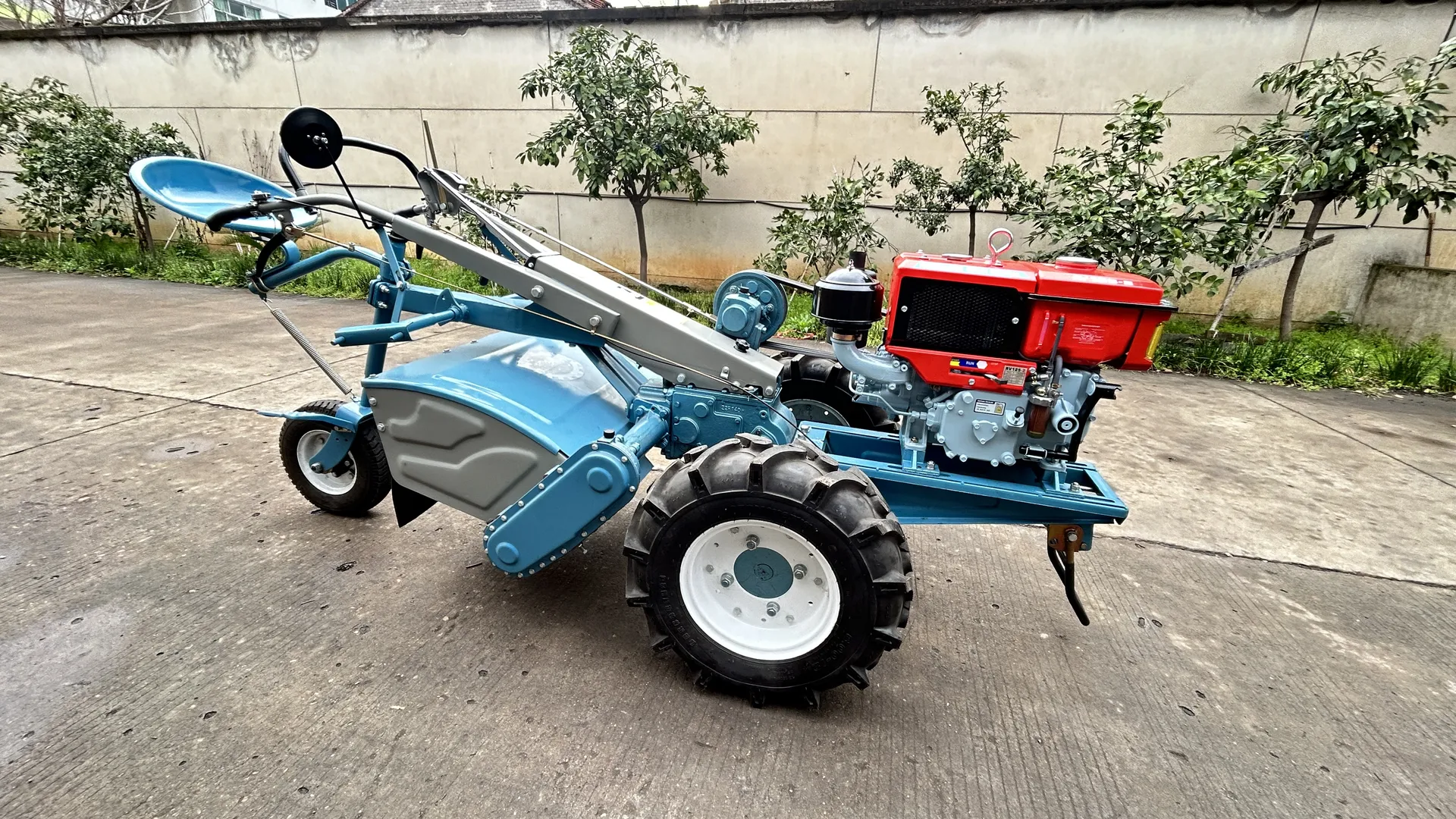
Search a supplier directory for "GN12" and you will not find one machine. One listing hangs a 9.7 kW engine, a 500 kg working weight and a 600 mm rotor on the model number; the next headlines the same GN12 with a 10.5 hp engine; a third gives no numbers at all beyond "contact us". The label describes a class of machine, not a fixed build.
That is the problem a GN12 walking tractor configuration has to solve, and it is why the order of the decisions matters more than the price on any single quotation. Engine, tilling width, wheel track, gearbox and implements are not a menu you pick from — each one constrains the next. Get the order wrong and every later choice is built on the wrong machine.
This guide works through that order using the GN12 platform as the worked example, so what you send a supplier is a configuration you can defend, not a model number you hope means the same thing on both sides.
The order is the specification: work and field first, then engine and starting method, then rotor width and blade set, then wheel track and traction, then gears, then implements — and packing last, because it is the item every earlier decision changes.
What the GN12 platform is built for, and when it is the wrong machine
Two-wheel tractors — called power tillers, hand tractors or walk-behind tractors in different markets — occupy an odd position in farm machinery statistics. The FAO mechanization review points out that two-wheel tractors are not counted as "tractors" under the standard FAO definition, even though in Bangladesh they carry about 90% of tillage operations (FAO, Mechanization for Rural Development). These are the machines that do the cultivation work on smallholder land, and the heavier end of the class is where light-duty equipment stops being enough.
What the 12.5 hp chassis changes, in numbers:
Chassis record | GN12 | MUBOTA M80 |
|---|---|---|
Tilling configuration recorded | 600 mm (18 or 24 blades) | 480 mm standard (14 blades) |
Maximum tilling configuration | 600 mm | 600 mm (16 blades) |
Weight without engine | 470 kg | 179 kg |
Minimum ground clearance | 210 mm | Not stated in the sheet |
Two things follow from that table. The width record starts higher on the heavier platform — 600 mm is already the GN12's recorded configuration, while the M80 reaches 600 mm as its maximum. And the extra bare weight is what keeps a rotor at depth and a trailer on the ground, with the 210 mm clearance letting the machine cross ridge bottoms and stubble without dragging.
The same numbers explain when the platform is wrong. On terraces, in orchard rows, on dry-land plots and anywhere the turning space is measured in metres, a 2,950 mm machine weighing 470 kg without engine is a liability, and the lighter platform is the honest recommendation. One disclosure before the details: the platforms used as worked examples here are the ones we build at SUNTEC, and every check below is written to stand up against our own numbers as well as anyone else's. The choice between the two SUNTEC platforms is collected in the power tiller configuration guide hub; the rest of this article assumes the heavier platform is the right one and goes through its configuration in order.
Fix the engine and the starting method first
The engine decision comes first because it sets the ceiling for everything after it. The GN12 chassis specification lists two diesel engine references, and on the headline figure they are identical.
Engine reference | Displacement | Maximum output | Continuous output | Starting method |
|---|---|---|---|---|
RV125-2 | 624 cc | 12.5 hp at 2,400 rpm | 10.5 hp at 2,200 rpm | Hand crank |
RT125DI / RT125DIE | 666 cc | 12.5 hp at 2,400 rpm | 11 hp at 2,400 rpm | Hand crank or electric start |
Both are 12.5 hp machines, so the headline number cannot separate them. Three things can: displacement, the continuous rating, and the starting method.
The continuous rating is the one to read twice. Engine datasheets distinguish continuous power from an intermittent or overload rating, and the overload figure is defined for a bounded window — in the ISO 3046 definitions reproduced in manufacturer data, intermittent power applies for no more than one hour in any twelve (Lister Petter engine data sheet). A 12.5 hp maximum output with a 10.5 hp continuous rating behaves differently in a full day of rotor work than a 12.5 hp maximum output with an 11 hp continuous rating, even though the two quotations will look the same at a glance.
Starting method is the second decision inside this step, and it is an operating one rather than a technical one. Hand crank versus electric start changes who can start the machine on a cold morning, and whether a battery and charging arrangement has to be written into the order. Both references are listed against the same chassis, and the engine fitted to a specific order is confirmed at quotation — so the configuration you send should name the reference you want instead of assuming the supplier's default.
Once the engine reference is fixed, the width decision in the next step has a known ceiling to work against.
Match tilling width and blade set to soil and passes
The GN12 chassis record gives the tilling configuration as 600 mm with either 18 or 24 blades. The confirmed public range for the platform is 480 mm or 600 mm, and the specification sheet's own entry is the 600 mm configuration — so both widths are shown here side by side, with the note that the recorded entry is the wider one.
Tilling configuration | Tilling width (working width) | Blade set | Source |
|---|---|---|---|
Specification sheet entry | 480 mm | 18 blades | GN12 chassis specification |
Second sheet entry | 600 mm | 24 blades | GN12 chassis specification |
Lighter platform, for reference | 480 mm standard / 600 mm maximum | 14 blades standard / 16 blades maximum | M80 chassis specification |
Width is second in the order because it decides how much soil the rotor turns in one pass. Rotary tillage equipment is specified by working width and operating depth for exactly that reason — the implement reference used in extension material lists rotary tools by width of cut and depth of operation (TNAU, Farm Machinery). A 600 mm rotor at a given depth moves a quarter more soil per pass than a 480 mm rotor — the same 25% that shows up as extra load on the engine you fixed in the previous step, and a heavier day for the operator behind it.

A rotary cultivator assembly mounted on the GN12 platform: the rotor, its hood and the drive side are what a width and blade-count specification is actually describing.
The 480 mm setting is not a downgrade — it is the right answer where the pass has to fit between crop rows, where terraces are narrow, or where the plan is to work lighter ground more often. The decision to make explicitly: one width for the whole order, or a rotor set that can be re-configured between the two.
Blade count is part of the same decision. The sheet records both an 18-blade and a 24-blade set on the same 600 mm width, and a quotation that names "600 mm rotor" without naming the blade set has left the specification open. The two sets work the soil differently, and worn blades are a replacement item your dealers will be asked about, so the blade set belongs in writing rather than in a verbal agreement.
With the rotor size settled, the next question is how the machine sits in the soil — which the wheel track decides.
Set wheel track and traction to the plots you serve
The GN12 chassis record lists five wheel-track settings. They are not decorative: the track decides whether the machine can work between the rows your market grows, and how stable it stays on a slope or under a loaded trailer.
Track setting (from the chassis record) | What that setting is for (working rule) |
|---|---|
810 mm | Widest setting; lateral stability on slopes and with trailed loads |
750 mm | Wide-row cultivation and transport work |
690 mm | Middle setting for mixed row widths |
630 mm | Narrower rows and confined headlands |
570 mm | Narrowest setting; inter-row work in tight spacing |
Wheel width is adjustable on most two-wheel tractors, and the bed or row layout of your market has to be checked against the track you order — a machine correct for one district's row spacing can be unusable in the next. Two further items belong in this step because they are decided with the track: the traction devices themselves (which wheels or tyres go on the machine, and whether a second set is packed with the order) and the ground clearance, recorded at 210 mm, which sets what the machine can cross with the track set wide.

Traction assemblies staged before shipment: which wheels or tyres ship with the machine, and where they are packed, is part of the configuration rather than an afterthought.
The platform's recorded specifications — overall dimensions of 2,950 × 980 × 1,240 mm, the five track settings and the 210 mm clearance — are published on the GN12 platform page, and it is worth having that page open when the quotation arrives so the two can be compared line by line.
Check the gearbox and travel speeds against the work mix
The chassis record states six forward gears and two reverse. What matters is the spread, not the count: cultivation happens at the bottom of the range, where a loaded rotor needs torque rather than speed, and transport work — a trailer on a road or a field track — needs the top of the range. A machine bought for both jobs has to cover both ends.
Chassis record | Value |
|---|---|
Travel gears | 6 forward, 2 reverse |
Overall dimensions | 2,950 × 980 × 1,240 mm |
Minimum ground clearance | 210 mm |
Weight without engine | 470 kg |
Container loading | 50 units with engine per 40HQ |
The sheet records the gear count, not the individual travel speeds, so state a requirement here rather than confirming a value: the slowest speed you need for rotor work in your soil, and the fastest for transport. That also closes the loop with the engine decision, since a machine at the top of the gear range with a full-width rotor is where a continuous power rating is actually tested. Reading power tiller specifications is the companion piece when the numbers need checking against the quotation.
Decide the implements and declare the interfaces
Implements are fifth, not first: the list is decided by the work you have already fixed. The practical sequence is to list the implement groups your market has to be served with — rotary tilling, transport, and whatever else your dealers already sell or are asked for — and only then to check each one against the platform.
Two questions settle each implement:
- How does it attach? The mounting side of the machine is a physical interface: a frame, a bracket and a drive connection that belong to the platform rather than to the implement category.
- Where does its drive come from? Tillage tools driven from the machine's own engine take their power through the platform's drive arrangement, which is a different engineering question from a trailed or drawn implement.
Neither question is answered by the implement's name. Implements are built for a machine system, and assuming that a rotary assembly or a trailer fits because both are "for a two-wheel tractor" is how an order arrives with an attachment that cannot be mounted. The implement groups are collected in the implements and attachments hub; for a specific order, the mounting interface, the drive side and the available implement set are confirmed against the platform at quotation, and the configuration request should ask for that confirmation in writing.
There is a commercial side to this step as well. Blades, tyres and the parts that wear are what your dealers come back for, so the implement list you declare should match what you are willing to support after the sale.
Work out packing and container load before you quote
Packing is last because it is the cost that changes with every decision above it. The GN12 chassis record gives a loading figure of 50 units with engine per 40HQ container, against overall dimensions of 2,950 × 980 × 1,240 mm and a 470 kg bare weight per unit. Three variables move that number: whether the engine is fitted before packing, whether the wheel sets are packed inside the crate or shipped separately, and how many implements are added to the shipment. Leave packing out and the first accurate cost estimate arrives after the order is priced.

Crating and container loading: the loading figure on the chassis record only holds if the engine, wheel sets and implements are packed the way the plan assumes.
The crates themselves are a compliance item, not only a cost one. Wood packaging in international trade — crates, boxes, dunnage, pallets — is regulated under ISPM 15, which requires approved treatment and a recognised mark on the material (IPPC, ISPM 15). Asking for the treatment mark and the accompanying paperwork before the container is loaded is a routine request; discovering that the question was never asked, at the port of discharge, is not. The order-level detail — what the quotation should state so that packing, documentation and shipment are not renegotiated later — is set out in the distributor procurement guide.
Put the GN12 walking tractor configuration into a written request
Six decisions, in this order, make a GN12 configuration that can be quoted without a second round of questions:
- The work and the field: soil, area per season, the area a day's work must cover, slopes or terraces, and the row or bed spacing you sell into.
- The engine reference and the starting method, with the continuous output stated next to the maximum.
- The tilling width — 480 mm or 600 mm — the blade set, and whether both widths are wanted in one order.
- The wheel track setting, the traction devices, and whether a second wheel or tyre set ships with the machine.
- The gear and speed requirement for the lowest and highest work in the mix.
- The implement groups and their interfaces, plus the packing and container plan for the shipment.
A request built this way also answers the question buyers ask first — what the machine will cost: the quotation price is the sum of these choices, and a supplier who has all six can quote a machine instead of a model number. If the field conditions themselves are still unsettled — which soil, which season, which crops in rotation — work through the field selection guide first, because the configuration order above assumes the field is a known quantity.
When the six items are ready, send us the field and configuration details and they can be checked against the platform record before a quotation is issued.