
A power tiller radiator is a system, not a single part
A request for power tiller radiator parts usually fails for a simple reason: the word "radiator" is treated as the name of one item, when it is really an index to a small system of separately supplied parts. Search the phrase and you find rows of product cards with a price and an "ask for price" button, and almost nothing that tells you which part of the cooling system has actually failed. This guide is written to close that gap — to turn a symptom on the machine into a named part and a support request a supplier can answer on the first reply.
One disclosure first, because it shapes how to read what follows: this article is published by SUNTEC, which builds the M80 and GN12 platforms used below as examples, so every step here is written to be run against us. Spare parts and technical support is how that side of the business is organised.
Not every power tiller is water-cooled, and it is worth settling this before anything else. An air-cooled engine has no radiator, no coolant and no water pump at all: it sheds heat through fins on the cylinder and a fan, so a request for a "radiator" for one has no part behind it. A liquid-cooled engine — the type this guide covers — carries heat away in coolant through a radiator, a cap, hoses and a pump. The quickest check is the machine itself: a coolant filler, a pressurised cap and a water pump mean liquid cooling; bare finned cylinder castings and no filler mean air.
In a power tiller cooling system, a water-cooled engine carries its heat away in liquid, and the radiator's job is to get rid of that heat to the air. Britannica's entry on the radiator describes it as a heat-dispersal device: hot coolant is circulated through a core, air passes over the fins, and the coolant returns cooled to the engine. Around that core sit the parts that make the circuit work, and each of these power tiller cooling system parts is quoted and supplied on its own.
Part | What it does | What most often prompts a request |
|---|---|---|
Radiator core and fins | Passes coolant through tubes so air can carry heat away | Bent or blocked fins, a cracked seam, a corroded core |
Radiator cap (pressure cap) | Holds system pressure, which raises the coolant's boiling point | Coolant pushed out, a weak or worn cap |
Thermostat | Opens and closes to keep the engine at working temperature | Runs hot or runs cold, warm-up never completes |
Water pump | Circulates coolant through the engine and the radiator | Weeping seal, noise, poor circulation |
Coolant hose and clamps | Carry coolant between engine, pump and radiator | Cracking, swelling, a clamp that no longer seals |
Cooling fan and drive belt | Pulls air through the core; the belt drives the pump and fan | Loose or glazed belt, a fan that does not turn |
Coolant (antifreeze mix) | Transfers heat and protects against freezing and corrosion | Low level, rusty or cloudy coolant |
Temperature sender and gauge | Reports coolant temperature to the operator | A reading that no longer matches the machine's behavior |
Reading that table as a list of "what to buy" is the mistake. It is a list of "what to check", and the symptom is what tells you where to start. Core and fin material is one example of a detail worth recording rather than assuming: copper and brass cores and aluminum cores are both in service, so if the material matters to the check, write down what yours is. The two current platforms, described on the power tiller product pages, are the reference for what a given machine is built with. The FAO training manual on the operation, maintenance and repair of farm machinery treats a machine the same way — as systems to be maintained together rather than one interchangeable whole.

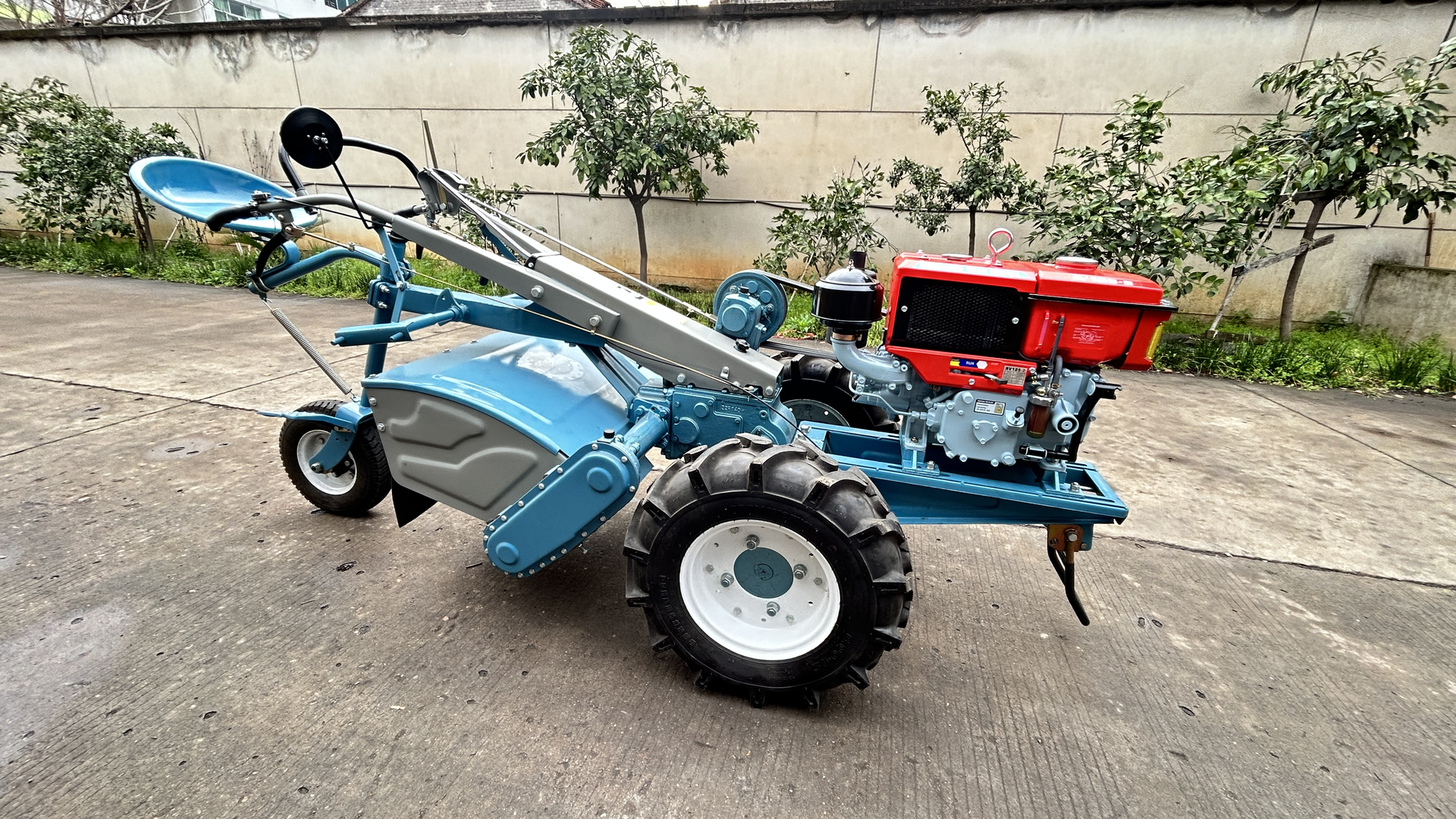
The engine is where the cooling system lives: on this GN12 the engine and its mounting frame sit above the chassis that carries the tiller, so a cooling-system enquiry starts from the engine, not the machine as a whole.
The symptom tells you which part to suspect
Before measuring anything, write down what the machine actually did. A symptom narrows the system faster than any photograph, because it points to the stage of the circuit that has failed.
What you observed | Which part to suspect first | Why |
|---|---|---|
Runs hot under load, cools again at idle | Blocked core, low coolant, a weak cap or a slipping belt | A thermostat stuck closed blocks circulation and overheats; a thermostat stuck open does the opposite — the engine never warms up. The two look like different faults |
Coolant level keeps dropping, no puddle on the ground | Radiator cap, or an internal leak | A weak cap lets coolant escape as vapour; a head-gasket fault consumes it |
Wet patch under the engine, faint sweet smell | Coolant hose, clamp, water-pump seal or radiator seam | These are the joints where liquid coolant reaches open air |
Steam or hissing at the filler neck | Radiator cap, then the whole circuit | Pressure is escaping somewhere it should not |
Fan not turning, or the belt slipping | Fan drive belt and its tension | A slipping belt stops moving air and circulating coolant together |
Coolant looks rusty or cloudy | Coolant service, and the core behind it | Old coolant loses its corrosion protection and deposits block the tubes |
The gauge reads hot but the machine feels normal | Sender, gauge or wiring | Correct the measurement before replacing cooling parts |
That last row matters more than it looks. Replacing a radiator because of a faulty gauge is an expensive way to fix a wiring fault, and it is the kind of thing a support request should rule out before a part is quoted.
Two failure modes deserve to be named, because they are the ones buyers ask about most. A radiator leak at a joint is a slow problem you can often see; an overheating event is a fast one that can warp a cylinder head if the machine keeps working while the gauge climbs. Treat any repeated overheating as a stop-work symptom, not a performance tune. Whichever one you are looking at, that symptom is the first line of the power tiller spare parts record you are about to build.
Measure and photograph the part before you describe it
With the system and the suspect part settled, the part itself has to give evidence. Suppliers work from four things, in this order.
1. Position and function. Say where the part sits and what it does — "the coolant hose between the pump and the radiator, low on the engine side" is worth more than any photograph of a hose.
2. Markings on the part. Castings and housings carry numbers, letters and foundry marks; bearings and seals carry size codes; belts carry a section and a length code. Those marks are the closest thing to a part number you will get without the original file.
3. Measured dimensions. Record the number and its unit. What to measure depends on the part type:
Part type | Record |
|---|---|
Radiator core | Core width, height and thickness; inlet and outlet positions; mounting points; fin and tube type if marked |
Radiator cap | Cap diameter, and the pressure rating stamped on it — that rating sets the cooling system's boiling point, so a cap below spec lets coolant escape early |
Thermostat | Housing thread or flange pattern, opening temperature if marked |
Coolant hose | Inside diameter at both ends, length, bends, and the clamp type |
Water pump | Mounting bolt pattern, pulley diameter, outlet position |
Fan and belt | Blade diameter and mount; belt section and length code |
4. The mating part. What does it bolt onto, press into or seal against? A thermostat is only identified once you name the housing it sits in; a hose is only confirmed once you say which two fittings it joins.
Then photograph it. Four images, in this order, cover almost every cooling-system question: a wider view of the installed location, the complete part front and back, every marking close enough to read, and a tape or rule laid alongside the dimension you measured. Send original files, not screenshots.
One safety rule belongs before any of this work, because it involves opening a hot, pressurised system: shut the engine down and let it cool before you remove a radiator cap, a hose or a radiator connection, and work with the drive shut off. Penn State Extension's summary of agricultural safety and machinery regulation is explicit that power is shut off before work on a machine. As a working rule, open the cooling system cold and depressurised: a hot system under pressure will scald, and neither the cap nor a hose should be lifted while the engine is still warm.
Match the part to the platform and the engine
A part is matched to a machine's build, not to the phrase "for a power tiller". A walking tractor radiator, like any cooling component, belongs to the engine it cools and the machine it is fitted to, and two machines that share a model name can be built differently.
The two current platforms are the reference, and their documented figures sit side by side:
M80 (light chassis) | GN12 (heavy chassis) | |
|---|---|---|
Overall size | 2050 × 710 × 1235 mm | 2950 × 980 × 1240 mm |
Weight without engine | 179 kg | 470 kg |
Engine reference | 7–10 hp compatible | 12.5 hp class |
Gears | 6 forward / 2 reverse | 6 forward / 2 reverse |
Tilling width | 480 mm standard / 600 mm optional | public 480 or 600 mm; customer sheet records 600 mm |
Blades | 14 standard / 16 in the wider build | customer sheet records 18 or 24 in the 600 mm build |
Cooling | set by the engine fitted; the RT90DI reference is radiator-cooled | documented as a horizontal single-cylinder water-cooled four-stroke diesel |
The GN12 walking tractor is the platform this cooling-system guide is written around, because its documentation names the water-cooled four-stroke diesel directly.
Two consequences follow. First, the engine is a separate supply item from the chassis: the specification sheet on file records an RT90DI engine reference for the 7–10 hp range at 487 cc, with hand-crank or electric starting shown as options, and which engine and starting method is finally supplied is confirmed per quotation. A cooling-system part is answered against the engine that is actually fitted, so "which engine is on my machine" belongs in the first line of the request. Second, working width changes the build: 480 mm and 600 mm are not two settings of one machine but different blade counts and rotor arrangements, and a request that does not say which build it came from will be asked to start again.
This boundary is not unique to one make. University extension guidance for small vegetable farms puts it plainly: each walk-behind tractor has its own set of matching implements, and you cannot connect implements from a different walk-behind tractor or a conventional tractor. The sentence, from extension guidance on walk-behind tractors, is about implements, but the same boundary runs through the parts that carry and drive them: the machine's build decides what fits.
Reading the machine's own documentation is its own skill; the guide to reading a power tiller specification sheet covers how to pull the configuration out of a spec sheet rather than guessing it.

The other end of the message: assemblies waiting to be matched against an incoming request. The record you send decides whether the match happens on the first reply.
Write the support request so the first reply is an answer
Everything above is preparation for one message. Write it in this order, keep it in one place rather than across three emails, and the reply can be a quotation instead of a question.
- Machine and platform. Model, build, and the tilling-width arrangement if a tiller-side part is involved.
- Engine. The engine reference and starting method as marked on the engine.
- Symptom. What the machine did, in the order it happened.
- System and position. Which part of the cooling circuit, and where it sits — "the hose between the pump and the radiator" rather than "a hose".
- Markings read off the part.
- Measurements, each with its unit.
- Photographs — the four-image set, as original files.
- Quantity, destination and packing requirement, so the reply can cover what you actually need to order.
# | Confirm | Where the answer comes from |
|---|---|---|
1 | Platform and build | Your machine record |
2 | Engine reference and starting method | The engine as marked |
3 | Symptom, in sequence | What the machine did |
4 | System and installed position | The part as it was fitted |
5 | Markings read off the part | The part itself |
6 | Measured dimensions, with units | Your measurements |
7 | Complete-part and installed-location photographs | Your photo set |
8 | Quantity required | Your stock or order plan |
9 | Destination and packing request | Your order |
What a non-answer looks like: "it fits" without naming the platform; "standard size" without a number; "same as the old one" without the old one's markings; or a part number offered with no statement of which machine it was checked against. Any of these means the check has not happened yet, on one side or the other.
If the request is part of a larger order, the same discipline applies one level up — the power tiller procurement guide sets out how to scope what an initial enquiry should carry.
What the reply can and cannot contain
It helps to know what a parts process can return. Cooling-system parts are confirmed item by item against the machine and the engine you have, and the reply will name the part it has matched. What a catalogue page or a first reply will not do is state a price for an unnamed part, because the price of a radiator is quoted against the machine, the engine and the part that was actually checked — not against the word "radiator" on its own.
That is not a delay for its own sake. It is the same reason a buyer who sends symptom, part and configuration first gets a shorter path to a quotable item than one who sends a name and waits. Worn or failed cooling parts also raise a warranty question, and a claim is checked against the same record: platform, engine, part and the way it failed. Send that record once and it does the work twice.
When the record is ready, send it to our team rather than describing the part again in a separate message. The naming that surrounds this work is worth one note: buyers, workshops and catalogues call the same machine a power tiller, a walking tractor or a hand tractor, and those names do not sort the same way on the other desk — the differences are set out in the guide to the two-wheel tractor's names.

The shipment end of a parts order: once a part is confirmed against your machine, packing and destination are the last things standing between the reply and the delivery.
FAQ
What does a radiator do in a power tiller? It removes engine heat. Coolant is circulated through the engine, where it absorbs heat, then through the radiator core, where air passing over the fins takes that heat away and the coolant returns cooled. On a water-cooled power tiller the radiator is the point where engine heat is finally released to the air.
What are the common problems with power tillers? For the cooling system specifically: a weak radiator cap, a thermostat that sticks open or closed, leaking coolant hoses and clamps, a weeping water-pump seal, a slipping fan belt, a core blocked by debris or corrosion, and coolant that has been left in service too long. Treat the symptom as the first filter — it points to which of these to check.
What happens if a radiator fails? Coolant is lost, the engine temperature climbs, and continued work while it climbs can damage the engine rather than just the radiator. A failed radiator is not only a cooling problem; it can become an engine problem, which is why an overheating machine should be stopped and checked rather than worked around.
Is a power tiller radiator the same as a tractor radiator? Do not assume it. A radiator part is matched to the engine and the machine it cools, and two engines in the same power class can use different cores, caps and connections. The safe path is to identify the engine as fitted and match the cooling part to that, using the machine record rather than the product category.
What to do next
Identification is a short procedure, not a search. Fix the platform and its build, name the engine as fitted, place the suspect part in the cooling circuit, read what is marked on it, measure what the part type requires, and photograph the whole item and where it worked. Then put those eight lines into one message — machine and build, engine reference, symptom, position in the circuit, markings, measurements, the four photographs, and quantity with destination — and send it through the spare-parts and support route above. Do that and the first reply can be a part matched to your machine — and the same record makes the next cooling-system order a lookup instead of a project.