
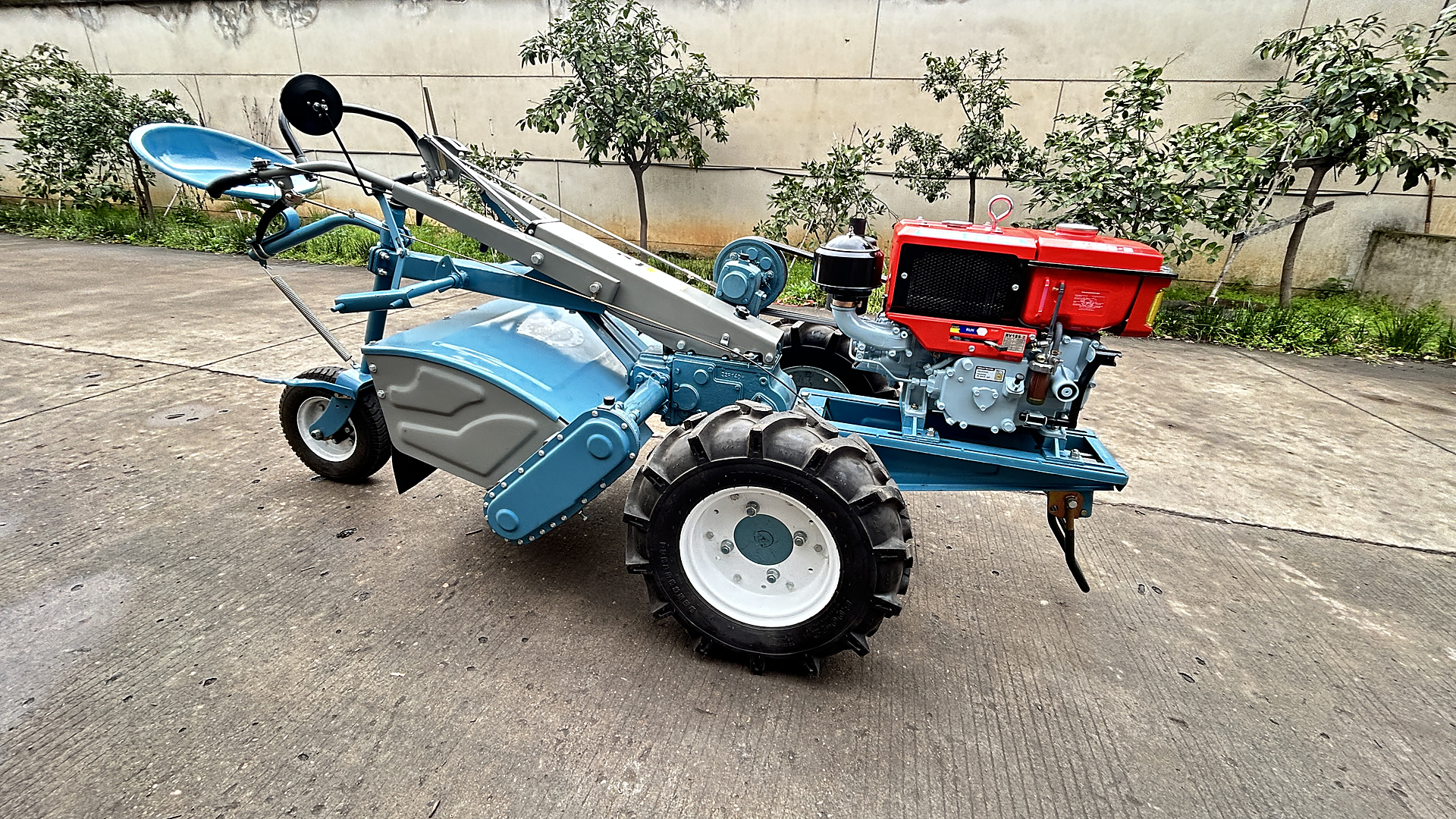
The power tiller vs mini tractor decision comes down to two measurements and one deadline. A two-wheel power tiller — also called a walking tractor, hand tractor or two-wheel tractor — is the machine that gets into the parcel a four-wheel machine cannot enter and cannot turn in. A compact four-wheel mini tractor is the machine that finishes more ground and more different jobs inside the season you actually have. Measure your access and your plot length first; then price the deadline.
This is from SUNTEC Machinery, which builds compact two-wheel power tillers and walking tractors — so the two-wheel side is our own category. That is exactly why the sections where a compact four-wheel tractor genuinely wins are written at full length rather than hedged. If your land is open, dry, contiguous and measured in tens of hectares, the recommendation in the last third of this page is going to be the other machine.
What actually separates a power tiller from a mini tractor
Three structural differences decide every dimension that follows. Everything else is detail.
Two wheels or four. A power tiller has two drive wheels, a handlebar, and an operator who walks. A mini tractor has four wheels, a steering wheel, and an operator who sits. Turning, balance and speed limits all fall out of that one difference before a single specification is compared.
Where the implement attaches. On a walking tractor the engine drives both the drive axle and the tiller blade shaft through the machine's own gearbox, and the implement is bolted to the machine's frame. On a four-wheel compact tractor the engine drives a rear power take-off (PTO) — a standard 540 rpm shaft — and the implement hangs on a three-point hitch behind the axle. The LSU AgCenter's guide to compact tractor selection, use and safety describes exactly this package: standard rear PTO, often a second PTO at the front or centre, a powered lift for implements, and a mounting system that accepts a wide range of implements including small farm implements, loaders and small backhoes (LSU AgCenter Publication 2906). A PTO is not a bigger version of a walking-tractor coupling. It is a different way of buying implements, priced differently and replaced differently.
How traction and steering are delivered. Handling a power tiller means steering with a clutch or differential arrangement and physically walking the machine through the turn. Handling a mini tractor means steering the front axle, and — as the LSU guide notes — engaging four-wheel assist changes how the machine turns: the overall turning radius is generally smaller without front-wheel assist, but turns are easier to make with it, because the tractor pulls itself around instead of sliding the front tyres.
Then there is the name problem, which costs distributors real time at the counter. Search "small tractor with tiller" in the United States and you are met with riding sub-compact tractors carrying a three-point-mounted tiller — a different machine class from a 7 to 12.5 hp walk-behind unit, and a different buyer. If that is the machine your customer wants, this page is not for them and the honest thing to say is so. If your customer is standing on a two-metre bund looking at a plot with no gate wide enough for a tractor, the same words mean something else entirely, and that is the customer this article is written for.
Power tiller vs mini tractor at a glance
Read this table first. Everything below it is the reasoning.
What matters | Two-wheel power tiller / walking tractor | Compact four-wheel mini tractor |
|---|---|---|
Access and turning | Walks in through a gap the operator can pass; turns within its own working width using the handlebar | Needs a gateway, headland and turning circle that fit the machine and the mounted implement |
Fragment size and shape | Width-limited, not length-limited: suits long narrow strips, terraces and irregular corners | Efficient on longer runs; every extra headland turn costs a larger share of the pass |
Soft and flooded ground | Engine sits over the drive axle and the operator walks, so the machine's footprint stays small | Needs to stay on top of the soil; wheel equipment and drainage become preconditions |
Work rate per day | Capped by walking speed; expect one to a few tenths of a hectare per hour | Several times the area per hour with a wider implement and faster passes |
Implements | Mounted on the machine's own frame and driven from its gearbox | Rear PTO plus three-point hitch: wider range, including loaders, backs and trailed equipment |
Operator | Walks the whole job; vibration and physical load are the price of the format | Sits; physical load drops, but the machine demands different skill and carries its own safety risks |
Running cost drivers | Simple driveline, fewer parts to replace, labour hours are the variable | Fuel and labour per hectare fall, but implement set, hydraulics and haulage add cost lines |
Service and parts | Narrow part list; failures are usually visible and mechanical | Broader part list including hydraulics and electrics; needs a workshop that can diagnose them |
The access test: turning radius, headland and gateway width
Start with a tape measure, not a brochure. Four measurements decide more machines than horsepower ever will — and the route between parcels makes a fifth: the narrowest gap the machine must pass through, the headland length at each end of the plot, the row or bed spacing you have to work inside, and the plot length from one headland to the other. If you are working backwards from terrain, soil and water rather than from access measurements, that route is laid out in matching the machine to field conditions.
A walking tractor's limit is the operator's own footprint plus the machine's width. There is no turning circle in the automotive sense: the operator pivots the machine, which is why it can work strips that a four-wheel machine of any size cannot enter. Its practical constraints are the gap it fits through and the amount of space needed to swing the handlebar around at the row end — usually a fraction of what a tractor needs, but not zero, and it has to be measured.
A four-wheel mini tractor's limit is geometric and published: minimum turning radius, plus the length of the mounted implement hanging behind the rear axle. Add those together and you have the headland depth the machine needs before the first pass can start and after the last one ends. That is why two plots of identical area can suit opposite machines — a 40 m × 25 m strip and a 100 m × 10 m strip are not the same job.
Here is the part most comparison articles skip: headland turns are a real, quantifiable loss, and short plots pay more of it. Field capacity is normally calculated from width × speed × field efficiency, where field efficiency is the factor that absorbs turning at the end of the field, overlapping, adjustments and stops — this is the standard method taught in extension machinery-management material such as the University of Kentucky's Calculating Farm Machinery Field Capacities (UKnowledge). The efficiency figure is not a constant of the machine; it is a property of the machine on your plot. A four-wheel tractor with a 1.2 m implement on 40 m runs turns far more often per hectare than the same tractor on 200 m runs, and its field efficiency falls accordingly. A walking tractor turning in its own width loses very little to the headland, which is why its disadvantage is speed rather than manoeuvring.
Measure this | Why it decides the machine |
|---|---|
Narrowest gateway, bund or track gap on the route in | Rules out any machine wider than the gap, regardless of power |
Headland depth at both ends of each parcel | Turning circle + implement overhang must fit, every pass |
Plot length from headland to headland | Short plots punish four-wheel turning losses disproportionately |
Row, bed or tree spacing to work within | Inter-cultivation requires a machine narrower than the alley |
Route between parcels (surface, slope, width) | Determines whether the machine can be driven, trailed or must be carried |
Fragmented plots: shape, parcel count and moving between them
Fragmentation is the condition this whole comparison exists for, and none of the four competitor pages read for this comparison covers it. A fragmented holding is not one field with awkward corners — it is several parcels that are physically separated, each with its own gateway, water source and access track. Mechanisation advice written for a single contiguous field simply does not transfer.
The FAO's 2022 State of Food and Agriculture describes small-sized motorised mechanisation — two-wheel tractors and water pumps among the examples — as the route through which it increased the availability of small farm machinery to small-scale producers (FAO, SOFA 2022). The FAO's global review of mechanisation patterns, Mechanization for Rural Development, approaches the same problem from the policy side: it examines land holdings and mechanisation side by side, which is the review's own way of treating farm size as the starting point for machinery choice rather than an afterthought (FAO). The practical translation for a dealer is blunt — count the parcels before you recommend the machine.
Do this arithmetic before you shortlist anything:
- How many parcels, and how far apart? Six parcels of half a hectare each spread over four kilometres is a transport problem wearing a tillage costume.
- How does the machine get from parcel to parcel? A walking tractor can be driven on its own wheels at walking pace for short hops, carried on a light trailer, or walked along a bund. A four-wheel tractor has to be driven and needs a track or road wide enough — and it needs a route on which the operator is willing to drive it.
- What is the shape of each parcel? Long, narrow strips and terraced benches favour the machine with the smallest working width. Squarish parcels with long runs give the four-wheel machine room to use its speed.
- Are parcels separated by bunds, ditches or other people's land? A machine that crosses a bund must fit over the bund, and a riding machine must have somewhere to come down.
None of that is visible on a specification sheet, which is why a distributor who walks three parcels with the buyer will out-sell one who quotes horsepower. If you sell into a market where average holdings are fractions of a hectare and split across several plots, the fragmented-plot arithmetic is the whole sale, and the checklist at the end of this page is designed to be handed to the buyer.
Wet land: why puddling work belongs to two-wheel machines
Flooded and puddled soil is where the geometry of the machine changes the answer again, and it is the second dimension that the competitor pages read here ignore completely.
Puddling is a different operation from dry tillage: it works saturated soil — and often standing water — into a paste, which is not a task where adding weight and power helps, because the traction surface itself is soft. In that condition the question stops being "how much horsepower" and becomes "what does the machine weigh, where does it sit, and what wheels does it have". A two-wheel machine puts its engine over the drive axle, puts the tiller (or the trailing implement) on the same frame, and keeps the operator off the machine entirely — three reasons why a walk-behind format remains in use across paddy geographies where four-wheeled traction is a liability rather than an advantage.
For a distributor advising a buyer who has wet land, the useful questions are these:
- Is the parcel flooded for the operation, or drained first? If it must be worked wet, wheel equipment — cage or anti-slip arrangements — matters more than engine size, and a machine whose wheels can be swapped is worth more than a bigger one.
- How deep is the water, and is the hardpan stable? Ask what weight and tyre configuration the supplier supports for that condition. A machine that cannot stay on top is a machine that will be stuck, whatever its rating.
- Does the operator need to stand? Walking the machine across a wet parcel is physically hard but it keeps the operator's weight off the traction surface, which is the point of the format.
Where a buyer's land is wet for a large part of the year, the comparison is usually already decided before tillage width enters the conversation. Where land is wet for three weeks and dry for the rest, the four-wheel machine often remains the better recommendation — a point that belongs in the next section rather than being buried. For holdings that are paddy first and everything else second, the planning sequence from water source through implement set is set out in planning paddy-field work with a two-wheel machine.
Work rate and the season: where the mini tractor genuinely wins
This is the section where the four-wheel machine wins clearly, and it should be read as a list of conditions rather than an apology.
Work rate is arithmetic: area per hour is a function of working width, forward speed and field efficiency. Extension machinery-management material sets out the formula and the typical values (University of Kentucky, Calculating Farm Machinery Field Capacities; the University of Arkansas publishes the same calculation in a worksheet form for growers sizing equipment, UAEX). Run it with assumptions you can check, not with numbers you cannot:
- a walking tractor with a 0.5–0.6 m tiller moving at 2.5 km/h and a field efficiency of around 0.65 covers roughly 0.08–0.1 hectare per hour;
- a compact four-wheel tractor with a 1.2 m implement at 6 km/h and a field efficiency nearer 0.8 covers roughly 0.55–0.6 hectare per hour.
Those are illustrative configurations — the point is not the exact figure but the ratio, which is somewhere between five and a half and seven and a half to one, and the reason it is that large: the walking machine cannot go faster than the person behind it. Speed, not engine capacity, is the ceiling. If you are checking a supplier's figures before running this arithmetic on your own plots, how power and working width are actually specified explains what those numbers do and do not include.
Sit with the consequences for a moment. On one hectare of dry land, the difference is hours in a day. On four hectares, it is a day against a week. On ten hectares with a short window before the rains, it decides whether the crop goes in at all. There is no version of this arithmetic in which the walk-behind machine "wins" on area per hour, and a distributor who pretends otherwise will lose the credibility of everything else in the quotation.
What that leaves is the right comparison. Below roughly one hectare of total, scattered, awkward land, the absolute difference is measured in a few hours per season and the access test decides the sale. Above a few hectares of contiguous, dry, open land — particularly where the land preparation window is short and the operator's hours are expensive — the four-wheel machine's work rate outweighs the access penalty, and the recommendation should say so without qualification. The break-even sits wherever your own measurements put it; the supplied figures above give you the method to find it.
Implement range and the power take-off question
When a buyer asks "what can it do?", the honest answer is "what can you hang on it?" — and this is where the two formats diverge most.
On a four-wheel compact tractor, the rear PTO and three-point hitch open a large implement market: rotary tillers that mount on the hitch and run off the PTO, ploughs, bed formers, cultivators, mowers, sprayers, trailers, and — on machines designed for it — front-end loaders and small backhoes. The LSU AgCenter guide also gives a detail that matters wherever a machine has to work close to a boundary: rotary tillers can be centred or offset, and an offset design lets the operator till next to a fence, or work the wheel tracks on one side. Implement choice on a mini tractor is a shopping decision with competition in it.
On a walking tractor, implements mount on the machine's own frame and are driven from its own gearbox. The range is narrower, and the set you buy defines the machine's usefulness for a decade. The confirmed implement lists differ by platform in our own tables: the heavier GN12 platform is listed with a rotary tiller, a double-furrow plough, anti-slip wheels and a small trailer, while the lighter M80 platform is listed with a rotary tiller, a single-furrow plough and a small trailer. On the rotary side, the M80 platform's standard configuration is 480 mm with 14 blades and its maximum is 600 mm with 16 blades, and the GN12 platform is offered at 480 or 600 mm working width — note that the manufacturer's own specification table for the GN series records the 600 mm configuration with 18 or 24 blades. Because those two records do not agree, state the working width you need explicitly in your enquiry.

Two practical consequences for a distributor. First, the implement inventory you keep is a commercial decision: on a mini tractor, a customer can buy a new implement from anyone; on a walking tractor, the implement set is closer to being part of the machine, so what you stock becomes part of what you sell. Second, the comparison is not tiller against tiller. A four-wheel machine with a PTO can lift, carry, pump and trail; a two-wheel machine with a trailer can haul far more than a person on foot, but it cannot lift a pallet, and it cannot power an implement that needs to be carried rather than towed. What can be fitted to a two-wheel platform, and what each attachment is for, is gathered in the walking tractor implement and attachment range.
Operator skill, fatigue and safety
None of the competitor pages read here says this out loud, so here it is: the two-wheel format has an operator cost, and it is measurable.
Hand-arm vibration is the clearest example. A study of tiller operators publishing in the International Journal of Occupational Hygiene measured hand-arm vibration exposure in three operating modes and found rota-tilling at 16.95 m/s² root-mean-square acceleration, with transportation at 14.16 and idling at 8.65 — levels at which the permitted working time under the ISO 5349 exposure framework is very short indeed. The authors concluded that operators were at risk of musculoskeletal disorders, discomfort and premature fatigue, and that intervention and control measures were required (Nassiri et al., IJOH). A walking tractor operated for long days in hard ground is a physically demanding tool, and that is a cost the buyer will pay in labour, in turnover of operators, and in the hours the machine can actually run per day.
The four-wheel format trades that cost for a different one. The operator sits, so the physical load per hour drops sharply; but the machine needs a different skill set — hitch and linkage operation, PTO safety, hydraulics — and a riding machine can injure its operator in ways a walk-behind machine cannot. Neither format is "safe"; they fail differently.
Skill acquisition is worth a sentence of its own, because it drives adoption. A walk-behind machine has very little to learn before it does useful work: the controls are the handlebar, the clutch and the throttle. A mini tractor adds hitch and linkage operation, PTO engagement and hydraulic controls before the same standard of work is reached. Where a dealer sells into a market of first-generation machinery users, that difference in the learning curve is a genuine argument for the smaller format — not a marketing claim, but a service reality, because every hour an operator spends learning on a more expensive machine is an hour of that machine at risk.
The safety checklist nobody supplies alongside the sale, and which is worth printing for both formats: PTO guarding intact and inspected before every season; nobody standing inside the turning area or behind a mounted implement during a lift; the machine stopped before any adjustment to blades, belts or chains; proper footwear and a clear understanding of which surfaces get slippery after rain; and a working knowledge of how to disengage the drive in a hurry. Above all, operate from the machine's own manual and whatever local rules apply in your market — this page is a buying framework, not an operating instruction.
Running cost and total cost of ownership — the arithmetic that matters
You will notice that this page quotes no prices. That is deliberate and it is not evasion: a machine's delivered cost depends on configuration, engine choice, implement set, packing, destination and exchange rate, so any figure printed here would be wrong for most readers and stale for the rest. What can be given instead is the structure of the calculation, which is the same in every market.
Start with the cost of the work, not the cost of the machine. The IRRI's Rice Today reports that the cost of one-pass ploughing — whether by animals, a two-wheel tractor or a four-wheel tractor — is broadly in the same band, around US$40–50 per hectare depending on locality, while manual labour costs more than US$200 per hectare for the same job (a 2012 IRRI figure — check current local rates; IRRI, Rice Today). Mechanisation pays by replacing labour hours, and the machine that replaces those hours at the lowest cost per hectare is the one that fits the field — not automatically the cheapest machine or the most powerful one.
Then count the costs that a dealer's quotation sheet usually omits:
Cost line | What drives it | Ask the supplier for |
|---|---|---|
Machine | Configuration, engine and the fuel it runs on, platform weight | Delivered configuration, what is included, and the fuel the engine reference in the specification table runs on — the engine references in our own confirmed tables are single-cylinder diesels, so confirm availability and any local fuel or emission rules for your market |
Implement set | How many operations you intend to mechanise | Per-implement working width and what each one is driven by |
Fuel and lubricants | Area covered per pass, number of passes, soil condition | Fuel consumption per hour or per hectare under stated conditions |
Labour hours | Machine speed and field efficiency on your plot length | Realistic area per hour for the implement you are buying |
Wear parts | Blades, belts, filters, clutches, tyres | A wear-part list with replacement intervals |
Downtime | How fast a failure is diagnosed and repaired | A parts list, and a service manual, before you stock |
Utilisation | Days per year the machine actually works | Nothing — this one you calculate: annual cost ÷ hours worked |
Utilisation is the number that kills small purchases quietly. A machine used twenty days a year carries its annual cost across those twenty days; the same machine used sixty days a year carries the same cost across sixty. This is why contract work and neighbour-to-neighbour hiring matter so much in smallholder markets — and why IRRI frames machine ownership around the fact that a farmer who owns a two-wheel tractor can also sell contract services to other farmers. For a distributor, that is a sales argument in itself: a buyer who can hire the machine out reaches utilisation figures a single-parcel owner never will.
One legitimate structural difference: the two-wheel driveline is short and mostly visible. In the confirmed configuration recorded for the M80 chassis, the engine drives the main shaft through two V-belts, the main shaft drives the wheel axle through gears, and the gearbox drives the blade shaft through a chain. Belts, chains and clutch plates are the wear items, and an operator can see a slipping belt before it fails. A four-wheel compact tractor adds hydraulics, an electrical system and more wearing surfaces, with the service benefit of a much larger parts and workshop ecosystem. Which one costs less over ten years depends on which one your market can actually repair.
Service, wear parts and what the dealer has to stock

The failure mode that ends a dealer's relationship with a market is not a broken machine. It is a machine that sits broken for three weeks. Everything in this section is written from that angle.
For a two-wheel fleet, the stock list is short and the turnover is steady: tiller blades and their fixings, drive belts, chains and sprockets, clutch plates, filters, seals, wheel and tyre options for the local soil, and the handlebar-side controls that operators break first. For a four-wheel fleet, add hydraulic hoses and seals, filters for both fuel and hydraulics, electrical components and the diagnostic ability to use them — which means a mechanic, not just a parts shelf.
Three things a distributor should be able to put on the table before committing to either format:
- A parts list with part numbers, not a promise of availability. If the supplier cannot produce one for the platform, the fleet is a risk whatever the machine does in a demo.
- A service manual or a documented service interval table. Wear intervals that exist only in a conversation do not survive a change of staff.
- A wheel and tyre option table for the market's soils. On both formats, wheel equipment is what converts a general-purpose machine into one that works in the buyer's field, and on wet land it is the difference between working and being stuck.
There is a fleet-consistency argument too, and it is easy to underestimate: the fewer platforms a dealer network services, the fewer part numbers, tools and procedures it has to hold. A workshop that services one walking-tractor platform services it properly; one that services five badly services all five badly. Standardisation across a market is a serviceability decision as much as a commercial one. The questions that decide whether a supplier can actually hold a market — and how to turn them into a request for quotation — are set out in evaluating a power tiller manufacturer for supply.
When a mini tractor is the better buy
If most of the following describe your customer's holding, the four-wheel machine is the better recommendation. This is not a hedge; it is the outcome of the arithmetic above.
- The land is dry, open, contiguous and larger than a few hectares. Work rate decides the season, and the walking tractor loses the work-rate comparison every time.
- The preparation window is short. When the rains are coming and the whole holding has to be ready at once, a machine that covers five and a half to seven and a half times the area per hour is worth more than a machine that reaches two more corners.
- The buyer needs one machine for many jobs. PTO-driven tillage, mowing, spraying, a trailer for haulage, and a loader or backhoe where it matters — a two-wheel machine cannot do the lifting and carrying half of that list.
- Inter-cultivation in orchards and plantations is the main job. A compact tractor that fits the alley, with an offset or centred tiller, works between rows all season; a walk-behind machine works only where the operator can walk.
- Labour is scarce or expensive. The physical cost of walking behind a machine shows up as shorter working days and higher operator turnover, and the four-wheel format removes most of it.
- The parcels are connected by vehicle tracks. If the machine can be driven between plots on a proper track, the transport objection largely disappears.
- There is a local workshop that can service hydraulics and electrics. Without it, the four-wheel machine's advantages in the field are consumed by repair delays.
One more, less comfortable for a distributor: where the buyer's holding will be consolidated or expanded within a few years, the four-wheel machine buys capacity the small machine cannot add later. Selling the smaller machine to a farmer who is already assembling more land is a short-term sale and a long-term complaint.
What the two-wheel side will not do — and what this article will not claim
The limits of the walk-behind format should be stated as plainly as its advantages.
A two-wheel power tiller has no three-point hitch and no hydraulic lift. It cannot carry a loader, it cannot raise a mounted implement off the ground at the operator's command, and it cannot power an implement that needs to be carried rather than pushed or towed. Its implement list is narrower, its haulage is slower and less comfortable than a trailer behind a tractor, and its deep-tillage envelope is smaller — you will not pull the heavy primary-tillage implements that a four-wheel machine takes in stride. Its working day is limited by the person walking behind it, and its vibration exposure is the price of the format. All of that is real, and none of it is compensated for by price alone.
Just as importantly, here is what this article does not claim. It does not publish prices, minimum order quantities, lead times, warranty terms or certification status for any machine, because those are commercial terms that change with configuration, destination and quotation — the right way to get them is to ask a supplier directly for your market. It does not claim compatibility with, or equivalence to, any other manufacturer's parts or models. It makes no claim about production or export volumes. And it does not publish specifications that the manufacturer has not itself confirmed: the widths, weights and dimensions referenced above come from confirmed specification tables, and where a table records fewer configurations than the public range (the GN series working width is the example), the table entry is stated rather than glossed over. Where a claim cannot be traced to a confirmed source, it is absent from this page — which is also the standard you should hold every supplier to when you compare machines.
A selection checklist for distributors and dealers
Print this. Fill it in with the buyer standing next to the machine, not afterwards in the office.
Question | If the answer is yes | If the answer is no |
|---|---|---|
Is every parcel accessible through a gap at least as wide as the machine? | Either machine is possible | Two-wheel only, or widen the gap first |
Does the headland fit the turning circle plus implement overhang, on every parcel? | Either machine is possible | Shorten the recommendation to the machine that turns in its own width |
Are the parcels contiguous, dry and open, totalling more than a few hectares? | Recommend the four-wheel machine | Continue down this list |
Is land preparation confined to a short window before the rains? | Four-wheel machine; work rate decides | Two-wheel machine remains viable |
Is any parcel worked wet, flooded or puddled? | Two-wheel machine, with the right wheels | Wheel options matter less |
Are parcels scattered over kilometres with no vehicle track between them? | Two-wheel machine plus a trailer | Either machine can be driven |
Does the buyer need lifting, carrying or PTO-driven implements beyond tillage? | Four-wheel machine | Two-wheel machine with a defined implement set |
Is the main job inter-cultivation between rows or trees? | Four-wheel compact machine that fits the alley | Either machine |
Is labour scarce, expensive or physically limited? | Four-wheel machine | Two-wheel machine is workable |
Is there a local workshop that can diagnose hydraulics and electrics? | Four-wheel machine is supportable | Prefer the simpler driveline |
Can the buyer produce a parts list, service interval table and wheel option table for the machine? | Proceed | Do not stock the platform yet |
Will the holding be consolidated or significantly expanded within three years? | Four-wheel capacity will be needed | Two-wheel machine fits the plan |
Worked end to end, those twelve questions resolve most small and fragmented-farm comparisons before a specification sheet is opened — and where they do not resolve it, the numbers in the work-rate section will.
If the answers point to the walk-behind format, the next step is a configuration discussion rather than a catalogue order: parcel sizes and shapes, soil and water conditions, the operations you intend to mechanise, the implement set you want to stock, and the working width that matches your rows. Put those on one page and send them to a supplier who will quote against them — that is what the Power Tiller Buying Guide for Agricultural Machinery Distributors is built around, and it is the way to get a quotation that survives contact with the field. If you would rather work a specific configuration through against your own parcels and soil, discussing a configuration for your market is where that conversation starts.