
What the four names mean
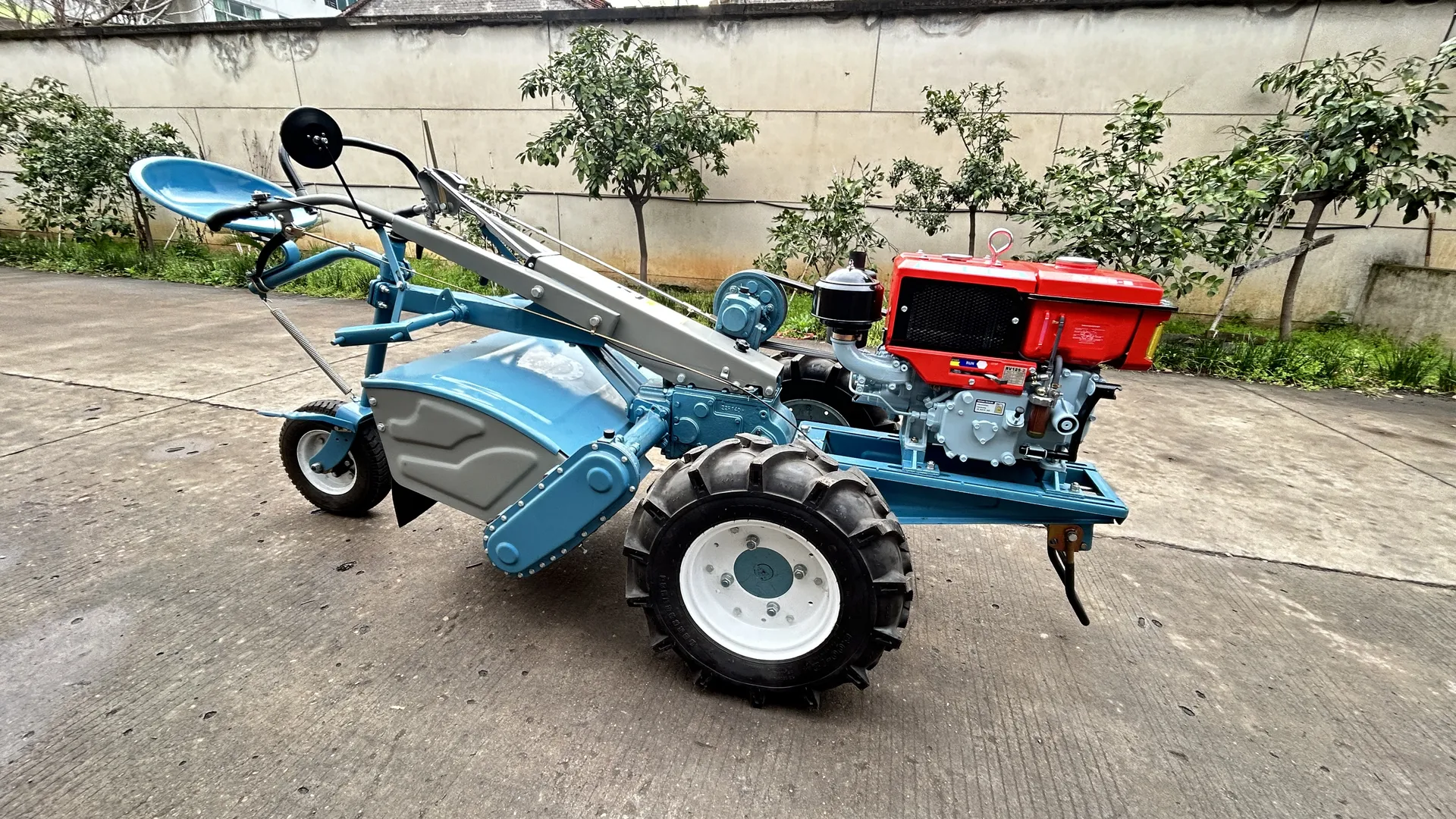
A power tiller, a walking tractor, a two-wheel tractor and a hand tractor are four names for one product class: a single-axle machine with its own engine that pulls and powers interchangeable implements while the operator walks behind it and steers with handlebars. Getting the power tiller terminology straight is mostly a matter of knowing which name belongs to which market — and which names are not part of this list at all.
That is the whole of the terminology, and the rest of this page exists because the names are used loosely. Two of them are also applied to machines outside the class, and the mix-up is not academic: it is the difference between quoting a garden rotorvator and quoting a field machine, or between reading a tender correctly and bidding the wrong product. Below is the name-to-machine map, the market-by-market usage, the lookalike terms worth checking twice, and the way to write a request so the answer comes back with the right machine.
Name | Where you meet it | What it tells you |
|---|---|---|
Power tiller | South Asian and African extension material, tenders, subsidy lists | The field machine in most of the world — but a garden machine in North American retail |
Walking tractor | Sell sheets translated from Italian and Spanish, southern Europe | The same single-axle machine, named after the operator |
Two-wheel tractor | North American small-farm suppliers, technical and academic writing | The neutral term; the one this page treats as canonical |
Hand tractor | Philippines, Indonesia, South Asia | Named after the hands on the handlebars, not after the axle |
What they have in common, and what actually changes
Two clauses carry the definition: one axle, and interchangeable implements. Almost every error in this category comes from dropping the second one.
One axle is the visible half. A single engine sits over a single driven axle; the two wheels you see are the ones that carry and drive it; the operator walks behind and steers with handlebars. There is no second axle, no cab, and no standard seat.
The second clause is the one that does the work. A machine belongs to this class because its frame has a place where the next implement attaches — a power take-off, a coupling, or a hitch plate — and because it was designed to run a succession of implements rather than one. That mount is the difference between a two-wheel tractor and a garden tiller, and it is also the reason one engine can plough, till, mow and haul.
The FAO's census classification marks the same fault line, in its own bureaucratic way: the single-axle tractor is listed among tractors, bulldozers and other vehicles, while the power tiller is listed under land preparation and planting machinery — two separate entries for what is frequently the same chassis (FAO, World Programme for the Census of Agriculture 2010, Appendix 6). That is a classification artefact, but it reads as a useful test: if a machine is described only by the job it does, it is being filed as an implement-holder rather than as a tractor.

The machine itself — what it is, how it is built and what work it can do — is covered separately in what a walk-behind tractor is. This page deals only with what people call it.
A power tiller terminology map: which market calls it what
The names are not random. They follow two things: the language the machine arrived in, and what it replaced.
Italy and southern Europe gave the class its technical vocabulary — motoculteur in French, Einachsschlepper in German, both of them names for a single-axle machine, and two-wheel tractor or walking tractor in the English translations that follow them (Wikipedia, Two-wheel tractor). North American small-farm suppliers say walk-behind tractor; technical writing and the census say two-wheel tractor and single-axle tractor.
South Asia says power tiller and hand tractor — the two words used in extension material, subsidy lists and tender documents across India, Bangladesh and Nepal. Sub-Saharan Africa leans to power tiller as well, largely because that is the term donor and extension programmes carried.
CIMMYT's training manual for these machines refuses to choose and lists nine names instead (CIMMYT, Training Manual for Two-wheel tractor and ancillary equipment):
"The two-wheel tractor is given many names, and these are: power tiller · walk-behind tractor · iron-ox · walking tractor · mechanical ox · ox-machine · pedestrian tractor · hand tractor · single-axle tractor."
Read that list once and the confusion largely dissolves. Three of the nine — iron-ox, mechanical ox, ox-machine — explain why the names diverge in the first place: in the markets where these machines spread, they replaced draught animals, and the vocabulary recorded the substitution.
IRRI's rice-production material writes it the same way, with the local synonyms inside brackets: "Two wheel tractors (also called walking tractor, iron or steel buffalo, hand tractor)" (IRRI knowledge bank, land preparation and farm power). Iron buffalo is the same idea as iron-ox — the animal, in metal.
Standards bodies then rename the machine again. In the Philippines the market says hand tractor, while the national standard for the same machine is titled walking-type agricultural tractor (Philippine Agricultural Engineering Standards 109:2000, cited in Amongo et al., IOP Conf. Series: Earth and Environmental Science 542, 2020). The field did not adopt the standard's vocabulary, and that divergence is not unusual — it is the normal state of this category.

Market | The name you will meet | Where the name comes from |
|---|---|---|
Italy and southern Europe | two-wheel tractor, walking tractor | Motoculteur / Einachsschlepper ancestry; single-axle design |
North America, small farms | walk-behind tractor, two-wheel tractor | Market-garden and small-farm trade |
South Asia | power tiller, hand tractor | Extension services, tenders, subsidy schemes |
Philippines, Indonesia | hand tractor; standard says walking-type agricultural tractor | Field usage vs standards vocabulary |
Sub-Saharan Africa | power tiller | Donor and extension programmes |
Statistics and classification | single-axle tractor | Census and machinery-classification vocabulary |
For how these names sit inside a distributor's buying decision — platform, implements, parts and support — the power tiller buying guide is the hub this page belongs to.
The names that are not synonyms
Four words get used as if they sat in this list. None of them names this machine class, and each one costs money when it is read as if it did.
Rotary tiller, rototiller, rotavator. In agricultural writing this is an implement — the rotor that mounts on a machine and is driven by it. In retail garden writing it is a complete, self-contained machine that does one job and cannot take a plough, a mower or a trailer. Both usages are current. Only one of them is a machine class.
Rear-tine tiller. The same split, and a sharper one, because the phrase means opposite things in a garden catalogue and a tractor catalogue: a self-propelled tiller with the tines behind the wheels on one side, and a rear-mounted tiller implement on the other. A request written as "tiller versus tiller" is really a question about machine versus implement.
Power weeder. A walking machine sized for inter-row weeding: lighter, narrower, and built for a different task from land preparation. It is a relative of this class, not a synonym for it.
Mini tractor, small tractor. A low-power four-wheel tractor — two axles, a three-point linkage, a seat. The class this page describes has one axle, and that single difference changes what the machine can be asked to do.
The word | What it actually names | The check that settles it |
|---|---|---|
Power tiller | The field machine (Asia, Africa) or a garden machine (North American retail) | Does it take a second implement, and what drives it? |
Rotary tiller / rototiller / rotavator | An implement, or a one-job garden machine | Is there a mounting point and a drive? |
Rear-tine tiller | An implement in the trade, a garden machine in retail | Same check — machine or attachment? |
Power weeder | A lighter walking machine for crop maintenance | Power class and working width |
Mini / small tractor | A two-axle four-wheel tractor | How many axles? |

The practical rule for anyone buying or selling across markets: never confirm the class from the name alone. A rotary tiller is not a smaller power tiller, and the difference between a power tiller and a rear-tine tiller is the difference between a machine and a part of one.
The one word that changes meaning by market: "power tiller"
Of the four names, one is genuinely ambiguous, and it is the most common of them.
In North American retail, a power tiller is a garden rototiller: a small petrol or electric machine, roughly 3–7 hp, usually sold as a rotary tiller and built around one operation. Elsewhere — in Asia, and in the export trade generally — the same two words name the rubber- or iron-wheeled, self-propelled 5–18 hp single-cylinder diesel machine that takes a plough, a trailer or a mower as well as a tiller. That double meaning is not a fringe case; the encyclopedia entry cited above records both usages side by side, and neither is marked as wrong.
Reading a document, the tell is the one that runs through this whole page. Does the machine have a take-off or a mounting point for a second implement, and a gearbox or belt drive that powers it? If yes, you are reading about the field machine, whatever the sheet calls it. If the description stops at tines, tilling depth and tilling width, you are reading about a garden tiller — and the same word may appear on both sheets.
How to write it on an inquiry so you get the right machine
The name is the label; three specifications are the content. When you send a requirement to a supplier, or write the catalogue line for your own market, name plus these three numbers is what removes the ambiguity.
- Power class, not a model number. Give the horsepower or kilowatt band you need — that is what fixes how large an implement the machine can drive and how deep it can hold.
- Working width, in millimetres. On the compact platforms this site builds, the confirmed rotary tiller widths are 480 mm and 600 mm, and the customer specification sheet records the 600 mm configuration for the heavier machine. Narrow widths suit inter-row work and tight plots; wider widths cut the number of passes on open ground.
- How the implement mounts, and what drives it — a power take-off, a belt-driven tiller under the frame, a rear hitch for a trailer. This is the line that decides whether the implements already in your inventory fit the machines you sell.
Written out, a usable line looks like this: power tiller (hand tractor), 12 hp class, 600 mm rotary tiller, take-off plus rear hitch, for paddy and dry land. A supplier reading that cannot reasonably send a garden tiller by mistake — and if your market calls it a two-wheel tractor, the same line still works with the name swapped.
For the machine side of the same list — engine, working width, gear steps and take-off as they appear on a supplier's sheet — reading a power tiller specification sheet covers the sheet itself, and the procurement sequence around it, from territory to packing, is set out elsewhere in this cluster.
The short version
Four names, one class: single axle, engine-driven, operator walking behind, interchangeable implements. Which name you meet is a fact about the market rather than about the machine — South Asia and Africa say power tiller, southern Europe says walking tractor, North America says walk-behind or two-wheel tractor, the Philippines says hand tractor, and the standards say single-axle or walking-type.
The words to check twice are the ones that name an implement rather than a machine: rotary tiller, rototiller, rear-tine tiller, power weeder. And the check is always the same — is there a mounting point, and what drives it?
If you are working this out for a specific market and a specific job, send us the market, the work and those three specifications and we will answer with a configuration rather than a name.