
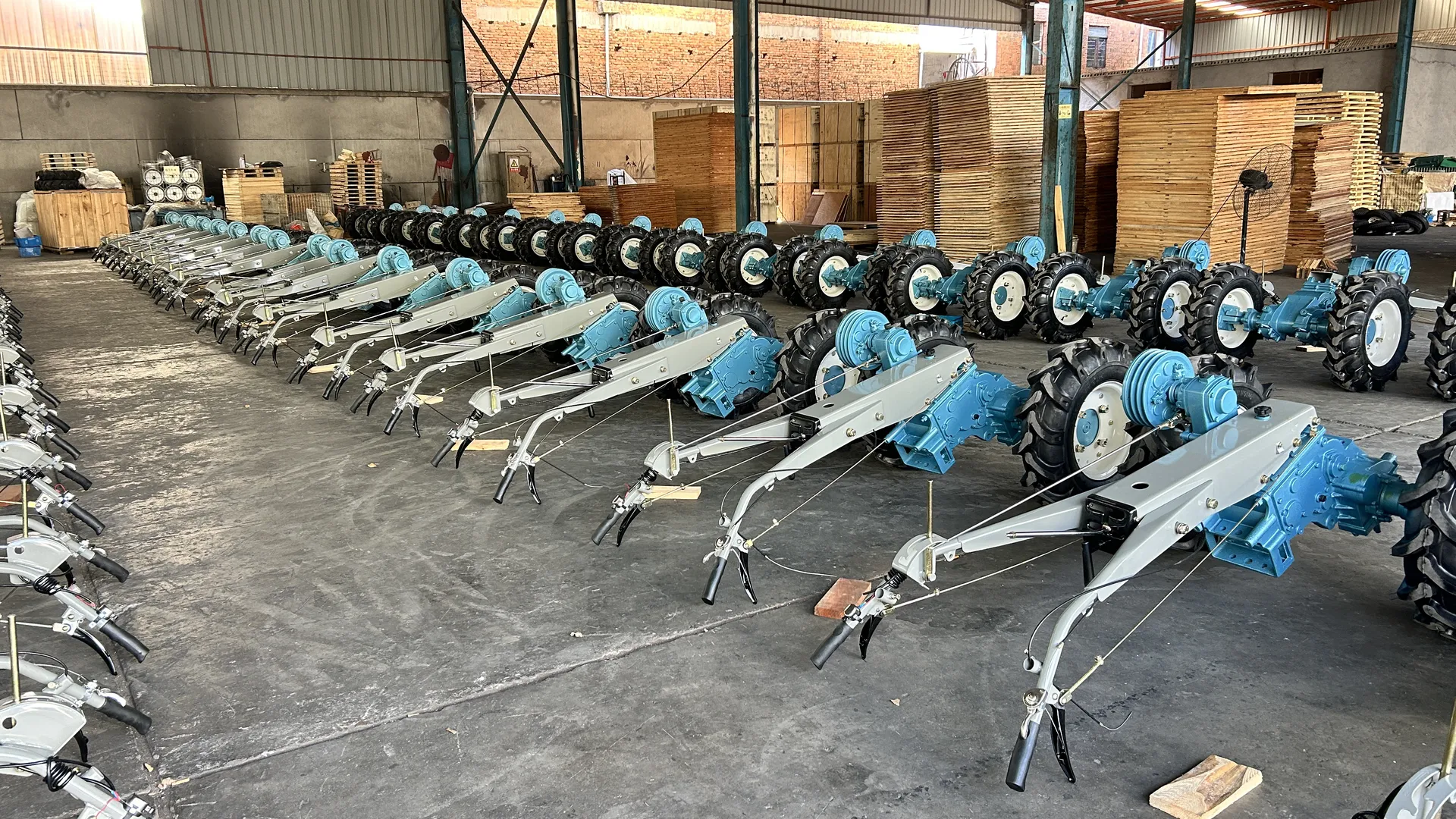
What a walk-behind tractor is
A walk-behind tractor is a self-propelled machine built on a single axle that pulls and powers interchangeable implements while the operator walks behind it and steers with handlebars. Two clauses carry the whole definition — one axle, and interchangeable implements — and almost every mistake in this category comes from dropping one of them.
Searches for a walk behind tractor, a walking tractor and a two-wheel tractor are all describing the same machine; the names split by market and by generation, not by design. CIMMYT's training manual for these machines gives the machine nine names in a single paragraph — power tiller, walk-behind tractor, iron-ox, walking tractor, mechanical ox, ox-machine, pedestrian tractor, hand tractor and single-axle tractor (CIMMYT, Training Manual for Two-wheel tractor and ancillary equipment).
Two of those names deserve to be pulled apart, because they are different machines. The FAO's census classification of agricultural machinery keeps the single-axle tractor and the power tiller as separate classes (FAO, World Programme for the Census of Agriculture 2010, Appendix 6). A power tiller is designed around one operation — turning soil. A single-axle tractor is designed around a coupling that accepts a succession of operations, one implement at a time.
That difference is what decides a purchase. If the same crop is worked the same way on the same ground every season, a tiller will do the job with less machinery to maintain. If the work changes as the season turns — break ground, prepare a seedbed, mow, haul — that is the workload a single-axle machine exists for. CIMMYT states the case in one line: a two-wheel tractor is "a multi-purpose tractor which can handle a lot of tasks if appropriate ancillary equipment is attached properly."
The parts that decide what the machine can do
Take the paint off and there are four systems on any walk-behind tractor. Each one sets a different ceiling on the work.
- Engine. Single-cylinder, diesel or petrol, water- or air-cooled. Its output is the number that fixes how much implement the machine can drive and how long it can hold a working depth. In the compact end of the market the useful comparison is between power classes rather than individual models: the light class covers tight plots and shallow passes, the heavy class buys depth, wider implements and more sustained work.
- Transmission and power take-off. The gearbox sends power two ways — to the wheels for travel, and through a take-off to the implement itself. This is why a walk-behind tractor can run a powered implement such as a rotary tiller and still pull an unpowered one such as a plough or trailer. Belt drive and gear drive both appear in this class; gear drive keeps the implement and wheel speeds independent.
- Handlebars. Adjustable and usually reversible, so the same machine can work with an implement mounted at the front or behind it, and so the operator can step to one side instead of walking on freshly tilled ground.
- Wheels and ballast. Pneumatic tyres with agricultural lugs are the default. Traction is the variable that changes most between markets: steel cage or spiked wheels for wet ground, axle extensions to widen the track on slopes, and wheel weights when a plough needs front-end grip.

The four systems are worth separating because the implement list hangs off them, not off the model name. The University of Minnesota Extension, which runs a walk-behind tractor programme for small farms, states the rule bluntly: "each Walk Behind tractor has its own universe of implements", and an implement built for one machine cannot be fitted to another (UMN Extension, Walk behind tractors: A low cost way to mechanize your farm operation). Its buying advice follows from that: choose the implements first, then work backwards to the machine that can run them.
To do that work-backwards step, read two candidate sheets side by side: engine output, working width, gear steps, take-off arrangement (guide to reading power tiller specifications).
Why one machine has so many names
The naming confusion is not accidental; it follows the machine's history, and that history is documented. In the United States, Gravely built a walk-behind tractor as early as 1911, and production had all but stopped by the 1970s as commodity farming displaced small family farms. In Italy, BCS developed its two-wheel tractor in 1942 as a walk-behind sickle-bar mower for cutting hay on mountainsides; the design gained ground through the 1950s and replaced draught power on small European farms. Both Italian brands, Grillo and BCS, still reach growers through dealers in the US (Southern Appalachian Highlands Conservancy, Farm Workshop: The two-wheel, walk-behind tractor).
So the market you are standing in decides what the machine is called. Italian and North American sources say two-wheel tractor and walk-behind tractor. South Asian trade and extension material says power tiller or hand tractor, often for the same chassis that a European catalogue would list under a different name. In South Asia the sequence of adoption ran the other way from Europe: there the single-axle format became the standard replacement for draught animals, and the vocabulary travelled with it. When two spec sheets look different but describe the same thing, the name is usually the reason.
The trap is the word "tiller". In much of the English-speaking retail market, "power tiller" and "rototiller" mean a garden machine that does one job and cannot take a plough, a mower or a trailer. Applied to a single-axle tractor, the same word describes a machine built to do several. Before comparing specifications, confirm which kind of machine the sheet is describing — the coupling is the tell. On a machine built to do several jobs it is usually a quick-attach coupling: a hitch plate that lets a plough, a mower or a trailer be swapped over in minutes, often without tools. If there is no take-off and no quick-attach mounting point for another implement, it is a tiller, whatever the catalogue calls it.
Format | Axles | Second implement? | Typical fit | Main trade-off |
|---|---|---|---|---|
Power tiller (garden type) | One, tiller built in | No | Garden beds and small plots, one job | Cheapest way to till one patch — and it can never do a second job |
Walk-behind / single-axle tractor | One, with take-off and coupling | Yes | Small acreage, mixed work, paddy, terraces | Costs more, takes longer to learn, and every implement is a separate purchase |
Four-wheel tractor | Two, with three-point hitch | Yes | Open fields and larger acreage | Needs access and turning room that fragmented or terraced holdings do not have |
A single check settles most naming arguments: a walk-behind tractor has somewhere to hang the next implement. If the machine has no take-off and no mounting point, the name on the badge does not matter — it is a one-job tiller.
The work a walk behind tractor can actually do
The job list is long, but it sorts into a handful of families, and each family has a precondition worth knowing before you count on it.
Breaking ground. Primary tillage is where the machine earns its place on a smallholding: a mouldboard or rotary plough turns soil that has not been worked, and does it in one pass where hand labour takes days. The precondition is traction, not power — hard, dry ground needs ballast and the right wheels before it needs more horsepower.
Making a seedbed. Rotary tillers do the heaviest part of it, turning a ploughed or stubbled surface into workable soil in one or two passes. A power harrow follows to level and firm the top few centimetres without inverting the profile or lifting fresh weed seed, which is what a fine seedbed needs. Ridgers and bed shapers then put that tilth where the crop wants it, up on a ridge or into a raised bed. All of them run off the same power unit and finish what the plough started. This is the family most owners use most often, and it is the one where working width matters most.
Mowing and clearing. Flail and sickle-bar mowers cut cover crops, field margins and weeds between rows. They are usually the second purchase, and they are the reason a single power unit can replace several single-purpose machines on the farm.
Hauling. With a trailer or a ride-behind sulky, the machine moves inputs, harvest and even the operator. FAO counts this kind of use as part of the case for mechanisation: tractors serve "not only for crop production, but also for transportation, stationary power applications and infrastructure improvement" (FAO, Agricultural mechanization: A key input for sub-Saharan African smallholders).
Running stationary equipment. The same engine can drive pumps and threshers through the take-off. In many markets this is where a two-wheel tractor pays for itself, because the machine is earning between cropping seasons instead of standing idle.
Working wet ground. Paddy is the clearest case of a job that a garden tiller cannot do and a single-axle tractor can. With cage or spiked wheels and a matched implement, the machine prepares puddled rice ground where a pneumatic-tyred machine would sit and spin. The scale matters here: FAO reports that in Bangladesh, two-wheel tractors have replaced draught animals and now perform 80 percent of land preparation.

Notice what the list has in common: every entry is an implement, and every implement belongs to a machine system. The range of work a walk-behind tractor can do is therefore the range of implements that fit your machine's coupling and drive — which is why the implements and attachments hub starts from the work rather than from the parts list.
What sets the ceiling: power, width and ground
Three variables decide how much of that job list a given machine can actually deliver. They are worth checking in this order.
Power class fixes how large an implement the machine can drive and how deep it can work at a sustainable pace. A larger rotary tiller needs a different machine from a smaller one — one of the practical rules in the UMN Extension material cited above. Overspecifying wastes money; underspecifying means the machine stalls in the work it was bought for.
Working width decides how many passes a job takes and whether the tool fits the rows. For a compact platform, a rotary tiller in the 480–600 mm range is typical, and the customer specification sheets behind the two SUNTEC platforms record the 600 mm configuration for the heavier machine. (SUNTEC manufactures the platforms used as examples here; the checks below apply to any supplier.) Narrow widths suit inter-row cultivation and tight plots; wider widths cut the number of passes on open ground.
Ground and traction decides whether the power reaches the soil at all. Wheel type, ballast, axle width and a lockable differential all change how much of the engine's output ends up turning the tines instead of the wheels. A machine that performs well on a dry, level field can be unusable in a wet one without the right wheel set.

Put the three together and they answer the question buyers actually have: not "how powerful is it", but "will this machine do this job, on this ground, in this market". The two compact platforms in the current SUNTEC range are organised around exactly that split — a lighter platform, sold as the M80 power tiller, for small plots and narrower working conditions, and a heavier GN12 walking tractor for more demanding cultivation and transport work.
Where it fits: paddy, dry land, hills and small plots
The size question has an answer with numbers in it rather than a rule of thumb. The farm workshop cited above puts the working envelope at "between 5,000 SF and 3-5 acres", and notes that the machine suits "smaller, tighter cultivated areas because of its small turning radius". UMN Extension's programme frames the same machines for farmers running small acreage, rather than for field-scale operations (UMN Extension). What changes between one small holding and the next is rarely total area; it is plot shape, access width, and how many separate blocks have to be worked in a season.
Walk-behind tractors are not a compromise for land that is "too small for a real tractor". They are the appropriate machine where access, ground condition or plot shape rules out a four-wheel tractor — and the fit varies by terrain far more than a model number suggests.
Ground | What the machine has to do | What to check before buying |
|---|---|---|
Small, level plots | Turn in a short radius and work between rows | Turning behaviour and the narrowest working width available |
Paddy and wet ground | Keep traction in soft, puddled soil | Cage or spiked wheel option, and sealing that suits wet conditions |
Dry, hard land | Hold depth and pace in compacted soil | Ballast options, differential lock, and a tiller matched to the power class |
Hillsides and terraces | Stay stable and steerable on slopes with narrow access | Axle extensions, weight distribution, and the operator's working position |
The terrain question is the one that field experience answers better than a specification sheet, which is why we keep it as a decision in its own right rather than a footnote — see selecting a machine by field conditions.
What a distributor or importer has to decide
So far this has been a farm-side question: what work does the machine need to do? A distributor or importer asks it one level up.
The unit of purchase stops being a machine and becomes a configuration for a market, and two decisions carry most of the risk.
The first is where the power sits in your range. If the territory's plots are fragmented, with narrow access and terraces, the light class and the narrowest working width available will outsell the heavy platform, because a machine that cannot reach the field is not a machine. If the ground is level and land preparation on larger blocks is the main job, the heavy class and the wider tiller are what your dealers re-order.
The second is what ships with the machine rather than after it. Wheels are the clearest case: if the market works wet ground, cage or spiked wheels and the matching axle set belong on the order, because a farmer who cannot get traction in the first season will not come back for the accessory in the second. The same logic applies to the first implement set. A rotary tiller and a plough between them cover the biggest jobs of the season, while a mower or a trailer is the natural second purchase once the machine has proved itself on the farm.
One variable is easy to miss from a factory floor: the machine is not always bought by the farm it works on. FAO describes "an increasing phenomenon of local entrepreneurs investing in two or three machines and running small-scale contractor (hire) businesses", and notes that demand for mechanisation services is latent — the customers are smallholders who do not own a machine. For a distributor, that changes the specification conversation: a contractor's machine runs more hours a year, changes implements more often, and needs a parts supply and a service turnaround that a single-farm buyer never asks for.

That is also where the commercial risk sits. An implement that fits the machines sold in your market is an upsell for years; an implement that fits nothing on the floor is dead stock. The same logic governs wear parts, which is why the export side of this category is decided as much by the parts and support plan as by the price list. For the procurement sequence — territory, configuration, packing, documentation and after-sales — the power tiller procurement guide sets out the order in which those decisions are best made.
If you are starting from the category rather than from a machine, the cluster that this page belongs to is the power tiller buying guide — it covers how the platforms, implements and after-sales requirements fit together for a distributor's market.
The short version
A walk-behind tractor is a single-axle machine that walks behind its operator and drives a set of interchangeable implements from one engine. What work it can do is not a property of the category; it is the sum of its power class, its working width, its traction, and the implements that its coupling and take-off will accept.
Two practical consequences follow. First, compare machines by their implement systems, not by their names — the same chassis travels under several names, and the word "tiller" does not distinguish between them. Second, decide the work before the machine, and the market before the work. The other side of that same decision — when a rear-tine tiller rather than a walk-behind tractor is the right answer — is covered in power tiller vs rear-tine tiller.
If you would rather work through your own field and market conditions with someone who builds these machines, send us the terrain, the plot sizes and the work you need done.