
Why packing, documents and shipment are procurement decisions
On an export order, the specification decides what the machine is. Three other things decide whether it arrives and clears: how it is packed, which documents travel with it, and how it is loaded and shipped. None of the three can be inspected from a photograph, and none is fixed by the price you agree.
That is why they belong in the order, not in the week before sailing. The U.S. Commercial Service puts the point in its guide to packing goods for cross-border trade: packing has to answer the demands of the journey and the destination, and the seller is expected to know what those are before the shipment is prepared. A distributor who leaves that to goodwill is buying a hope with a delivery date on it.
The FAO treats the same moment as a planned stage rather than a formality: its course on selecting, assessing and purchasing power sources and implements walks equipment purchase through planning, selection criteria and the purchase process itself, in that order. Packing, documents and shipment preparation sit inside that third stage — which is why they belong in the enquiry and the purchase order, not in a set of emails after the deposit.

The questions below are grouped the way the work happens: first the box, then the wood the box is made of, then the paper, then the loading, then the parts that travel beside the machine.
The rule for the whole article: a question that is not answered in writing before the order is not a term — it is a preference. Ask it early enough to be able to say no to the answer.
If you are still building the machine specification itself, the guide to evaluating a power tiller manufacturer for distributor supply covers that side; this article starts where the machine is already chosen and the container is still empty.
What export packing has to survive
Sea freight is not a warehouse with a roof. Between the works and the importer's yard the machine passes through loading, stacking, moisture, salt air and repeated handling, and the packing has to assume all of it. Most packing that fails quietly: the crate arrives, the machine is rusted, and by then the argument is about who pays.
Ask these before the order is placed:
- What happens to control cables, levers, belts and anything removable? Loose parts that move inside a crate damage themselves and the parts around them. They should be fixed, bagged or boxed as a named item.
- How are machined surfaces and bare metal protected? A sea voyage is a humidity test. The packing specification should say what protection is used, not that protection exists.
- Is the machine shipped assembled, partly assembled, or knocked down? This choice changes the crate, the loading plan and what the importer has to do on arrival — and it is often decided late, by whoever is packing that day.
- How is moisture controlled inside the crate? Whether the answer is a lining, a desiccant or ventilation, it should be written down and reproducible.
- Is the crate strong enough to be stacked? If the unit is not stackable, that has to be said, because a freight forwarder who is not told will stack it.
- What is the packed weight and the packed size per unit? Not the machine weight — the crate weight and crate dimensions, per model.

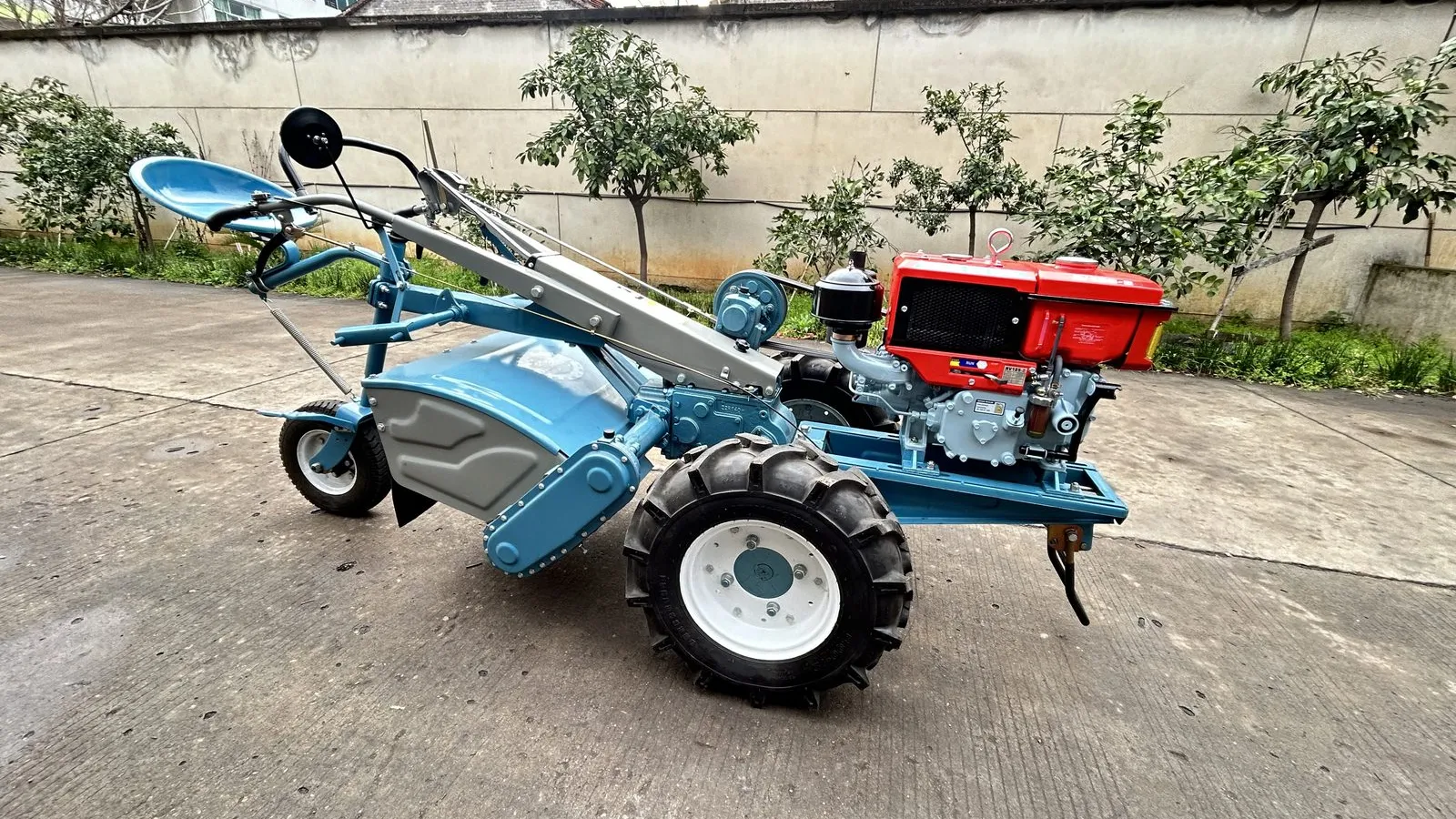
One practical warning for distributors who carry more than one model: the two platforms in a typical compact range are not the same size, so they do not pack into the same crate or load into the same space. Within the current SUNTEC range, the lighter, more manoeuvrable platform runs in the 7–10 hp class MUBOTA M80 and the heavier GN12 walking tractor in the 12.5 hp class, with working width stated as 480 or 600 mm — the customer specification sheets behind the two platforms record the 600 mm configuration for the heavier machine. Ask for packed dimensions per model, not per brand, and the loading plan you build will survive contact with the container.
There is a second, quieter cost to a vague packing answer: it hides in the quote. When a supplier quotes freight without a packed weight and packed size per unit, the number that reaches you is an estimate that will be trued up at the terminal — and the true-up almost never goes down. Getting the packing figures before the quote is not extra paperwork; it is the only way two suppliers can be compared on the same basis.
The wood question: ISPM 15 and crating that clears
Solid-wood packing is regulated internationally, and this is the single most common reason a machine is held at the port rather than delivered. The rule is ISPM 15, the international standard for regulating wood packaging material in trade, which the IPPC's page on the regulation of wood packaging material describes directly: wood packaging must be either heat-treated or fumigated, and then marked to show it.
What that means for a distributor's order is surprisingly simple, and it is usually not asked:
- Is the crate made of solid wood or of a processed board? Many packers now use plywood or processed board precisely to stay outside the standard. If so, ask whether the marking is still applied for port inspection.
- If it is solid wood, which treatment — heat treatment or fumigation? The two are not interchangeable at every destination, and the answer belongs in the order and on the certificate.
- Where is the ISPM 15 stamp applied, and is a copy of the treatment certificate supplied with the shipping documents? A stamp on the crate with no certificate behind it still stops at the port.
- Does any dunnage, pallet or bracing count as wood packaging? Anything made of solid wood in the container is in scope, including the timber blocks that stop the machine sliding.
Note what has not been said here: nothing about a particular certificate that any supplier holds. The question is what will be done to this order and what paper will prove it. Treat any answer you cannot attach to a shipment as unanswered.
One more consequence worth stating, because it catches distributors on split orders: the wood is treated per shipment, not per model. If an order ships in two containers on two dates, the treatment certificate and the stamp belong to each consignment, and a treatment record that covers only the first cannot be used for the second. Ask that the certificate is issued in the name of the consignment you are importing, with the container and mark details matched to the packing list — the same discipline the document section below applies to the rest of the paper.
The document set a distributor has to be able to produce
The documents are what your customs broker reads, and the broker does not work from the machine. If the paper is wrong the container sits at the terminal while the freight clock runs, so the document list belongs in the purchase order, not in a later email chain.
Four documents carry almost every machinery shipment, and a distributor should be able to say, for each one, who issues it and what it must show:
Document | Who normally issues it | What a buyer must confirm it will contain |
|---|---|---|
Commercial invoice | Seller | Exact model and configuration, unit price, Incoterm, currency, and the same quantity as the packing list |
Packing list | Seller | Number of packages, contents of each package, net and gross weight, dimensions, and crate marks matching the physical marks |
Bill of lading | Carrier / forwarder | Shipper, consignee, notify party, port pair, container number, and whether it is original, telex-release or sea-waybill |
Certificate of origin | Chamber of commerce or authorised body | Origin criteria, and the exact form a trade agreement in destination requires |
Around those four sit two more that decide how long the container waits: the customs classification (the HS code, and who is responsible for it) and the fumigation or heat-treatment certificate for the wood packing. On the export side the paperwork is not optional either — many markets require the export declaration to be filed electronically before loading, which is the role of systems such as the U.S. Census Bureau's Automated Export System and their national equivalents. The UK government's step-by-step export guide is a useful worked example of how a single authority sequences those steps.
Three of these belong in the request, not just the checklist:
- Ask for a scanned copy of the document set before the container is sealed. Corrections on paper are cheap; corrections after sailing are not.
- Ask whose HS code it is. The importer's broker may classify differently from the shipper, and the difference shows up as duty — or as a hold.
- Ask what the packing list will say about the spare parts. If spares are inside the crate, they must appear as line items, or the importer's inventory gains a mystery.
If the fields above look familiar, it is because a specification sheet and a shipping document overlap: the field-by-field datasheet checklist for distributors covers where packing dimensions and weights should already appear before they reach the invoice.
Shipping marks, weights and the container loading plan
The container is where packing and paperwork meet the physical world. Everything the documents promise has to be found on the outside of the boxes, and the loading plan is the drawing that makes it true.
Shipping marks are the identifier written on each package — consignee, destination, reference number, package count, weight. They matter for a blunt reason: when a container is held or inspected, the person looking inside has only the marks and the packing list to work from. Ask that the marks on the crate match the packing list character for character, and that the shipper keeps a photograph of the loaded container.

Then the loading plan itself. A container loading plan is not a nicety for large orders; it is how you know in advance whether the order fits, what the residual space can carry, and where the weight sits. Ask for:
- How many units per container, per model, in the container size you are booking — and whether that figure assumes assembled or partly assembled packing.
- Whether mixed models can be loaded together, and what that does to the count.
- How the load is secured — dunnage, blocking, strapping — and who is responsible if it shifts.
- Where the spare parts and implements sit in the plan, because they consume space that was otherwise going to machines.
- The gross weight of the loaded container, against the road limits between the port and your warehouse, not just the vessel's limit.
Get all of this as a plan, ideally one drawing per container, before the order is final. A loading plan that arrives after the container is stuffed is a record, not a plan.
Keep the container seal number with the loading photographs. It is a small detail that settles a large argument: if a container is opened in transit or arrives light, the seal number is how the carrier, the forwarder and the importer establish where the load stopped matching the packing list. Ask for it at the same time as the plan, and file it with the document set rather than in a chat thread.
Spare parts, implements and mixed loads
Spares and implements are the items prone to oversight in this part of an order. They are usually added at the end, packed by whoever is nearest, and discovered to be missing when a customer's machine is already in the field.

The questions are about separation and identification:
- Are wear parts packed with the machine or shipped separately? Both are valid; the mistake is not knowing which you bought.
- Is every spare item listed by its part number on the packing list? A box of filters with no numbers is inventory you cannot reorder from.
- Are sharp or heavy items packed so they cannot damage the machine? Blades, tines and hitch components need their own space and their own protection.
- Are implements checked against the machine they will mount on before packing? Coupling and hitch fit is a specification question, and the checklist for confirming implement compatibility before ordering walks that fit through before it becomes a shipment.
- If the order is split across two shipments, which items are in which? Split shipments are normal; undocumented split shipments are not.
Terms that decide who pays when the plan slips
Everything above is technical until the shipment is late, held or damaged — and then it becomes a question of who booked what under which rule. That is the job of the trade terms, and they should be agreed at the same time as the price, not after it.
- Incoterms. The Incoterm fixes where the seller's cost and risk stop and yours begin — who pays freight, who insures, who clears export, who clears import. The ICC's official Incoterms 2020 rules are the reference; what matters for the order is that both sides name the same rule and the same named place, because "FOB" without a port is not an answer.
- Who books the space, and in whose name? The party that controls the booking controls the sailing date. Ask which one it is, and whether you can see the booking confirmation.
- Who insures, and against what? Marine cover is not automatic at every Incoterm, and the amount is frequently the argument.
- When does inspection happen, and who witnesses it? Pre-shipment inspection is only worth having if it is agreed before packing, with a date and a scope.
- What happens to demurrage, detention and storage if customs holds the container? The party that pays should know it is paying before the container is on the water.
None of these questions asks a supplier to promise a term today. They ask who answers for each one — which is exactly the discipline the three-link chain of manufacturer, exporter and dealer is built to make visible: work out which business controls each part of the order, then put it in writing.
The question list, in the order to ask it
Pull the sections above into one page and the order of operations becomes obvious. Ask the specification questions first, then packing, then documents, then loading, then terms — because each answer constrains the next, and a document cannot be corrected to match a crate that has not been built yet.
# | Question | Ask whom | What it costs to leave it open |
|---|---|---|---|
1 | Packed dimensions, packed weight and protection method, per model | Seller / factory | Freight is quoted on a guess and re-rated later |
2 | Assembled, partly assembled or knocked down | Seller | The loading plan and the importer's labor cost both change |
3 | Wood packing: solid wood or processed board, treatment and marking | Seller | The container is held at the port for the ISPM 15 stamp |
4 | Commercial invoice, packing list, bill of lading, certificate of origin — scanned before sealing | Seller | A one-character error becomes a customs hold |
5 | HS classification and who owns it | Seller, with the broker | Duty is mis-declared and the entry is rejected |
6 | Shipping marks matching the packing list | Seller | Inspection has nothing to reconcile against |
7 | Container loading plan, units per model, mixed-load rules | Seller, with your forwarder | It may be found the order does not fit after it is packed |
8 | Spares and implements: packing, part numbers, split across shipments | Seller | Missing or unidentifiable spare parts reach the field |
9 | Incoterm, named place, who books and who insures | All parties | The first delay becomes an argument about who pays |
Three habits make the list work. Send it early enough to be answered — a packing question asked the week of sailing is a request, not a requirement. Get the answers on one document, ideally an annex to the purchase order, so the packing list can be checked against it. And keep the loaded-container photographs, because on the rare occasion a claim is made, they are the only record of what left the works.
None of the nine questions needs a lawyer, a laboratory or a specialist consultant. They need to be asked while the answer is still free — because the whole value of a question about packing, documents or loading is that it is cheap before the order and expensive after the container is sealed.
For the buyer's side of the same order — the configuration, quantity and market details that should be in the enquiry before any of this is quoted — the power tiller procurement guide and RFQ template shows how to frame the request, while this article covers what to confirm once the machine is chosen. And if you want the packing and document set discussed against your own order rather than in the abstract, send us the models, quantities and destination port and we will work through the list above with you.