
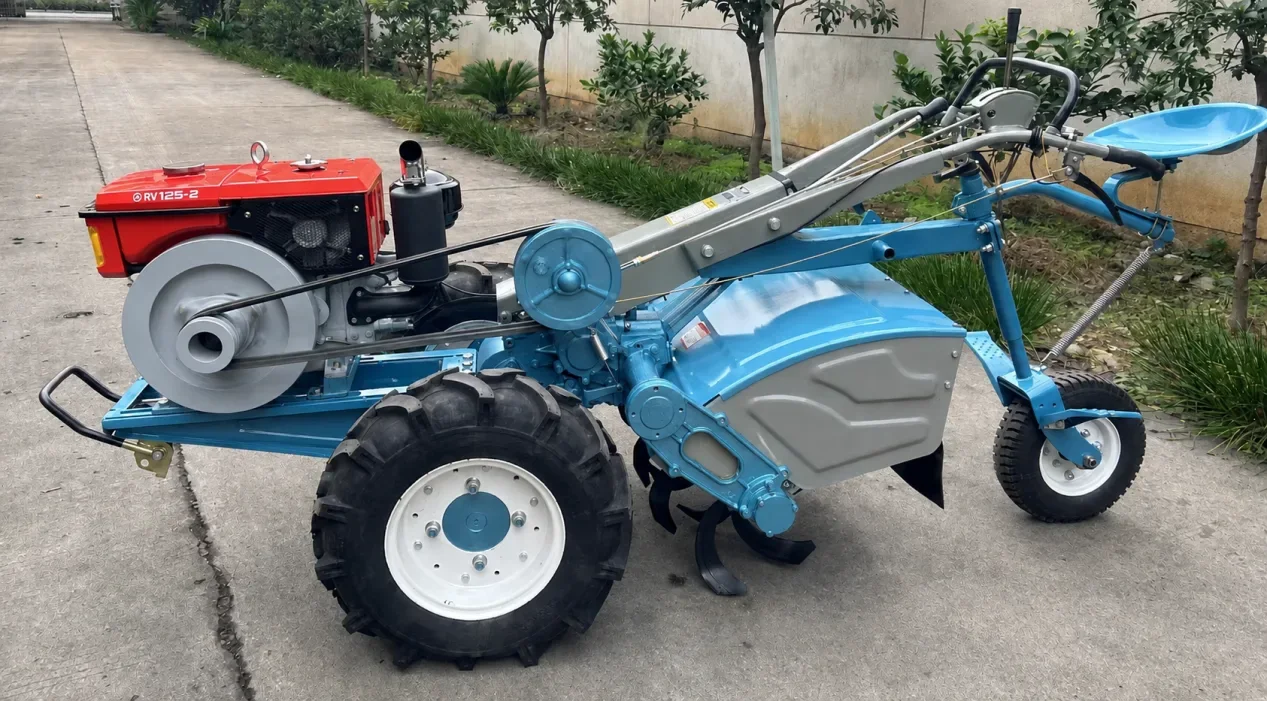
A customer who asks for "the biggest one you have" is answering a question nobody asked. The power tiller workload — the hours actually spent tilling, the area finished in each pass, and how many passes a season demands — decides the working width and the engine class long before anyone talks about price. Work those three numbers first and the machine choice becomes arithmetic. Skip them and every later comparison is a guess dressed up as a specification.
Define the power tiller workload in three numbers
The power tiller workload sounds like a feeling. In a dealership it has to be a figure, because it is the input that turns "which tiller?" into a calculation you can put in front of a customer and defend.
Three numbers carry almost all of it:
- Net tilling hours per day. Not the hours the machine is on site, and not the hours the customer is awake. The time the rotor is actually turning in soil.
- Area finished in one pass. The plot or field the customer expects to complete in a single working session.
- Passes per season. Seedbed preparation, a second cultivation, ridging, a pass before planting. Each one runs the same ground back through the machine.
A fourth variable multiplies all three rather than adding a category: soil condition. The same working width at the same depth draws noticeably more power out of heavier or wetter soil, which is why two customers with identical acreage can end up with different machines. Field condition is a multiplier you apply to those three numbers, not a label you paste on the customer.
The reason this matters commercially is scale. Two-wheel tractors — also sold as walking tractors or hand tractors — and power tillers are the machines that most smallholders can actually buy and run, and across Asia and Africa they carry the tillage load that would otherwise fall on hand tools or on hire of a four-wheel tractor (FAO, Mechanization for Rural Development). A distributor selling into that market is not choosing between one big machine and one small machine. You are matching a machine to a workload, over and over, for customers whose plots are measured in fractions of a hectare.
So the first question in a sizing conversation is never "how much horsepower do you want". It is: how many hours a day, how much ground per pass, how many passes. Ask for the power tiller daily workload in those units and most of the ambiguity disappears before you open a catalogue. Those three answers settle the power tiller working width and the engine class in that order — width first, because it is the cheaper of the two to change. If you want the wider picture of how field conditions feed into that conversation, our field-conditions guides collect the buyer-side inputs in one place.
Convert the workload into a work rate
Two of those three numbers convert straight into machine capability. The third tells you how many times you have to repeat the conversion.
The calculation is standard farm machinery economics. Theoretical field capacity is working width multiplied by travel speed; effective field capacity is that figure discounted by field efficiency, the factor that absorbs turning on headlands, blocked rotors, refills and stops (J. N. Hancock et al., Calculating Farm Machinery Field Capacities, University of Kentucky). Field efficiency is where the honest numbers live: a machine never covers the geometric maximum, and the gap between the two is what separates a brochure figure from a plan.
Work an example with the arithmetic visible. Take an implement cutting 0.6 m per pass at 2 km/h. Theoretical capacity is 0.12 ha per hour, about a third of an acre. Apply a field efficiency of 80 percent and the effective rate is 0.096 ha/h, roughly 0.24 acre/h. Over a six-hour working session that is 0.58 ha, or 1.42 acres, of finished ground in one pass.
Working width | Travel speed | Effective rate (ha/h) | Effective rate (acre/h) |
|---|---|---|---|
480 mm | 1.5 km/h | 0.058 | 0.14 |
480 mm | 2.0 km/h | 0.077 | 0.19 |
480 mm | 2.5 km/h | 0.096 | 0.24 |
600 mm | 1.5 km/h | 0.072 | 0.18 |
600 mm | 2.0 km/h | 0.096 | 0.24 |
600 mm | 2.5 km/h | 0.120 | 0.30 |
Rates assume 80 percent field efficiency — an optimistic planning figure set by us, not a claim about your customers' fields. Both widths are SUNTEC customer-confirmed public configurations for the platforms discussed below; the customer's own specification table records the 600 mm setting. Treat the efficiency figure as a variable rather than a constant: the same publication's own worked examples came out at 57.75 percent for a one-day check against 66 percent measured over two weeks on the same machine, both below 80, so a rate built on one good afternoon is not a planning number. Substitute the efficiency your own customers actually achieve.
Read the table twice, because it says two different things. Going from 480 mm to 600 mm at the same speed raises the work rate by 25 percent without touching the engine. Speed does the same job — 1.5 km/h to 2.5 km/h is two-thirds more ground per hour. Width looks like the cheaper lever until you remember that a wider cut bites more soil, which pushes back in the next section.
This is also where most published numbers fall apart. A power tiller workload expressed as one headline rate cannot be checked against anything, and a power tiller field capacity quoted without a width, a speed and an efficiency assumption has the same problem. The power tiller acres per day figure that circulates in blog posts often carries no assumptions at all. If you want a power tiller work rate you can quote to a customer, derive it from the two inputs you can measure on their farm.

The working width belongs to the configured machine, not the chassis model. Our field selection guide walks through the plot-level inputs that sit upstream of this calculation.
Read the engine load, not the headline horsepower
A work rate tells you how much ground the machine can turn over. It says nothing about whether the engine can sustain the power tiller workload you have just calculated, because the power a tillage implement demands is not a fixed property of the machine.
Draft — the force the soil pushes back with — rises with working width, with tilling depth and with travel speed, and it changes with soil type and moisture. Trials on clay loam measured a significant increase in both draft and power requirement as depth and speed went up, and the resulting power requirement is the product of that draft and the operating speed (P. Okoko et al., Draft and power requirements for some tillage implements, CIGR Journal). Two consequences follow for sizing. Going wider or deeper to raise capacity raises the load just as fast. And a machine that holds speed in dry loam can lose it in wet clay at the same setting.
The second effect bites hardest in rice systems. Puddled or waterlogged ground raises the resistance the rotor meets while reducing the grip the wheels can put down, so the work rate from the previous section drops even with the engine at full output — and puddling and levelling usually ride on top of the tillage pass as extra passes over the same ground. Treat paddy and wetland work as the same calculation under a heavier load, not as a different kind of decision.
The second thing to check is which rating you are reading. Engine specifications usually carry two output figures, and the gap between them is the difference between a peak and a working day.
Engine reference | Displacement | Maximum output | Continuous output |
|---|---|---|---|
RT90DI | 487 cc | 9 hp at 2,400 rpm | 8 hp at 2,400 rpm |
RV125-2 | 624 cc | 12.5 hp at 2,400 rpm | 10.5 hp at 2,200 rpm |
RT125DI / RT125DIE | 666 cc | 12.5 hp at 2,400 rpm | 11 hp at 2,400 rpm |
Figures as recorded in SUNTEC reference specification tables for the M80 and GN12 chassis. Engine pairing, starting option and final supply configuration are confirmed per quotation.
Those numbers are illustrative of the pattern rather than special to one supplier, and the pattern is what costs a distributor money. A continuous rating sits eleven to sixteen percent below the peak figure in the rows above. A customer who quotes the peak number back to you and plans a full day at it will report that the machine "loses power in heavy soil" — and they will be describing exactly the load the continuous rating exists to define. Size the day on the continuous figure and treat the peak as headroom for a hard patch, not as the number the machine works at.

The two output ratings live on the engine, not on the brochure. Our guide to reading a power tiller specification covers the other fields that move with them.
Cap the working day by the operator, not the fuel tank
Everything above assumes the machine can work the hours the customer quoted. On a walk-behind machine, something else usually gives first.
Work bouts during rotatilling operation by power tiller should not exceed 75 minutes ... Rest pauses of 10 minutes were found insufficient ... the minimum duration of rest pauses should be of 15 minutes. The duration of the lunch break should be more than 45 minutes.
That conclusion comes from a study that measured heart rate and postural discomfort across four work-rest schedules on a 6.7 kW rotary power tiller, with total work and rest of six hours and two hours respectively (P. S. Tiwari and L. P. Gite, Evaluation of work-rest schedules during operation of a rotary power tiller). It is the one genuinely hard number in this whole calculation, and it cuts directly into the capacity estimate.
A customer who describes an eight-hour day is describing roughly six hours of tilling, once 75-minute work bouts are separated by proper rest. Plan the power tiller workload on eight hours and the width or the pass count comes out about a third too optimistic. There are two honest ways to close that gap: recommend the larger working width so the same area finishes inside the real tilling hours, or plan two operators so the machine keeps working while one rests. What does not work is quoting the theoretical figure and letting the customer discover the difference at the end of their first long day.
Match the workload band to the platform
Put the power tiller workload inputs together, and the choice narrows to a band, not a model number. What distinguishes the bands is mostly weight and width: how much machine the customer has to move, and how much of it has to fit through the gate.
Workload signature | Platform class | Working width | Confirm before quotation |
|---|---|---|---|
Small area per pass, tight plot access, part-day work | Compact chassis, 7–10 hp engine band | 480 mm standard, 600 mm optional | Narrowest gap the machine must pass; turning room at the headland |
Same soil, more area per pass, longer working days | Compact chassis, wider drum | 600 mm | That the engine choice sustains the wider drum continuously, not just at peak |
Larger area per pass, transport between plots, heavier soil | Heavier chassis | 480 mm or 600 mm | Ground clearance, wheel tread settings, transport between plots |
The compact end of that range carries a 179 kg chassis without the engine, measures 2,050 × 710 × 1,235 mm, and runs six forward and two reverse gears with four tilling speed settings. Its 710 mm overall width is what gets it into plots a wider machine cannot enter, and its wheel tread adjusts between 390 and 780 mm. The heavier platform weighs 470 kg without the engine, measures 2,950 × 980 × 1,240 mm, provides 210 mm of ground clearance, and shares the same six-forward, two-reverse layout. It ships 50 units with engines per 40HQ container, which is the kind of figure a distributor needs when the workload conversation turns into a shipping plan.
Neither platform is the right answer on its own. Access decides for the compact machine; area per pass, transport duties and heavier soil decide for the heavier one. You can compare the current range on our product pages once the workload band is fixed.

One workshop holds several weight and power bands. Power tiller sizing starts by deciding which band the workload needs, not which model looks strongest.
Add the implements and the season to the same sum
The tiller is one attachment on a machine that will spend its life carrying several. Each implement brings its own power demand, and the specification for a mounted implement usually states the power tiller it is designed around.
Published implement specifications show the spread. A power-tiller-mounted terracer cum leveller is rated for an 8–10 hp power tiller. A power-tiller-operated slasher cum in-situ shredder is rated for 10–15 hp and carries a working capacity of 0.8 ha per day (Tamil Nadu Agricultural University, Farm Machinery). The second implement asks for roughly half again the power of the first, and it is the same chassis underneath both.
So the check is whether the machine clears the highest demand on the customer's job list, not the demand of the tiller alone. A configuration that handles soil beautifully can still be under-specified the moment the order includes a shredder, a ridger or a trailer that the customer intends to use every week.
Then multiply by the season. Once the implement list enters the power tiller workload, the passes compound it: three passes over the same ground is three times the hours from the first section, which is identical to asking for three times the area per day. Distributors who skip this step tend to sell a machine that is correctly sized for one pass and consistently worked past its rating for three. Our implements and attachments guides cover the attachment side of that question in more depth.
What to send a supplier (the workload brief)
Once the power tiller workload is on paper, the sizing conversation stops being about preferences and becomes a specification. Write down:
- Net tilling hours per working day, based on the work-rest pattern the operator will actually keep.
- Area to be finished in one pass, in hectares or acres, with the unit stated.
- Passes per season over that area.
- Soil type, and the tilling depth the customer expects to work at.
- The narrowest gap the machine has to pass, and the turning space at the headland.
- Every implement the machine will carry, including the ones used just once a season.
- Who operates it, and how long a shift that person works.
Send with a request for quotation, that list lets a supplier size the machine instead of guessing at it, and it makes two quotations comparable when they arrive. The same discipline applies on the buying side — our procurement guide for distributors sets out what a finished RFQ has to state.
Starting from the power tiller workload does not make the decision smaller. It makes the answer defensible: hours, area and passes pointing to a working width and an engine class, the implement list confirms the power, and the operator's rest pattern keeps the estimate honest. When you have that list in hand, send it to us and we will work through the configuration with you.

Configuration starts here: the brief decides which implements get mounted and how the machine is set up before it ships.