
Soil resistance is the force a power tiller is actually bought against
The sheet in front of you lists engine output, gear steps and a working width. None of those numbers decides whether the machine will work your customer's ground. Soil resistance is the force the soil puts up against the tool, and it is a property of the field, not of the catalogue.
A soil-bin study of rotary tiller blades states the relationship without hedging: draft requirement "depend on the soil strength and moisture contents along with compactness" (soil-bin evaluation of rotary tiller blade–soil interaction). That single sentence is the reason a 7 hp machine can be the right answer on one holding and hopeless on the next.
Three levers move when the resistance moves, and they are not interchangeable.
Lever | What it changes | When it is the right lever |
|---|---|---|
Power (engine output / power class) | How much force the machine can supply continuously | Resistance is high across the whole working depth |
Weight and wheels (ballast, tyre type, track width) | How much of that force actually reaches the soil before the wheels slip | The machine has the power but stalls, spins or loses depth |
Implement (rotary tiller, plough, width, depth, timing) | How much resistance you ask the machine to overcome per pass | Resistance is concentrated in one layer, or the job can be split |
One check settles most machine complaints before anyone argues about horsepower: if the wheels are spinning, the problem is in the second row of that table, not the first.
Where the resistance comes from
Four things set it, and all four are observable in the field before a quotation is written.
Texture. Clay holds more of its resistance at any moisture than sand does. Its particles are small, the contact area between tool and soil is larger, and the soil is sticky when wet and near-cemented when dry. That is why "power tiller for clay soil" and "tiller for hard soil" describe two different problems even though they read alike.
Moisture. The same soil is a different material at different water content. In controlled soil-bin tests, cone index — and with it the force needed to cut — fell as moisture content rose towards an optimum, then rose again once the soil passed it. This is the single most controllable variable in the list, and the one most often ignored because the machine happens to be available that week.
Compaction and hardpan. A compacted layer is a band of soil denser than what sits above and below it, and a tillage pan forms under the depth you work year after year. It is not visible from the cab or from a photograph. It has to be measured.
Depth and width of the cut. Resistance acts over the section of soil the tool takes. A wider tiller at the same depth and the same speed demands proportionally more force; so does a deeper pass. Working width is therefore not a convenience number — it is one of the two multipliers on the resistance the machine has to beat.
Measure it before you buy: cone index and penetration resistance
The instrument for this is the cone penetrometer, and it is standardised: according to the USDA-ARS review of compaction-layer detection, soil cone penetrometers are standardised under ASAE Standard S313.3 and their result is reported as the cone index (CI) per ASAE Standard EP542 — defined as the force required to push the probe into the soil divided by the cone base area.
That definition matters commercially, because it means the number is comparable between fields and between visits. The practical procedure is unglamorous: push the cone down slowly and steadily, note the resistance at fixed depth intervals, and repeat at several points across the field — Penn State Extension's guidance on diagnosing compaction with a penetrometer sets out the field routine. Reading resistance as a curve against depth, rather than as one number, is what reveals whether the restriction is a shallow pan, a deep subsoil condition, or simple surface dryness.

Two readings matter more than the absolute figures, and neither requires a laboratory:
- The depth at which resistance rises sharply. That depth is the layer the implement has to reach and break. A tiller set above it polishes the surface and leaves the problem in place.
- The difference between an undisturbed strip and a worked one. A fence line, a headland or a strip that has not been cropped gives you the field's own baseline. The gap between the two curves is the compaction you are actually buying a machine to fix.
Write both down before the machine is chosen. They are the two numbers that the rest of this decision runs on, and they cost a morning.
Measure in two conditions rather than one. Penetration resistance rises as soil dries, so a reading taken in a dry spell and a reading taken near field capacity describe the same soil at two different strengths — and both are real. For specification purposes the wetter reading is the more useful, because it is closer to the condition the machine will actually work in, and it is the one that separates a genuine structural problem from a dry week.
From resistance to power: draft, drawbar power and speed
Resistance becomes a machine requirement through one relationship: power = force × speed, with the force known as draft. The engineering literature has quantified how the choice of implement changes that force long before the machine is selected. In W. Soehne's review Aspects of Tillage, a rotary tiller requires 2.5 times the power of a plough on light soil and 3.5 times on heavy soil at the same width and depth of cultivation — but once the harrowing a plough leaves behind and the tractor's rolling resistance and slip are counted, the two come back to roughly 1 : 1.5. The implement, not the engine, moves the requirement by that much.
Two corrections stop the arithmetic from flattering the machine.
Engine output is not draft power. The same review notes that when ploughing, rolling resistance and slip consume 35–45% of the engine power available. A machine rated at a given output is not supplying that figure at the drawbar, and the harder the ground, the larger the gap.

The power class that works depends on which implement you put on it. A field survey of 22 rotary tillers, 11 mouldboard ploughs and 27 hydro tillers working paddy in Indonesia found rotary tillers running 8.5–10.5 hp and mouldboard ploughs 6.5–8.5 hp for the same land preparation (comparison of three power tiller types for small-scale rice farming). Same job, same region, different power bands — because the implement decides the draft.
The practical consequence is worth stating plainly: on the same soil, a lower-draft implement can let a smaller and cheaper machine do the job, while a higher-draft implement with a wider cut can outrun a machine several horsepower larger. Only the readings tell you which side of that trade you are on. One evaluation of a 6.71 kW power tiller on tar roads measured both draft and drawbar power to make exactly this comparison (evaluation of a 6.71 kW power tiller for draft and drawbar power on tar roads).
Speed sits on the same equation, and it is not free either. Cutting faster raises the power the job needs, and running the rotor faster than the job needs raises it further still. The same review puts rotary-tiller tine peripheral velocity at 12 to 22 fps, against a ploughing velocity of 4 to 5.3 fps — several times the forward speed a plough works at. A slower rotor taking a longer bite, set to the tilth the crop actually needs, is usually the cheaper setting on a compact machine — and it is the setting most often given away to habit.
For a wider purchase decision on the same axis — reading a specification sheet so that working width, gear steps and take-off are compared against a real job rather than against each other — the guide to reading power tiller specifications breaks the sheet into the three numbers that change the answer.
Why weight decides whether that power reaches the soil
A machine can have ample power and still fail, because power only counts once it has travelled through the wheels into the soil. Traction, not horsepower, is the gate.
Weight is the lever that opens it. Adding ballast to the wheels raises the force a tyre can transmit before it slips, and tyre pressure changes both the contact patch and the slip that follows. Iowa State Extension's note on getting the most out of a tractor makes the same point in the field language: ballast and inflation are set to the job, and a badly inflated tyre slips, bounces, burns fuel and compacts soil that the machine is being bought to loosen. The 6.71 kW power-tiller evaluation cited above took the question seriously enough to mount 40 kg of wheel ballast and measure what changed.

This is why "power tiller weight" is a real specification question rather than a shipping detail, and why the answer is a trade rather than a target:
- On hard, dry ground, more weight on the driven wheels converts engine output into penetration and depth. A heavier platform in the same power class will hold its working depth where a lighter one rides up.
- On wet or puddled ground, the same weight drives the machine down and the wheels spin anyway. Here the fix is wheel and tyre choice — cage or spiked wheels, or axle extensions to widen the track — not more ballast.
- On a wrong choice, extra weight simply makes a machine that already cannot hold depth sink further and burn more fuel doing it.
Weight is therefore a lever you set after you know what the readings say, not a quality ranking. The machine configuration section deals with how wheels, gearing and weight interact on the same platform.
Weight does not create pulling power. It converts power that is already there into depth — and it stops converting the moment the wheel starts to slip.
Choosing the implement that matches the resistance
The implement is the third lever, and on a compact machine it does more of the work than buyers expect.
Match the implement to the layer, not to the job title. A mouldboard plough is for breaking ground that has not been worked. A rotary tiller does the heaviest of the seedbed preparation in one pass, which is exactly why it draws more power at the same width and depth. If the readings show a single compacted band, the question is which tool reaches and breaks that band — not which machine has the largest engine.
Trade width against depth deliberately. At a fixed power, more width means less depth and vice versa. On narrow plots and between rows, a narrower tiller at the depth the readings demand beats a wide one that never gets down to the layer. Working-width choices on the compact end of the market are typically quoted in the 480–600 mm range; the customer specification sheets behind the two SUNTEC platforms record the 600 mm configuration for the heavier machine.
Price the implement on the energy it costs, not only the seedbed it leaves. The same soil-bin work notes two things at once: the rotary tiller's high energy demand is what normally restricts it to shallow tillage, while its ability to complete several tillage operations in one stage is what keeps the total power needed for the job low. One high-demand implement replacing two or three lighter ones is the trade to price.
Match depth to the layer. A pass that reaches the restrictive layer does the work. A pass set deeper than the soil needs spends power on soil that is already loose.
Work the moisture window. Because resistance falls to a minimum at the soil's optimum moisture content and rises on either side of it, the timing of the pass is a free reduction in draft. Tilling when the soil is too dry to fail cleanly is the most expensive mistake in this list to correct afterwards.

Machine geometry belongs in the same decision. The implements and attachments section starts from the work to be done and the coupling that has to carry it, which is the order that keeps an implement purchase from becoming dead stock.
Turning field readings into a machine configuration
Nothing so far needs a laboratory or a software licence. It needs three actions, in order.
- Read the field. Penetration resistance against depth, at several points, plus one undisturbed strip for a baseline. Record the depth of the restrictive layer and the size of the gap.
- Match the reading to a lever. Use the table below. Change one lever at a time; each one has a different cost and a different risk.
- Write the configuration down in the enquiry, next to plot size, access width, crop and the work the machine has to do.
Reading from the penetrometer | What it usually means | Change this first |
|---|---|---|
Resistance rises sharply just below the depth normally worked | A tillage pan sitting at the bottom of the cultivated layer | Implement depth — one pass reaching just below the pan, before any change of power |
High resistance through the top 10 cm, after a dry spell | Surface hardness driven by dryness, not by structure | Timing — move the pass to the right moisture window, and take a shallower first cut |
High resistance down the whole profile in heavy clay | A clay soil offering high resistance at every depth | Power class, with a low-draft implement for the first pass; wheels set for the ground condition |
Moderate resistance, but the machine stalls or rides up | Traction, not soil resistance | Ballast, tyre type and track width — this is the second lever, not the first |
High resistance only in patches, headlands and gateways | Local or traffic-induced compaction | Variable depth and pass planning; do not over-specify the machine for the worst five metres |
The fifth row is the one that costs money, because a distributor who sizes every machine for a gateway will sell a heavy platform into ground that never needed one. Record the readings that represent the field, not the worst corner of it.
For trade buyers the same three actions turn into a specification conversation. A quotation built on a measurement is short: the readings, the depth of the restrictive layer, the plot size and access width, the crop, and the work the machine has to do in the first season. That is the sequence the field-conditions selection guide and this cluster's hub on selecting a machine by field conditions are built around, and it is the difference between quoting a machine and quoting a configuration.
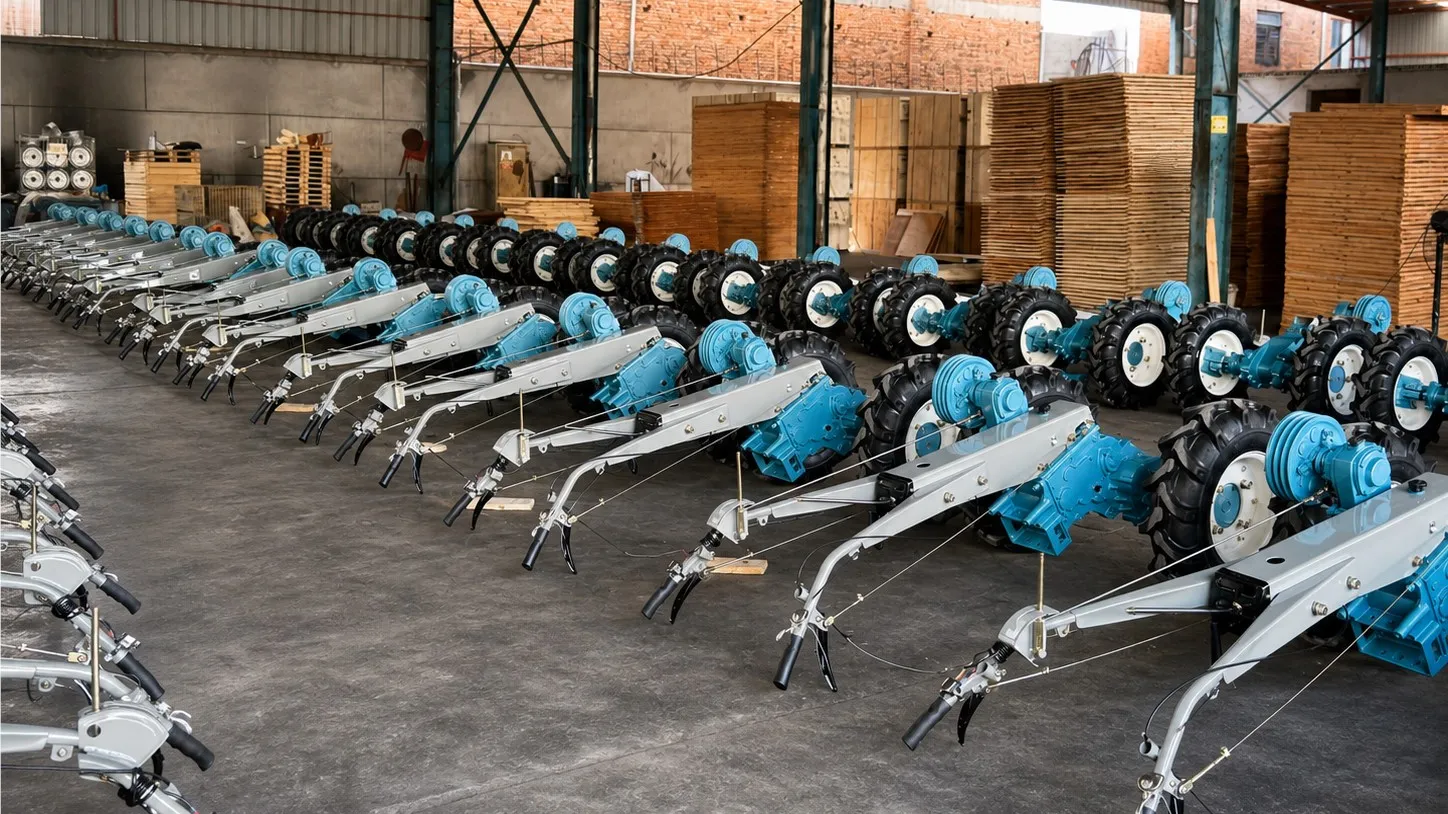
Within the current SUNTEC range, that split runs between a lighter, more manoeuvrable 7–10 hp platform for shallower and narrower work and a heavier 12.5 hp-class platform for more demanding cultivation and short-distance transport, such as the GN12 walking tractor. Both are offered as configurations for a set of field conditions rather than as one universal answer, with working width and implement set stated for the configuration quoted.
The short version
The force a machine has to beat comes from the soil, and it is measurable before a rupee, dollar or rupiah is committed. Cone index and penetration resistance give you the depth of the restrictive layer and the size of the problem; draft and speed convert that into a power requirement; weight and wheels decide whether the power reaches the soil at all; and the implement decides how much resistance you ask the machine to overcome on each pass.
So the order of decisions is fixed. Measure first. Then move one lever — power, weight, or implement — and re-check the reading before moving the next. A machine that is undersized for a field that has never been measured is not a specification problem; it is a measurement problem, and it is cheaper to fix.
If you would rather work through your own readings with the people who build the machines, send us the penetrometer results, the plot sizes and the work the tiller has to do.