
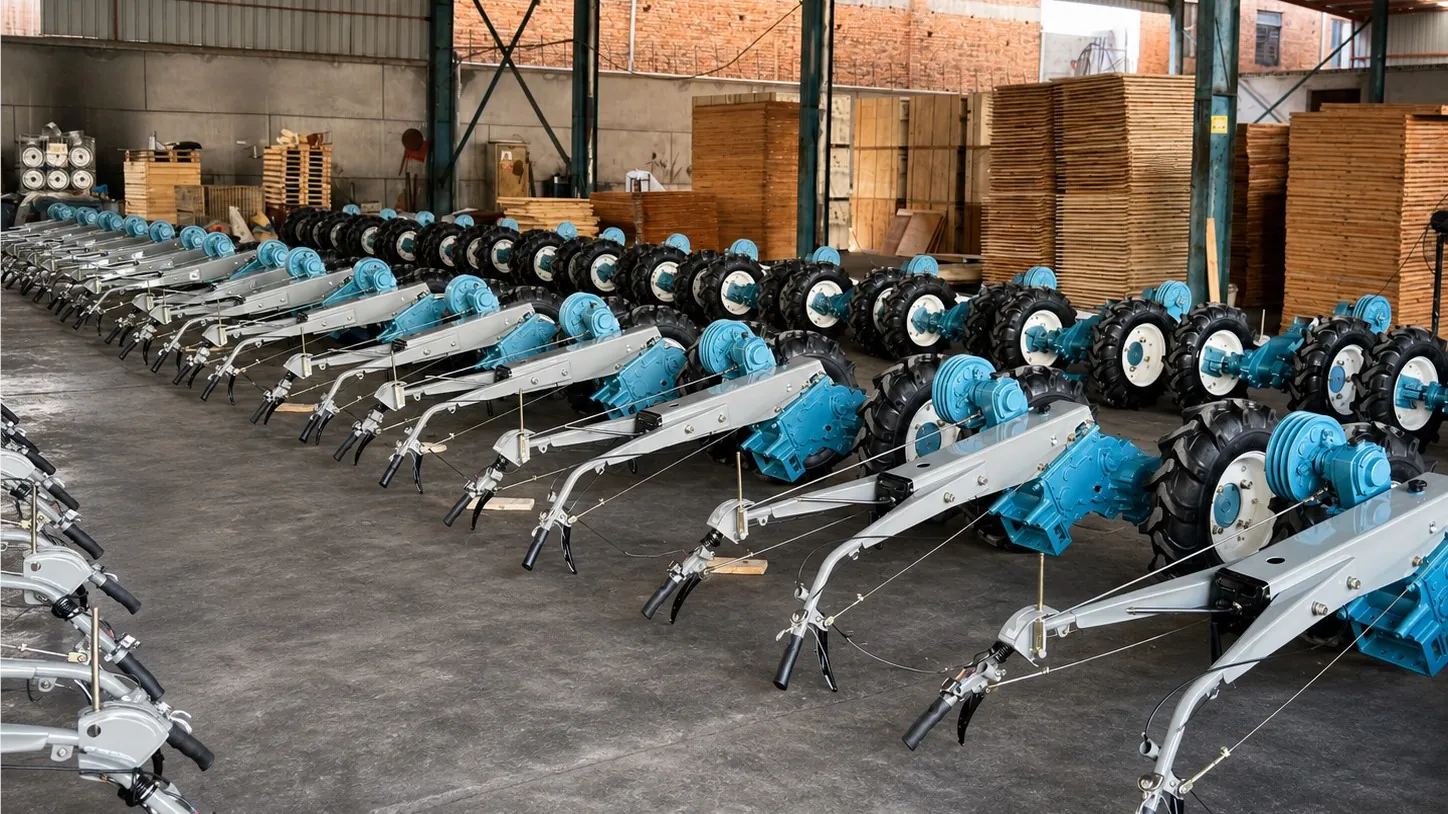
The tenth machine is the one that decides whether the warranty meant anything
Sell one power tiller and the warranty is paperwork. Sell a hundred and it becomes a line item in your business plan, because the tenth machine — or the forty-second — will stop in a customer's field during planting week. At that moment the length of the warranty is not the question anyone is asking. The questions are: is there a part, who says it is covered, how long until it arrives, and who pays for it.
Search power tiller warranty and support and you will not find those answers. You will find brand pages that state coverage terms for people who already own the machine — retail names, dealer locators, registration forms, a phone number. That material is written for the end user. A distributor needs something different before signing: a way to tell whether a supplier's warranty and support story survives contact with a broken machine 6,000 km away.
This article is that way. It is twelve questions, grouped by the three things that actually have to be true for a warranty to be worth anything — the part exists, the decision is fast, and the cost has an owner — plus a method for scoring the answers.
One thing to state plainly at the start: this is written from the selling side of the trade. Read it as a description of what a supplier should be able to hand you, not as a neutral survey. And read every question as a test of evidence, not of goodwill. Suppliers are not usually lying about support. They are answering a different question than the one you asked.
If you want the wider map, the spare parts and technical support hub collects the rest of it — how a parts kit is built, how a part is identified before it is quoted, how one system's components are described. This article is the procurement-stage slice: the questions that belong in the conversation before the first order.
What a power tiller warranty and support answer must contain
Most warranty conversations fail in the same place: the buyer asks how long coverage lasts, the supplier answers with a number of months, and both sides leave believing an agreement has been reached. Duration is the least informative part of the answer, because it is the part that costs nothing to say.
A warranty is only operational when four things are defined. Miss any one of them and the promise becomes discretionary — it will be honoured when the supplier feels like it and disputed when the amount is large.
Element | The question it answers | What "undefined" looks like |
|---|---|---|
Decision owner | Who is allowed to say yes to a claim, and where do they sit? | "Our service department will assess it" — no name, no location, no authority limit |
Evidence standard | What must the distributor submit for a claim to be judged? | A list of photos and a form that nobody has seen |
Cost allocation | Who pays the part, the labour, and the freight in each direction? | "Warranty covers the part" — and nothing about the other three |
Time limit | How many days from claim to decision, and from approval to dispatch? | Silence, or "as soon as possible" |
None of these four is exotic. Every one of them is a sentence a supplier can write. The reason they are usually missing is that they are the expensive sentences — and a supplier who has not thought about them is a supplier whose support depends on how busy the season is.
Read the four together and the real subject of this article appears: you are not buying a warranty period, you are buying an adjudication process. At SUNTEC, that is the frame we use when a distributor asks what happens after the sale — and it is the frame the distributor procurement hub is built around, because the same four questions apply to any manufacturer you shortlist.
Spare parts: the five questions that prove parts exist
A warranty without a parts pipeline is a promise to argue later. This is where most evaluations are thinnest, because parts questions feel technical and buyers skip them. They are not technical. They are inventory questions, and inventory questions have yes-or-no answers.
1. Can you send a parts catalogue with part numbers, per platform?
Not a price list. Not a photo of a shelf. A document where each component has a number, sits in an exploded view, and maps to a position on the machine. A power tiller parts catalogue is the proof that a parts system exists at all, because you cannot number what you have not organised.
Ask for it before the quotation, and check two things in it: whether the numbers are stable (a supplier who renumbers every season will break your stock records) and whether the diagrams show the machine you are buying rather than a generic illustration. If one catalogue is offered for every model in the range — for example for both a lighter platform and a heavier one — treat that catalogue as a brochure until the supplier shows you the page where the two diverge. A parts book that cannot show a difference between two platforms is not describing either of them.
If identifying the part is itself the hard step on your side, the guide to identifying a power tiller part before you ask for a quote walks through the order in which to describe it — system, position, then number.

A part number is only useful if it resolves to one physical item — which is why a parts catalogue starts with the item, not the price.
2. Which items are wear parts, and on what clock do they run?
Every supplier will say blades, belts, seals and filters wear. Almost none will tell you the interval, because the interval is a commitment. Ask anyway, and ask per 100 operating hours rather than per season — hours are measurable, seasons are opinions.
The answer you want is a short table: item, inspection interval, replacement interval, and what a worn item looks like. The answer that should worry you is a list of part names with no intervals, because it means your customers will discover the interval themselves, in the field, at the worst time.
This is also where the parts kit question starts. A distributor stocking plan is not a shopping list of popular items; it is a set built by system and by replacement clock. That logic — and the way consumption differs between the engine side and the transmission side — is set out in the distributor wear-parts kit checklist.

Transmission housings on a factory floor: the parts a distributor argues about in year three are usually in this group, not in the blade group.
3. What ships with every machine?
Tool kit, spare filters, a spare belt, fasteners for the implements, the operator manual. The shipping list is a small document with a large diagnostic value: it tells you what the supplier considers normal to lose in the first month. A machine that arrives with no spare fasteners and no filter has been packed by someone who has never had a customer.
Ask for the packing list as a document, not as a verbal assurance, and compare it with what actually arrives in the first container. Discrepancies there are an early warning about the whole logistics chain.
4. How long will this model's parts stay available, and how do you announce a supersession?
Two questions in one, and the second is the one nobody asks. A part number that quietly changes is worse than a part that is discontinued, because you find out after you have quoted a customer and taken the order.
Ask for the mechanism, not the date: how does the supplier tell you that part 12-3 has become 12-3A, and does the new number appear in an updated catalogue you receive automatically? A supplier with a real system answers this in one sentence. A supplier without one answers with a promise that nothing will change.
5. If I stock parts, what do you require me to hold — and how do you pack a mixed order?
Some manufacturers set a minimum parts commitment for distributors; some do not. Either answer is workable, but you need it in writing before you sign, because it changes your working capital. The follow-up matters more: when you order twenty different part numbers in small quantities, do they arrive as one identified shipment with a line-by-line packing list, or as a box you have to sort on the floor?
Ask for a sample packing list from a real mixed order. It is the cheapest way to see how the supplier's warehouse actually works.
Warranty: the four questions that decide who pays
Warranty wording is usually written to be defensible rather than readable, so the useful approach is not to read it closely but to make the supplier state the operational version. These four questions do that. The fourth is the one most negotiations skip.

A warranty claim almost always lands on one component, not on the machine as a whole — which is why the claim process has to be defined at component level.
6. When does coverage start?
Invoice date, shipment date, or arrival date. The gap between them can be two months on a sea freight route, and it is two months of coverage that either exists or does not. Ask which one, and ask what happens if the container sits at port for three weeks through no fault of yours.
There is no universally right answer here — a supplier who starts coverage at arrival is carrying more risk than one who starts at invoice. What matters is that the answer is explicit, because this is the single most common source of "your warranty had already expired" disputes in the first year.
Registration is the other half of that question, and it is the half that quietly decides claims. Ask who registers the machine — factory, importer, or end user — how long the window is, and what happens to a claim on a machine that was never registered. A warranty that requires registration, paired with a process nobody owns, fails on a technicality, and the technicality will be discovered by your customer rather than by you.
7. Which items are excluded — and how is a wear part defined in writing?
Every warranty excludes wear, and every argument about warranty is an argument about whether a failure was wear. So the definition is the whole clause. "Normal wear" is not a definition; "blade thickness below the service limit stated in the manual" is.
Ask for the excluded list and for the wear criteria that go with it, then check whether the two documents agree. A warranty that excludes wear parts while the manual gives no wear limits has effectively excluded everything that will ever fail.
8. Who pays the part, the labour, and the freight in each direction?
Four costs live inside one claim: the replacement part, the labour to fit it, the freight to send the part out, and the freight to return the failed part for inspection. Most warranty text addresses the first and stays silent on the other three, which means the other three land on you.
The question to ask is not "is labour covered" but "what is the labour allowance per claim, and is it a fixed amount or an hourly rate". A fixed allowance is workable. An hourly rate with no cap is a number that will be negotiated downward at the worst moment. On freight, ask specifically about the return leg — a supplier who requires the failed part back for inspection but will not pay for it has transferred a real cost to you.
Shipping damage belongs in the same conversation, because it is the claim you will file most often in the first year and the one most likely to fall between the warranty and the freight terms. Get a sentence that says who inspects and who pays when a machine arrives damaged.
9. Who is allowed to decide a claim locally, and what evidence do you require?
This is the question that separates a support system from a support department. If every claim must travel to the factory for a decision, your customer waits weeks and you absorb the relationship damage. If a named person in your organisation can approve up to a stated limit, the whole thing becomes workable.
Ask for three specifics: who on your side may authorise, what the value limit is, and what evidence the factory needs to accept that authorisation. Photographs, a serial number, a description of the failure, hours on the machine, and the invoice or proof of purchase that ties the unit to a shipment — the list is usually short. Get it as a document, because it will be your claim template for the next five years.
Two related items are worth confirming in the same answer: whether coverage transfers to the end customer when you sell the machine on, and whether an extended warranty or maintenance plan is available for customers who want one. Both are ordinary commercial questions, and both are easier to settle before the first order than after.
What you have to hold on your side
A large share of disputed claims starts on the distributor's side rather than in the factory, and it is worth saying so before you audit anyone else. Three records do most of the work: the registration of each unit against its serial number, the invoice that ties that serial number to a shipment, and an hours figure at the point of failure. If your dealer network cannot produce those three when a claim is filed, the strongest warranty in the market will still be argued down.
So the supplier questions have a mirror image. Who in your organisation registers machines, and by when? Where is the record kept, and can it be searched by serial number? What is your own deadline for reporting a failure, and does your dealer agreement pass that deadline down to the dealer? Power tiller dealer support is not only what the factory gives you; it is also what you can prove on the day — and a supplier who asks you these questions is telling you something useful about how they handle claims.
Technical support: the three questions that make it usable
"Technical support" is the softest claim in the industry. Everyone offers power tiller technical support. What varies is whether it can answer a question in a language your technician speaks, within a time that matters, with a document that shows the actual machine.
10. Who answers a technical question, in what language, and within what time?
Name the person or the role, the language, and the channel. A generic support inbox in a language your technicians do not read is not support; it is a delay with a tracking number.
Ask what happens out of hours during planting season, and ask how a question escalates from a sales contact to someone who has actually repaired the machine. A supplier who cannot describe the escalation path does not have one.
11. What documentation comes with the machine?
The minimum set is: operator manual, parts catalogue, and a troubleshooting section that maps a symptom to a probable cause and a part. The operator manual is the piece with a published standard behind it — agricultural machinery manuals have their own content and format standard (ISO 3600:2022), which covers manuals written for operators, not for service technicians. The parts catalogue and the troubleshooting section are the two documents it does not cover, which is exactly why you have to ask for them explicitly. In the EU, instructions for use are also part of the documentation a manufacturer must supply before machinery can be placed on the market: the requirement currently sits in Directive 2006/42/EC and moves to Regulation (EU) 2023/1230 on 20 January 2027 (the original Official Journal text printed 14 January; a July 2023 corrigendum corrected it).
The practical test is not whether documents exist but whether they match the machine in the crate. Serial-number-specific manuals, a parts book that reflects the configuration you ordered, and a troubleshooting page that names parts rather than symptoms — those three are what a technician can work with at 7 a.m. in a field.
If your shortlist includes machines with cooling or hydraulic systems, the parts and support article on radiator and cooling-system components is a useful reference for how far a system-level parts description should go before it is useful.
12. What training do you give my technicians — and does it cover the warranty decision?
Most training offers cover operation: how to start it, how to set the depth, how to change a blade. That is the easy half. The half that pays for itself is the warranty half: how to tell a wear failure from a material failure, what evidence to photograph, and when to stop repairing and file a claim.
Ask whether training is at your site or theirs, whether it is hands-on with a machine, and whether the person delivering it has authority to discuss claims. A trainer who can only talk about operation will teach your technicians to repair everything, which is exactly how a distributor loses money on warranty.
How to score the answers you get
Twelve questions produce twelve answers, and answers are not equal. Four tests sort them quickly, and you can run all four in a single conversation without the supplier noticing that they are being assessed.
Test | What you do | What a strong answer looks like | What a weak answer looks like |
|---|---|---|---|
Specificity | Look for a number, a name, or a document | A stated interval with a check step, e.g. "inspect at 50 hours, replace at 150" | "Blades wear depending on soil conditions" |
Cross-consistency | Ask the same question to sales and to service | Both give the same interval and the same approver | One says 12 months, the other says "about a year, depends" |
Evidencing | Ask to see a redacted claim record or a real packing list | A real document with names and dates removed | "We can arrange that later" |
Ownership | Ask who signs | A role with a limit, in a named department | "The team" |
The third test is the one that changes minds, because it is the only one that cannot be answered with language. A supplier who has processed claims has a record of them; a supplier who has not has a policy document. Asking to see one redacted record is a reasonable request and an extremely informative one.
Score each of the twelve answers 0, 1 or 2 — 0 for no answer or a promise, 1 for a partial answer that would need renegotiation, 2 for a specific answer backed by a document. On that scale, a working cut-off is 14 out of 24: below it you are not looking at a support system you can build a dealer network on, however good the machine is. The threshold is ours rather than an industry convention, so adjust it to your own risk appetite — but fix it before you start scoring, not after you have seen the answers. The score is also useful internally: it turns "we felt good about this supplier" into something you can put in front of a business partner.
Red flags that show up in the answers, not the brochure
Six patterns are worth memorising, because each one predicts a specific future problem.
- Warranty tied to service by an authorised dealer only. Read the sentence carefully. If your customers are farmers three hours from the nearest town, a dealer-only service condition converts the warranty into a warranty for people who live near a city.
- Parts priced as a percentage of the machine. It sounds tidy; it means the parts price moves every time the machine price does, and your stock valuation moves with it.
- "Lifetime" or "permanent" in a warranty line. Lifetime of what, measured how, by whom. A term with no measurement is not a term.
- A blanket statement that third-party parts void the warranty. It may be legitimate, but ask which parts and on what evidence, because the answer determines whether you can source consumables locally. If the policy is broad, your parts margin belongs to the supplier permanently.
- No named approver, anywhere. Support without a decision owner is a correspondence channel.
- A parts catalogue that is really a price list. If the document has prices but no exploded views or position numbers, it was made for a quotation, not for a workshop.
Putting the twelve questions into the supplier conversation
Do not send the list as an email and wait. Twelve questions in writing get twelve paragraphs of marketing. Send them as a table with three columns — question, your answer, document reference — and ask for it back before the commercial negotiation starts. The format does most of the work: a supplier who has the answers fills it in quickly, and a supplier who does not will visibly struggle, which is itself the information you needed.
Two practical notes. First, weight the parts questions higher than the warranty questions if you are building a dealer network rather than selling one container: warranty disputes are occasional, parts availability is weekly. Second, keep the completed table. In two years it becomes the baseline against which you measure whether the after-sales service you were promised is the service you are getting.
If you are still assembling the rest of the evaluation, the power tiller procurement guide covers the commercial sequence around this step, and the datasheet checklist covers the specification questions that sit next to it. The two documents together are what a distributor usually needs before a first order: what the machine is, and what happens after it breaks.
If you would rather test these twelve questions on a real configuration than on a list, send your market, field conditions and intended machine setup through the quotation page and ask for the answers in writing — including the ones we cannot answer yet. A supplier's gaps are more useful to you than its brochure.
FAQ
Does the warranty cover the freight on a replacement part? Only if the warranty says so. Ask specifically about both directions, outbound and return, because the return leg for inspection is frequently excluded and is the more expensive of the two on small parts. It is the cheapest gap to close at the negotiation stage.
Is the warranty void if I use non-original parts? It depends on the wording and on the part. Ask which components are affected and what evidence the supplier would accept, rather than accepting a blanket statement. A policy that covers everything is as unhelpful as one that covers nothing.
How long should parts be available after a model is discontinued? Ask the supplier to state a period and a notification mechanism rather than a promise. What you need is not a number in a brochure but an agreement about how you will be told, and how much notice you get, so you can buy ahead.
What if the supplier has no dealer or service point in my country? Then questions 8 and 9 carry the whole relationship: who approves locally, what the limit is, and who pays freight. Distributors without a local supplier presence can still run a support operation, but only with a written authorisation limit and a documented evidence standard. Without those two, every claim becomes a negotiation.