
A wear parts kit is a stock decision, not a shopping list
Search for a power tiller wear parts kit and you will find shelves. Retail parts sites, marketplaces and marketplace aggregators are what currently own this phrase, and every one of them answers a single-part question: which part, for which model, how many, add to cart. That is a real question, but it is not the one a distributor is holding when they write the words down.
A distributor's question is a stock question: what has to be on the shelf, in what quantity, decided before anything fails — because the machine that stops in a customer's field is not waiting for a purchase order to clear. A kit that answers that question is not a selection of popular parts. It is a table with three axes: the groups of the machine it covers, the clock each item is replaced on, and the layer of stock each item sits in.
One definition first, because the phrase "wear parts" gets used loosely and the looseness costs money. The German Society for Tribology, in a white paper on the terms wear part, spare part and wear-out part, defines a wear part as
"A wear part is a replaceable part, subassembly or assembly identical to and interchangeable with the object it is intended to replace, all with the purpose of restoring the loss of function caused by wear mechanisms impairing either product or part."
Read that against the everyday use of "spare part" and the difference matters for a stock list. Every wear part is also a spare part, but not every spare part is a wear part. A gearbox housing, an axle or a wheel hub may sit on a shelf for years and never be touched — it belongs in your stock because of the cost of a failure, not because it wears. A blade, a seal or a belt is the opposite: you know it will be replaced, the only open question is when. Those two kinds of items are budgeted differently, moved differently and replenished on different rhythms, and a kit that mixes them without saying which is which is just a box of parts.
This is how spare parts and technical support is organised on our side of the trade — and this article is written from the selling side of a transaction, so read it as a description of what a supplier should be able to give you, not as a neutral survey.
The five groups every kit has to cover
Almost every parts enquiry that goes wrong goes wrong the same way: it names a part before it names the system the part belongs to. A drive belt and a chain both "wear", both come off during a service, and both come back as the wrong item when the request says only "the belt". The machine's own drive path is the map that prevents this — on a compact two-wheel tiller the engine reaches the main shaft through belts, the main shaft reaches the wheel axle through gears, and the transmission reaches the blade axle through a chain. That one sentence turns "a part" into "a position on a drive path", which is the only description a parts file can be checked against.
So a kit is built against five groups, and every group has to have at least one line in it. A kit with four groups and a gap is a kit that will be filled by an emergency air-freight shipment.
Group | What lives in it | What drives its consumption |
|---|---|---|
Engine and fuel supply | Filters, fuel lines, gaskets, injector and carburettor consumables, starting components | Dust in the intake, fuel quality, hours run |
Clutch and belt drive | V-belts, pulleys, belt guards, main clutch and its plates, main shaft bearings | Load, belt tension, hours run |
Transmission and final drive | Gears, bearings, oil seals, gaskets, gear oil, selector mechanism | Oil condition, load, hours run |
Rotary tiller drive | Blades and blade bolts, blade axle, chain case, chain and sprockets, oil seals | Soil abrasiveness, stones, depth and speed |
Controls, wheels and hitch hardware | Control cables and end fittings, pins and bushes, hubs, wheel and tyre hardware, hitch frame parts | Field surface, tread setting, mounting and turning |
Two of these groups behave like an insurance policy and three behave like a service account, and the table hides that. The engine, clutch and tiller groups consume items continuously and predictably — the same ones, season after season. The transmission and the controls group mostly consume items you cannot predict: a bearing fails because an oil seal let water in, a selector wears because the linkage was out of adjustment. The first kind belongs on your shelf in quantity; the second kind belongs on your shelf in ones.

A kit's smallest honest unit: one gear and the bearing it turns on. What makes this a "set" is not that the two parts are sold together — it is that you can state the position each one occupies inside the gearbox.
Where a part has to be named rather than described, the naming discipline is covered in this note on identifying a power tiller part before you ask for a quote — misreading a lever position as a gear number is how a correct machine ends up with the wrong part.
Wear parts and consumables run on two different clocks
A stock list is only as good as the clock it runs on, and there are two. Some items are replaced because they have been worked — hours on the engine, hectares under the blades, cycles on the clutch. Others are replaced because time has passed: rubber that has hardened, a fuel filter that has sat in a damp store, oil that has absorbed moisture while the machine waited for the season.
The second clock is the one buyers underestimate, and it is the reason a "wear parts" list has to include items that do not wear in any mechanical sense. The same white paper is explicit about it:
"Filters, oils, greases and seals primarily serve to retain value, although they do not actually wear."
That sentence is the licence for putting a filter and a gasket in a wear parts kit. They fail the strict tribological test and pass the commercial one: they are the parts you replace on schedule to prevent the failure of parts you cannot afford to replace.
The cost of ignoring the hours-driven clock is measurable in a way that makes it easy to argue to a customer. U.S. extension guidance on machinery maintenance for energy efficiency states it plainly: "Poorly lubricated bearings, dull blades and cutting edges, and loose drive belts require more energy and power to complete a given task." A blunt blade is not neutral — it is a permanent tax on the engine, and it shows up as fuel, as heat, and eventually as a bearing. On the other end of the same machine, the design of the transmission itself decides how long that account runs: for its rotary tiller range, John Deere describes components as "enclosed in an oil bath, gear drive components feature higher wear life, decreasing maintenance costs". Oil bath versus grease, gear drive versus chain: those are design facts you inherit, and they set the interval your kit has to live with.
Hours-driven items | Calendar-driven items | |
|---|---|---|
Typical lines | Blades and blade bolts, V-belts, clutch plates, chain and sprockets, bearings | Engine oil and filters, fuel and hydraulic filters, seals and gaskets, fuel and hydraulic lines, drive belts in storage |
What triggers replacement | Accumulated work, load, abrasiveness of the ground | Time, storage conditions, contamination, moisture |
What to record | Hours or hectares since replacement | Date of fitting and date of storage |
What it means for stock | Quantity proportional to the number of machines in the market | Quantity proportional to shelf life and season length |
Failure mode if ignored | Wear-out in the field, mid-season | Sudden failure after a period of standing, often on first start |

The items around this housing — oil, seals, gaskets, bearings, pulley and belt — are the ones a kit is really built out of. The housing itself is stock you hold for a reason other than wear.
The two clocks also explain why a parts list inherited from a catalogue is not a stock plan. A catalogue is organised by assembly and part number — the right way to find something, the wrong way to decide what to hold. Sorting the same lines by replacement clock, and then by what a failure costs your customer, is the step that turns a catalogue into a kit. Where a specific item has its own failure pattern — cooling and radiator parts on a machine working in dust and heat, say — that pattern is worth reading on its own; the cooling-system parts and support note breaks that group down.
Build the list in three layers
Once the groups are covered and the clocks are labelled, the list sorts itself into three layers. Layering is what makes the kit affordable: a distributor who stocks everything at the same depth has tied up capital in parts that will still be on the shelf in five years, and is still out of stock on the two items that move all season.
Layer | What goes in it | Depth | Why |
|---|---|---|---|
Fast-moving | Blades and blade bolts, V-belts, filters, seals and gaskets, control-cable end fittings, pins and bushes | Multiple units per machine in the market, held continuously | Consumed predictably, replaced often, cheap to hold, expensive to run out of |
Seasonal | Clutch plates, chain and sprocket sets, bearings, gear sets, gear oil and coolants | One to two units per machine, ordered ahead of the season | Replacement is predictable in aggregate but not in timing |
Long-lead | Gearbox assemblies and housings, shafts, axles, wheel assemblies, hubs | One unit per platform configuration, decided deliberately | Rarely needed, high value, long replenishment time — held because the cost of not holding it is a stopped customer |

The long-lead layer in physical form. A complete wheel assembly is held at one unit per configuration — not because it wears quickly, but because the machine that needs it cannot wait out a replenishment cycle.
Two rules keep the layers honest as the list grows.
The first is to configure before you list. Parts belong to a configuration, not to a model name. The two SUNTEC platforms carry the same width question in different words. The M80 is offered at a 480 mm standard or 600 mm optional tilling width. The GN12 is publicly listed at 480 or 600 mm, and the customer specification sheets on file record the 600 mm configuration for that heavier platform. What matters for the kit is that the two width arrangements do not use the same blade set or the same rotor arrangement: a kit keyed to a model name and nothing else will produce a blade order that does not fit half the machines it was meant for. The practical answer for a distributor is to state the arrangement, the blade count and the machine population behind the number, and let the supplier confirm the set against it.
The second is to write down the identity of every line the way a supplier can actually use it. The FAO's Training of trainers manual on the operation, maintenance and repair of farm machinery (FAO, 2022 — document reference cb9549en) puts the fallback in one sentence: where a stock cannot be built up, "it is always wise to write down the number, type, name, model and make of the part so dealers can easily find the right piece or at least compare for compatibility with others". The same manual points at what a supplier can hand over that a photograph cannot — machine distributors, it notes, "often can provide exploded views for assembly/disassembly" of the more common replacement jobs. An illustrated parts breakdown is a better kit document than any spreadsheet you build yourself, because the figure and item numbers on it are the same coordinates both sides are working from.

The implement side is where configuration bites: which tiller arrangement, which wheel set, which blade count. Settle that before the parts list, not after.
Blades are the clearest case of a fast-moving line that still has to be specified properly. What wears out, how often, and what a replacement set looks like on these machines is covered in the rotary blade replacement guide.
What to agree with the supplier when the kit is specified
A kit is a two-sided document. You hold the market knowledge — how many machines, what ground they work, how fast the customer expects a repair — and the supplier holds the technical identity of the part. One thing complicates every line of that document: the same figure can exist as the machine maker's original part, as an OEM-line equivalent and as an aftermarket substitute — three different claims, and which one a line refers to belongs in the line itself. Neither side can build the list alone, and the agreement is worth making explicit before the first order rather than during the first shortage.
To agree | What good looks like | Why it saves a season |
|---|---|---|
Part identity convention | Every line carries the machine configuration, the system, the position in it, and the supplier's own item reference | Two visually identical gears separate on tooth count and bore, and nothing else |
Illustrated reference | An exploded view or parts breakdown per platform, with figure and item numbering | It converts a photo of a broken part into a number both sides agree on |
Kit composition rule | Which items are supplied as a set and which are separate lines, stated rather than assumed | Prevents "the kit" meaning two different things either side of an email |
Packing and preservation | Seals, gaskets, belts and bearings packed so they arrive fit to fit — not compressed, not damp, not exposed | A perished seal on arrival is indistinguishable from a wrongly sized one |
Verification before dispatch | Which lines are checked against the machine configuration, and by whom | This is the step that stops a correct-looking order shipping to the wrong platform |
Replenishment terms | How a reorder is placed, what the lead time is per layer, and what happens to a fast-moving line | Turns a one-off kit into a supply relationship you can plan against |
Commercial terms | Price, minimum quantity, lead time, warranty and packing details, stated in the quotation | These are confirmed per order and per market — never assume them from a catalogue page |
The FAO manual makes the case for opening this conversation before the machines ship rather than after the blades are blunt: "it is important to review the availability of spare parts with the machine providers upon purchase and to make sure you have a stock of at least one of each at your disposal." Read that as a specification you hand to a supplier. A first order that includes the machine and the minimum stock of its own wear parts is one shipment and one customs entry; the same stock ordered three months later is a second transaction with its own freight, paperwork and delay. The purchasing side of that first order is where the power tiller procurement guide sets out the sequence, and the field-level specification you are buying against is what the note on what a power tiller datasheet should include is about.

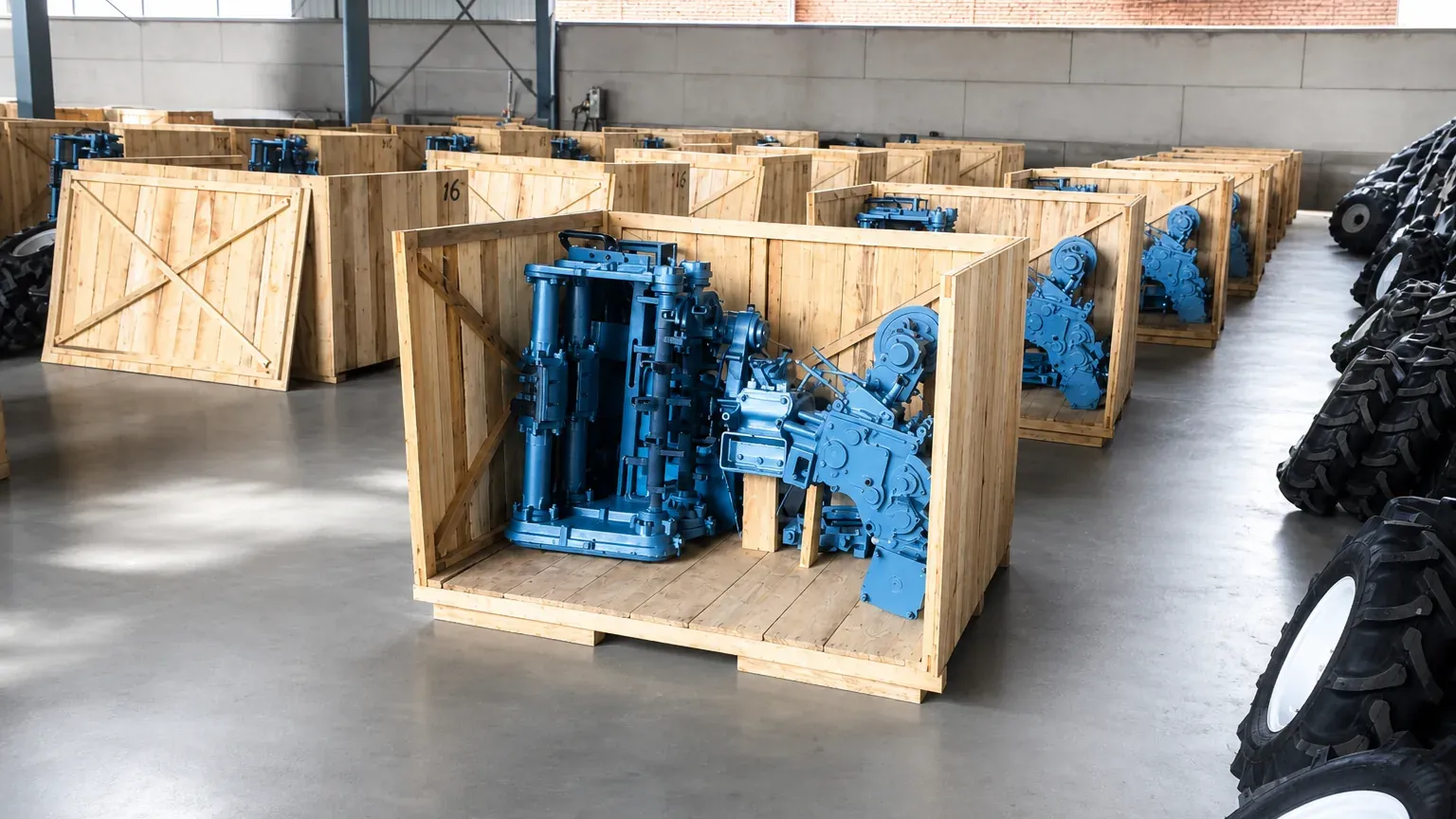
Stocking layers in physical form: complete wheel and chassis units at one depth, the fast-moving lines that go with them at another. The crate is not the unit of decision — the layer is.
The reorder rhythm that keeps the kit complete
The difference between a kit and a pile of parts is what happens after the first season. A kit has a trigger; a pile has a memory.
Set the trigger on the clock each line runs on. Hours-driven lines get replaced on accumulated work — and the interval is not something to invent: the two-wheel tractor training manual prepared by the International Maize and Wheat Improvement Centre and the International Livestock Research Institute states that it "is recommended to use the maintenance schedule provided in the operator's manual, which is the best source of information regarding equipment maintenance", and its own schedule works in bands of 100, 500 and 1,000 working hours. Calendar-driven lines get replaced on the date, whether or not the machine ran, and that includes anything that has been in your own store since the last shipment. Two triggers, two columns, one list. A single "reorder when low" rule fails on exactly the two cases that matter: the line nobody touched all season but that has aged out, and the line that looks plentiful until you count it against the machines already sold.
Keep three records and the trigger maintains itself. A machine record per platform configuration in the market, so you know the population a line serves. A consumption record per part line — what went out, to whom, and on which clock — so next season's fast-moving depth is a calculation instead of a guess. And a document record of what each order contained, because the paperwork that travels with a parts shipment is the same paperwork that lets you claim a shortage; the packing and shipment documentation side of that is worth reading before the second order, not after the first dispute.

A parts reorder does not end at the supplier's dispatch note. Carton numbering, marks and packing lists are part of the same list — the one that tells you a shipment arrived complete.
Then review it once a season against the market rather than against the last order. Which configurations gained machines? Which line has now failed twice in the same position, which is a signal about a cause rather than about stock? A list nobody reviews is a list of what used to break.
For a distributor who has not yet settled which platform the market needs, the field-conditions selection guide is the better starting point than a parts list: the field comes first, and the kit follows it.
The safety rules that belong with the kit
This is not a boilerplate paragraph bolted onto a purchasing article, because the parts in these five groups are exactly the parts that are reached through guards, under covers or inside a machine that is still under power.
The UK Health and Safety Executive's guidance on working safely with agricultural machinery puts it in its Safe Stop sequence: before anyone carries out maintenance, adjustments, or deals with a blockage, the handbrake goes on and you "make sure the controls are in neutral (equipment made safe)" — then the engine is stopped, the key removed, and the power isolated. It also names "poor maintenance" among the causes of fatal accidents on these machines, alongside guards that are missing or defective; the same guidance is blunt that you should not run a machine with its guards removed, and that they go back on before it runs again.
Penn State Extension's summary of agricultural safety and machinery law makes the same point from the regulatory side: power is shut off before work on a machine, and drive and nip points stay guarded. For a distributor this is a kit instruction as much as a workshop one — the parts you sell to a market are fitted by someone in that market, and the difference between a blade change and a serious injury is whether the machine was stopped, immobilised and de-energised first. If a kit ships with any document at all, that procedure belongs on it.
FAQ
How many parts should a wear parts kit contain? There is no correct number, and any answer in the hundreds should be treated with suspicion. The working answer is one line per system at minimum, then a quantity set by how many machines each line serves. Start with five lines — one per group — give the fast-moving ones depth, and let the first season's consumption records set the rest.
Should the kit be ordered with the machines or separately? With them, wherever the commercial terms allow. The FAO guidance is to review parts availability with the supplier at the point of purchase and hold at least one of each of the critical items from the start — the same shipment, the same documentation, the same freight. A later order is a second transaction with its own lead time, and it usually arrives after the first machine has already stopped.
How do I avoid ordering the wrong part for a configuration? Settle the configuration before the part. State the platform, the tilling-width arrangement, the blade count if a tiller part is involved, the wheel and tread setting, and the position inside the system the part occupies. Where the supplier can give you an illustrated parts breakdown, use its figure and item numbers as the language for the whole list, so both sides are describing the same coordinate.
Does stock keep indefinitely? No, and the items that expire are usually the cheap ones. Rubber hardens in storage, gaskets and seals take on moisture, fuel and hydraulic lines age, and oil absorbs water while a machine waits for the season. Store seals, belts and gaskets as you would fit them to a machine — dry, uncompressed, out of sunlight — and treat the date of receipt as the start of the clock, not the date of fitting.
Do we need to hold complete assemblies as well as individual parts? Hold them deliberately rather than by default. Complete assemblies — a gearbox, an axle, a wheel set — belong in the long-lead layer, at one unit per platform configuration, for two reasons: the failure they answer cannot wait for a replenishment cycle, and a customer facing a full harvest cannot be kept running by a bearing if the housing around it is gone. That is a decision to be taken with the numbers in front of you, not a line to be added to every order.
Bottom line
A power tiller wear parts kit is not a selection of parts. It is a stock table with three axes — five systems, two replacement clocks, three stocking layers — and it is only complete when the identity of every line has been agreed with the supplier in a form both sides can read back. Build it against the machine configuration you actually sold, open the parts conversation at the point of purchase rather than at the point of failure, and put the safe-stop procedure on the document that ships with it.
If you want to work through a kit list against your own market — platforms, configurations, ground conditions and the repair turnaround your customers expect — bring those numbers to us and we will answer on the configuration rather than on the part. The contact page is where a specification turns into a quotation.