
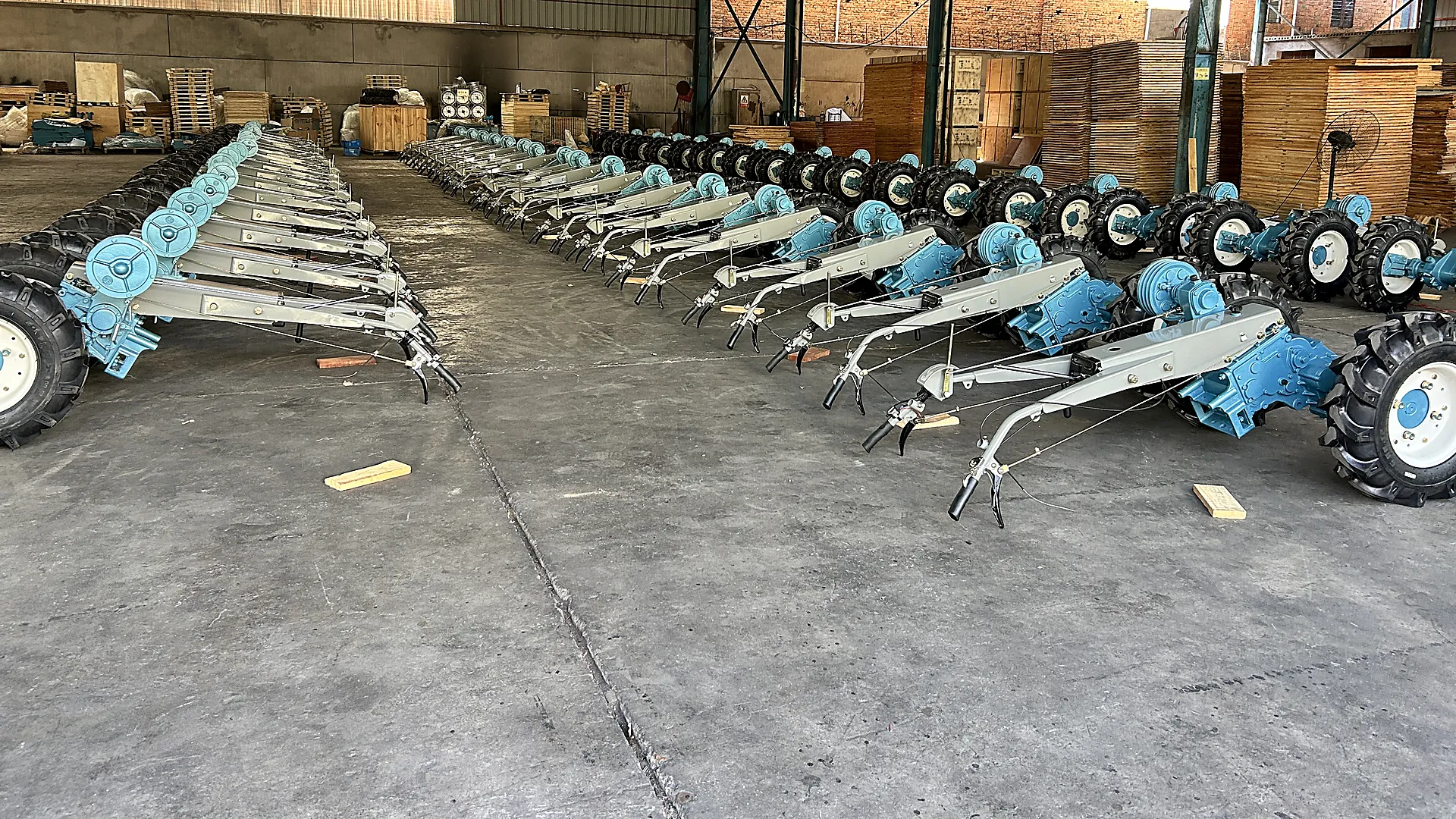
The paddy field vs dry land tiller question is usually answered as a machine choice. In practice it is a setup choice: the same two-wheel platform is configured differently in each condition, and the difference starts at the wheels rather than at the engine. The chassis, the gearbox and the engine class stay as they are. What changes is a short list of decisions made on the axle, on the blade shaft and on the back of the machine — which wheel or cage goes on, where the wheels sit on that axle, which rotor speed and blade form the tiller runs, how much weight the machine carries, how wide and how deep it works, and which implement is fitted.
That list is what this article covers. It is published by SUNTEC Machinery, which builds compact two-wheel power tillers and walking tractors, so the two-wheel side of the comparison is our own product category. The sections where a heavier four-wheel machine is genuinely the better answer are written at full length rather than hedged.
One note on words before the detail: two wheel tractor, walking tractor, hand tractor and power tiller are used across markets for overlapping machine classes rather than for clearly separate products, and this article uses them in that overlapping sense.
One boundary on scope: this page assumes the machine class is already settled. If you are still deciding which platform suits a particular farm, that decision comes first and it is a different question — see build a field-selection brief for one machine. This page starts after that, at the configuration.
Two field types, two different traction problems
A puddled paddy is a machine working on a soft, saturated layer that sits above a compacted plough pan (hardpan). That pan is defined in the CTA Agrodoks lowland-rice guide as a hard layer of soil at 15–20 cm depth, developed through continuous ploughing at the same depth; it reduces downward water loss during flooding and prevents roots from penetrating deeper, which is why the machine draws its support from that layer rather than from the loose soil above it. Above it, the soil is closer to a suspension than to a solid. Published lowland-rice practice reflects this: wet tillage is normally carried out at 10–15 cm, and it is recommended to plough with only a thin layer of water on the land specifically to reduce the power required, particularly when the work is done with draught animals or two-wheel tractors (CTA Agrodoks, Improving lowland rice cultivation).
Dry upland is the inverse situation. The surface carries the machine easily, and the constraint moves to the tool: dry, cohesive soil resists penetration, and the machine has to develop its pull from the drive wheels biting into a firm surface. That difference shows up in measured field data. In a rotavator trial comparing dry and wet land preparation, wheel slip ran at 1.22–2.10% on dry land and 3.90–5.88% in wetland conditions, and slip increased as soil moisture increased (Aman et al., Performance evaluation of tractor drawn rotavator for dry and wet land preparation, 2020).
What the field does to the machine | Puddled paddy | Dry upland |
|---|---|---|
What limits the work | Bearing capacity of the soft layer above the hardpan | Draft and penetration resistance of the soil |
What the drive wheels must do | Float, and keep grip without sinking | Bite, and convert load into pull |
What extra weight does | Adds sinkage and rolling resistance | Adds thrust, up to the point slip stops falling |
What water does to the tool | Turns the tilled layer into a mud that must be mixed and levelled | Removes water as a lubricant; breaking dry clods takes power |
What the job needs from the setup | Flotation, mud clearance, slow passes, shallow working depth | Traction, penetration, wider and faster passes |
Two field types, two different problems — and the setup list is where they stop being the same machine.
Paddy field vs dry land tiller setup: the short answer
A paddy-field tiller setup leans on flotation and mud clearance: cage or anti-skid wheels, a light chassis, a working width the soft layer can carry, slow passes, and a tiller that keeps the mud moving rather than packing it. A dry land tiller setup leans on penetration and load: traction tyres or anti-skid wheels that bite, ballast where the machine is designed to take it, a deeper first pass, and a plough or tiller matched to the soil rather than to the calendar. That distinction is why a power tiller for paddy field work, a walking tractor for paddy field work and a power tiller for dry land are all configured from the same catalogue of parts, but not to the same settings.
Paddy field preparation and dry-land preparation differ in more than the season. The table below is the machine-level version of the answer, and it is the reference the rest of this article expands.
Setting | For puddled paddy | For dry upland | Confirm before ordering |
|---|---|---|---|
Traction device | Cage or anti-skid wheels for flotation and grip | Agricultural lug tyres for penetration | Which wheel package the platform is quoted with |
Wheel spacing | Narrow enough to work between bunds | Set to the row or furrow spacing, and to the trailer | Tread range and positions; trailer track |
Rotor speed | Slower passes; puddling quality falls as forward speed rises | Faster working to cover ground, within the engine's limit | Which speed settings exist and how they are changed |
Blade form | Form that clears wet soil from the rotor | Form that cuts and shatters a firm seedbed | Which blade set ships with the quoted tiller |
Machine weight | As light as the duty allows | Weight is useful — where the platform accepts ballast | Chassis weight without engine; ballast policy |
Working width | Width the soft layer can carry; often the narrower option | Width matched to rows and headland | Documented width range and blade count |
Working depth | Shallow primary and secondary passes | Deeper first pass, then seedbed passes | Target depth for each operation |
Drive and seals | Continuous wet duty around the blade shaft and final drive | Grit and dust duty | Sealing specification and service intervals |
Implement | Puddling and levelling tools; tiller | Plough and tiller matched to the soil | Documented implement list for the platform |
Transport | Wet machines often still have to travel between plots | Trailer and road transfer are routine | Trailer specification and wheel/road fit |
Tyres or cage wheels: the first decision
This is the setting that changes first, and on wet ground the answer is well established. In paddy fields, open flat-lugged cage wheels are more popular than rubber tyres because they deliver both higher traction and better floatation, and the same body of research records that tractive power reaches a maximum at roughly 15% wheel slip before falling away again as slip increases (Soekarno and Salokhe, Agricultural Engineering International: the CIGR Journal, July 2003, on cage-wheel performance in wet clay soil).
On firm, dry upland the same cage is the wrong tool. Grip there comes from lugs pressing into a surface that can support the load, and a cage wheel spreads the machine's weight over a small area with a hard ride and no flotation benefit to collect. Agricultural lug tyres, run at a sensible pressure for the soil, are the dry-land starting point, and a tiller for wet field work is the same machine with the other wheel package fitted.

Customer photograph: the wheel and tiller side of a two-wheel walking tractor.
Two things make this decision harder than it looks in a catalogue:
Transport between plots. A machine that has to pull a trailer along a road or a farm track needs rubber. If the working season is split between puddled and dry ground and the same machine does both, the wheel swap is a seasonal event, not a one-off purchase decision — and it is worth confirming how the swap is done on the specific machine before you count on it.
Slip is the measurement that tells you whether you got it right. Slip rises as soil moisture rises, which means the wet-working machine loses a larger share of its power to turning the soil rather than moving it. Slip is measured by comparing the distance a drive wheel covers in a set number of revolutions under load against the same number of revolutions on firm ground. If the wet-machine number is drifting upward through the season, the wheel setup, the ballast or the pass depth is wrong — not the engine.
The documented implement list for the GN12 / Super 12 platform includes anti-skid wheels, and the documented tyre size for the MUBOTA M80 chassis is 5–12 with an adjustable 390–780 mm tread. Which wheel package is actually quoted is confirmed per order, because it depends on the field, not on the model number.
Wheel spacing and track width: fitting the machine to the row and the bund
Track width is the setting most often treated as a fixed specification and most usefully treated as an adjustment. The two documented platforms provide a range rather than a single figure: the MUBOTA M80 chassis runs a 390–780 mm tread, and the GN12 / Super 12 chassis offers five tread positions at 810, 750, 690, 630 and 570 mm with 210 mm of minimum ground clearance — the GN series walking-tractor tread settings are published on the platform page. On a machine with those numbers, "which machine" and "which setting" are two separate conversations.
In paddy, the tread has to fit between bunds and stay off the bund shoulders. A narrow tread keeps the machine inside the worked corridor and disturbs less of the field; on some layouts it is the only setting that lets the machine enter at all. Ground clearance matters for the same reason: a low chassis drags in mud and slurry.
On dry land, where a walking tractor for dry land is usually earning its keep on row crops, the tread follows the crop rather than the field. Where the work is inter-row cultivation or orchard work, the wheels should run in the furrow or between rows and leave the crop row alone. Where the machine pulls a trailer, the trailer track and the implement width both have to match the tread you selected — a wheel setting that suits the field can still be wrong for the equipment behind it.
Record three numbers before choosing: the narrowest gap the machine must pass, the row or working spacing, and the track of anything it has to tow. Then ask whether the tread will be changed between seasons; if it will, put it in the quotation so the second-season setting uses the same parts as the first.
Rotor speed and blade form: the wet cutting job and the dry cutting job
The two field types are not asking the tiller to do the same job. In a paddy, the objective is to break the soil into a mix that will hold water and keep weeds from re-establishing; the puddling operation reduces percolation loss and buries weed growth under the mud, and it is normally finished with a rake or levelling board to smooth and level the mud layer (CTA Agrodoks, the lowland-rice guide cited above). On dry upland the objective is a seedbed: cut, lift and shatter the soil so seed can be placed into a firm, fine tilth.
Blade form follows from that, and power tiller blades are not one universal pattern. Published comparisons of blade shapes for rotary tillage of wet rice soil report roughly a 30% power reduction with a C blade against an L blade, for only a small difference in forward thrust — about 23.74 N per bank, which the same work judges not worth the power (Aman et al., 2020, reporting Benny et al., 1970; the dry-versus-wet rotavator trial cited above). Put plainly: the L blade is the shape that pushes hardest, and the C blade is the shape that costs least power. The same paper notes that a rotavator's working depth is adjustable to about 125 mm, while wetland primary ploughing practice more commonly runs 10–15 cm — the two depths belong to two different operations, not to one number.
The implication for setup is a question rather than a rule: in a wet field, where the machine is already paying for traction, the lower-draw blade shape is worth asking the supplier about, and on dry breaking work the shape that develops thrust is doing the job the field is asking for.

Customer photograph: the rotary tiller mounted on a two-wheel walking tractor, with the blades visible below the housing.
Rotor speed is a mechanical setting, not a driving habit. On the MUBOTA M80 chassis, the rotary drive is documented with four tilling-speed settings, two of which are changed by moving the chain onto a secondary sprocket — so wet duty and dry duty can be set at the machine rather than worked around by the operator. The tilling-speed arrangement for a specific platform and tiller is confirmed in the quotation. How power, working width and gearing are specified and read is covered separately in how power, working width and gears are specified.
Forward speed belongs in the same list. Puddling quality falls as forward speed rises, which makes wet preparation a slow-pass operation by design. The cage-wheel traction study cited above ran its soil-bin tests at 0.87 m/s — about 3.1 km/h — a speed it describes as common for two-wheel tractors, and that order of speed is what the wet setup is built around.
Weight and ballast: why the same machine is set up lighter in water
Weight works in opposite directions in the two conditions, and this is where most configuration mistakes originate.
On dry, firm ground, load on the drive wheels is converted into pull. Adding weight — cast weights, liquid ballast where the machine is designed for it — reduces slip and increases the draft the machine can sustain, until the point where the extra rolling resistance costs more than the extra grip returns. That is a legitimate dry-land setup step on machines built to accept it.
In a wet field, the same weight stops buying grip and starts buying sinkage. Published lowland-rice guidance is direct about the consequence:
Moreover, if the soil is kept wet and soft, then all equipment – especially larger equipment – will tend to sink, creating problems of mobility, soil compaction and tillage depth. >— CTA Agrodoks, Improving lowland rice cultivation
The same source recommends that smallholder rice farms move from hand hoeing to animal traction or two-wheel tractors rather than jumping straight to four-wheel machines, and notes that four-wheel tractors are not a viable option for very small rice fields (CTA Agrodoks, the lowland-rice guide linked above).
The practical translation for a configuration discussion: for paddy work, the lightest platform that can carry the chosen implement is usually the better answer, and any ballast is treated as removable. For sustained dry tillage, the heavier platform has a reason to exist. The documented chassis weights reflect that ladder — the M80 power tiller chassis at 179 kg without the engine, and the GN12 / Super 12 chassis at 470 kg without the engine. Both are chassis figures, not machine weights: the engine, the wheels and the implement all add to them, which is why the decision has to be made on the whole package rather than on the bare chassis number.
Working width and tilling depth: what actually changes
Working width is a productivity number in a dry field and a carrying-capacity question in a wet one. A wider cut covers more ground per pass and demands more torque; in a paddy, that torque demand lands on a surface with less bearing capacity, which is the standard way a working wet machine becomes a stuck one. Slow, narrower and repeated usually beats fast and wide when the field is soft.
The documented public working-width range on both current platforms is 480 mm or 600 mm, but the two workbooks record it differently. The GN Series workbook records the 600 mm configuration, with 18 or 24 blades depending on the tiller setup; the M80 workbook records 480 mm with 14 blades as standard, and 600 mm with 16 blades as the maximum. A buyer reading one table is therefore reading one configuration rather than the whole range — confirm the width and the blade count for the quoted tiller in the quotation.
Depth has to be stated per operation, not per machine. Wet preparation and dry seedbed preparation sit at different depths, and a single "tilling depth" figure cannot serve both. What the field allows — narrowest entrance, row spacing, turning area — is what the tread and width settings have to satisfy, so record it as a configuration input rather than leaving it to the quotation. Two working notes for the two conditions: planning paddy-field work with a two-wheel machine and planning dry-land cultivation work.
Final drives and seals: what to ask instead of assuming
A wet-working tiller runs its blade shaft, tiller housing and final drive inside an abrasive slurry. A dry-working machine runs the same parts in grit and dust. Those are different duty cycles, and they consume different parts.
This section deliberately contains no limits, because there is no honest universal number for mud depth, sealing pressure or service interval that applies to every configuration. What belongs in the enquiry instead is a short set of questions:
- Which seals and which lubrication specification are used for continuous wet work on this machine?
- What service interval does the manufacturer state for each of the two conditions?
- Which wear parts are expected to be consumed faster in wet duty, and which in dry duty?
- What does the machine need between seasons — wash-down, corrosion protection, storage procedure?
A distributor who asks these four questions before placing an order is in a different position from one who discovers the answers in the second season.
Implements: what a wet field needs that a dry field does not
The wet field needs a finishing implement that a dry field does not. Puddling is completed with a rake or a levelling board that buries remaining weeds and levels the mud layer; the dry-land equivalent is a sequence of breaking and seedbed passes rather than a levelling operation (CTA Agrodoks, the lowland-rice guide linked above).
Walking tractor attachments are not a single list across a range, and for the two documented platforms the lists differ. It matters that they are kept apart rather than merged into one platform-level list:
- MUBOTA M80 — documented as configurable with a rotary tiller, a single-furrow plough and a small trailer.
- GN12 / Super 12 — documented as configurable with a rotary tiller, a double-furrow plough, anti-skid wheels and a small trailer. A seat or ride-on arrangement is also referenced; whether it is standard or optional is confirmed per order.
The two first-party specification sheets are the reference documents for the chassis and engine side: the M80 and RT90 platform download and the GN Series platform download. Read them as chassis and engine references, and confirm the implement package and the width configuration in the quotation rather than inferring them from the sheet.
For a dealer, the overlap is the interesting part. A rotary tiller and a trailer appear on both lists; that overlap is what lets one platform serve a market where some customers work puddled ground and others work dry. The implements that appear on only one side are the ones that decide whether a single machine can cover the season or whether the market needs two configurations in stock.
Seasonal reconfiguration: moving one machine between the two conditions
This is the part of the decision that is easiest to leave out of a quotation, and it is where a distributor's margin and a farmer's second season are actually decided.
The changes divide into two classes, and keeping them apart is the whole point:
Bolt-level and reversible — decide per season. Traction device (tyre against cage or anti-skid wheel), tread position on the axle, rotor speed setting, blade form, working width, ballast, implement, and trailer specification. These are the settings that make the same machine a paddy machine in one month and a dry-land machine in another.
Not a field change — decide once. Chassis class and weight, gearbox type, engine class and the machine's drive layout. Changing these means changing machine, not configuration.
A practical sequence for a market that works both conditions:
- Establish the primary duty — which condition the machine will spend most of its hours in.
- Choose the platform on that primary duty, then check the secondary duty against its documented range.
- List the settings that will actually be changed seasonally, rather than assuming the operator will change everything.
- Get that list documented in the quotation, so the parts needed in the second season are the parts specified in the first.
- Confirm, on the machine in front of you, how each change is performed and whether any of them requires tooling that the dealer will not have in the field.
The length of the reversible list is what separates a market that can be served by one machine from a market that needs two. A dealer who knows that length can price a second season; a dealer who assumes it can be surprised by it.
Where a two-wheel platform differs from a four-wheel one in each condition
The two-wheel side does not win everywhere, and it is worth being precise about where it does not.
Work rate. On any measure of area covered per hour, a four-wheel machine is faster. Published figures for lowland rice place a two-wheel tractor at 2–3 times the work rate of animal traction, and a four-wheel tractor at 4–8 times the work rate of a two-wheel tractor; a four-wheel tractor is also more expensive to buy and to maintain (CTA Agrodoks, the lowland-rice guide linked above). Real mechanisation patterns look nothing like a single template, and the two-wheel class is not marginal in them: in Bangladesh, over 80% of tillage operations are mechanised and about 90% of those are performed by two-wheel tractors — a class that is not even counted in the standard tractor statistics the same review discusses (FAO, Mechanization for Rural Development: A review of patterns and progress from around the world, section 4.4.1). If the land is open, dry, contiguous and measured in tens of hectares, a four-wheel machine is the productivity answer, and a two-wheel machine is a compromise.
Wet ground. The advantage reverses on bearing capacity rather than on power. Soft, saturated ground penalises the heavier machine first: larger equipment tends to sink, which limits mobility, tillage depth and can compact the layer underneath. That is why the same published guidance steers smallholder rice systems toward two-wheel machines rather than straight to four-wheel ones, and it is consistent with FAO's own reading of the business case for motorised mechanisation, which records that switching from animal-drawn ploughs to power tillers in intensive wetland rice systems in Asia produced major labour cost savings in land preparation, and which treats machinery tailored to small-scale production as a condition of that case (FAO, The business case for motorized mechanization, SOFA 2022).
Turning and access run the other way, and this is where the two-wheel platform earns its place in a smallholder system. A two-wheel machine turns in its own length and fits through gaps a four-wheel machine cannot use. In a bunded paddy the headland is productive ground, and every extra metre of turning circle is crop that gets driven over. On dry, open plots the same advantage largely disappears.
The honest decision rule is not "which machine is stronger". It is which limit the field imposes first — bearing capacity and access, or draft and work rate. Puddled ground sorts by the first pair; open dry ground sorts by the second.
What this article will not claim
Configuration guidance is only useful if its edges are visible. This article deliberately does not state:
- prices, minimum order quantities, lead times, warranty terms or certification status for any configuration;
- compatibility between this machine and any other manufacturer's machine, parts or model numbers;
- production or export volume figures;
- an independent specification for any platform other than the two documented above;
- universal limits for mud depth, slope, sinking depth or acceptable wheel slip — those follow from a specific machine, a specific setup, a specific operator and a local safety assessment;
- that every combination of wheel, width, blade and implement is available at all times.
Working width in this article means the confirmed public range of 480 mm or 600 mm; the GN Series workbook records the 600 mm configuration, while the M80 workbook records 480 mm as standard and 600 mm as the maximum. Any figure that is going to be written into a purchase order should be confirmed on the quotation, against a described field.
A configuration checklist for distributors and dealers
Ten items, in the order they are usually answered. Copied into an enquiry, this becomes a configuration request a factory can quote against.
- Field profile — puddled paddy, dry upland, or both; approximate area of each.
- Water regime — irrigated, rain-fed, standing water depth at the time of work, and how long the ground stays soft.
- Access and geometry — the narrowest gap, bund width and row spacing that the tread position and working width have to satisfy, plus the turning area at the headland.
- Primary duty — which condition the machine will work most, expressed as a share of the hours rather than as a preference.
- Traction device — the wheel or cage package required for each condition, and whether it will be swapped.
- Wheel spacing — the tread setting required for each condition, plus the track of any implement or trailer in use.
- Rotor and blade — the blade form and the rotor speed setting required for each condition.
- Width and depth — the target working width and the target depth per operation, given separately for wet and dry work.
- Ballast — whether weight will be added for dry work, and how, on this machine.
- Service and wear — the sealing specification, the service interval, the expected wear items and the between-season procedure for each condition.
If the field profile is described this way, the answers stop being guesses. Matching the machine, the power range, the working width and the implements to real field conditions is the whole point of the platform discussion.
Send the completed profile and ask which settings on your intended machine are still open — request a configuration review. The rest of the field-condition guidance for distributors and dealers sits under the power tiller field-condition selection guides.