
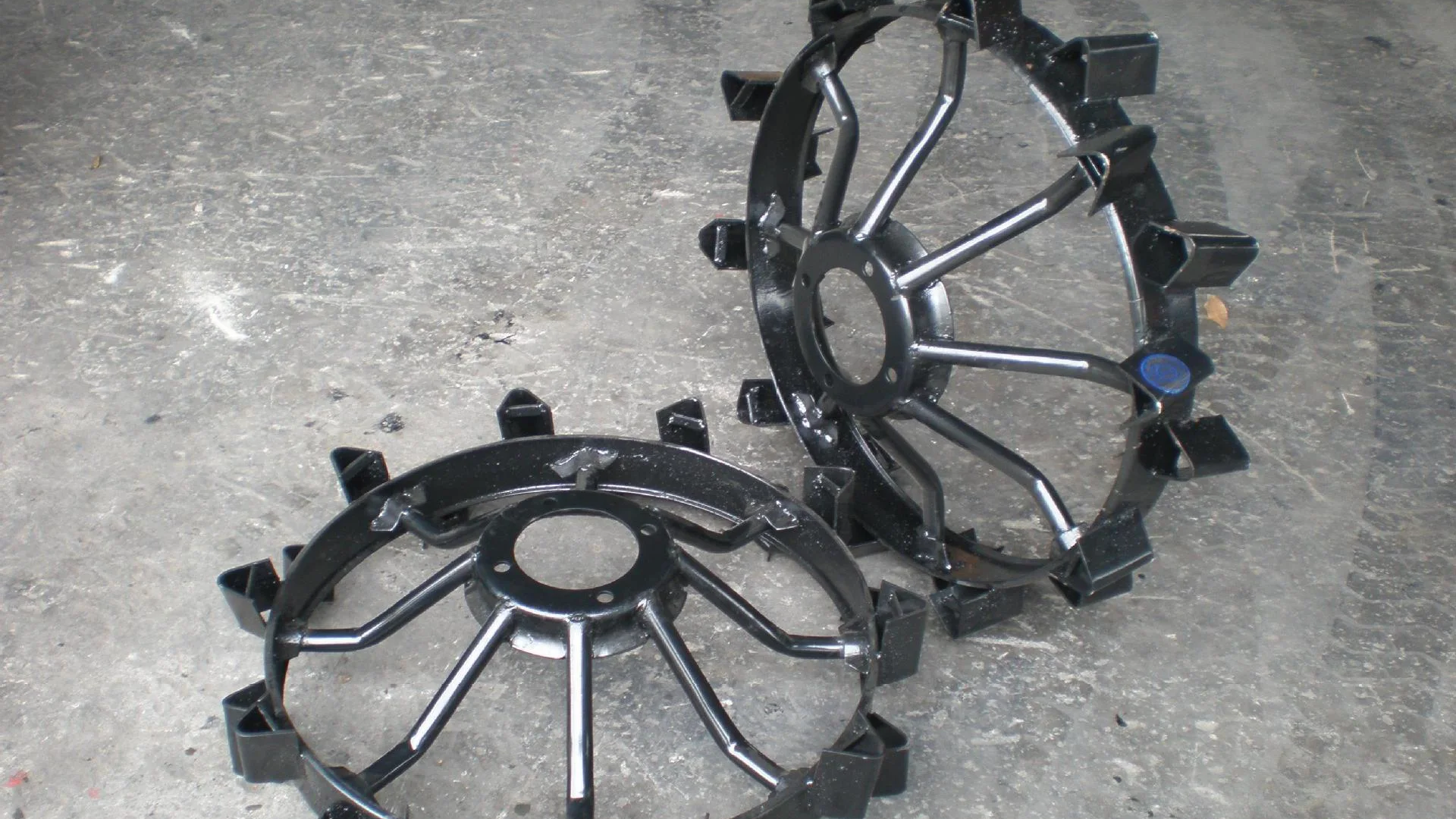
Spike wheels and wheel extensions are two different fixes on a two-wheel tractor. A spike wheel — also sold as an anti-slip wheel, an iron wheel or a cage wheel — replaces the rubber drive wheel so the machine can bite into soft, wet or flooded ground. A wheel extension moves the wheel outboard of its hub and changes track width. One buys grip; the other buys position.
This page is written by SUNTEC Machinery, which builds compact two-wheel power tillers and walking tractors, so the two-wheel side of this page is our own category. It is also why the traction mechanics below are cited to third-party research, and why the fitment section makes no compatibility claim for any specific wheel, tyre or extension: on this class that data is confirmed against the actual machine, per order.
What "spike wheels" and "wheel extensions" mean on a two-wheel tractor
Search either term in an English-language search engine and you will be shown car parts: alloy rims with decorative spikes, valve-stem extensions for a pickup's dual wheels, and wheel spacers for trucks. None of that is the hardware this page is about — and the gap between the meanings is how a distributor ends up ordering the wrong item off a phrase that looked unambiguous on a purchase list.
On a power tiller, a walking tractor or a two-wheel tractor — one machine class carrying four names depending on the market, which is why these platform pages stay distinct rather than duplicating per name — both terms describe parts of the drive end of the machine. If you are still choosing between our two platforms, the platform-level configuration guides walk through the machine as a whole; this page stays on the wheels.
A spike wheel is a wheel. It is the drive wheel built in steel: a rim carrying projected lugs or teeth, mounted on the drive axle in place of the rubber tyre, so that what meets the soil is a row of teeth rather than a rubber carcass.
A wheel extension is not a wheel at all. It is a spacer or adapter that moves an existing wheel further out from its hub. Fit one and the machine runs wider with exactly the same wheels still on it.
That distinction is the whole of the article. Everything a buyer gets wrong about these two items comes from treating them as one upgrade: one changes what the machine does to the soil, the other changes where the machine's wheels sit on the ground. They solve different problems, they are ordered separately, and only one of them is a response to a wet field.
One hardware family, four names: spiked, anti-slip, iron and cage wheels
The naming is the second problem, and it costs real time at the counter. The same steel wheel is sold under at least four names in the export market, and the names describe the shape of the rim rather than a specification you can order to.
What it is called | What the hardware actually is | What it changes |
|---|---|---|
Spike wheel, spiked wheel | Steel drive wheel whose lugs or teeth project from the rim | Grip: teeth penetrate soft ground instead of riding on top of it |
Anti-slip wheel (防滑轮) | The same steel wheel family, named for the outcome rather than the shape | Grip: removes the slip that a smooth rubber carcass develops in wet soil |
Iron wheel, steel wheel | Again the same family, named for the material | Grip, with a much harder, heavier wheel than a pneumatic tyre |
Cage wheel (also called a paddy wheel in some markets) | An open spoked steel wheel that the soil passes through as it turns | Grip and flotation: it keeps turning in mud a solid rim would pack and stall in |
Wheel extension (wheel spacer, axle extension) | Not a wheel. A spacer or adapter between hub and wheel | Position only: track width, not grip |
Two consequences follow from that table.
First, the names do not tell you what you are buying. "Spike" and "cage" describe two shapes of the same idea, and "anti-slip" and "iron" describe an outcome and a material. A specification line that says only "anti-slip wheel" is a category, not a part. Ask for the wheel's overall diameter, the number and form of the teeth or the cage, how many bolts hold it to the hub and how far apart those bolts sit, and the tyre size the wheel replaces.
Second, the vocabulary collides with other industries. In an English-language search "cage wheels" also returns pet cages and baseball cages, and "paddy wheels" returns a die-cast toy car. That is not a curiosity — it is why a distributor ordering by name from a translated list should expect the supplier to come back with questions. Ordering by measurement instead of by name removes the problem in one step.
Our own product documentation for the GN series lists the anti-slip wheel (防滑轮) among the implements a GN12 platform can be configured with, alongside the rotary tiller, the two-furrow plough and the small trailer. It is a documented configuration line, which is precisely why fitment for a specific order is confirmed against the machine rather than assumed from the name. The wheel is one member of that family — how attachments combine into a working package covers the rest of it.
What a spike wheel does that a rubber tyre cannot

A pneumatic tyre develops its grip by pressing a contact patch onto the soil and shearing the soil beneath it. That works while the soil has the strength to resist. In a wet clay soil, or in a flood-irrigated paddy, it does not: the tyre cannot develop enough shear, so the wheel slips, and as it slips it also sinks, and the two effects feed each other. The steel wheel attacks the same problem from a different direction — its teeth concentrate the drive force over a small area and reach down through the soft layer, so the machine pulls against soil that is still strong enough to push back.
That mechanism is measurable. A traction study on a 4.85 kW power tiller cultivator working clay soil in wet-land and flood conditions tested two cage-wheel designs and reported a maximum tractive efficiency of 72.91% and 69.86% for the two wheels in puddle soil, with maximum draft of 1192 N and 1039 N in flood conditions (BIBECHANA 13 (2016)). Among the outcomes that paper reports for these wheels are maximum draft, tractive efficiency and wheel slip — on this ground, slip is a first-order result rather than a footnote.
The soil side of the same equation shows up in a study of tillage in dry and wet land, where wheel slip ranged from 1.22% to 2.10% in dry land conditions and from 3.90% to 5.88% in wetland conditions, with the authors noting plainly that as soil moisture increased, wheel slip increased too (Phyto Journal 9(6S), 2020). Read the machine before you read the number: that study is a tractor-drawn rotavator — a four-wheel machine, not the two-wheel class this page is about. Its value here is that it isolates one variable: the ground the machine is standing on.
Four-wheel tractor with a rotavator, not a two-wheel machine.Dry land: 1.22–2.10% wheel slip. Wetland, same implement, same field: 3.90–5.88%.Change the ground and the same drive train slips three times as much.
Read the two studies together and the practical consequence is straightforward: wheel slip is a property of the soil as much as of the wheel. A machine asked to work a wet paddy on pneumatic tyres will lose a large share of its available pull to slip, and no amount of driving skill recovers it. What a spike wheel or a cage wheel does is move the point of contact down to soil that has not been weakened by standing water.
There are costs. Steel wheels are for soil, not for road: on a hard surface there is nothing to bite into and nothing to gain, and a machine wearing them is not one you can take onto a road — so a buyer who also needs transport work will need the rubber wheels back for it. They are also heavier than a pneumatic tyre, and far less forgiving of stones and roots. The wheel set is a working configuration, not a permanent conversion — see planning paddy-field work with a two-wheel machine for how the rest of the machine is set up for the same conditions.
What a wheel extension changes — and what it cannot change

Track width is the distance across the machine, measured between the centre lines of its two drive wheels. On a two-wheel tractor that distance is a platform setting, and a wheel extension is one of the ways to change it: the wheel is unbolted and moved further outboard of the hub, with a spacer or adapter taking up the new distance. The wheel itself does not change.
What it cannot change is grip. Two otherwise identical machines running the same wheel at two different track widths have the same traction at each wheel — the drive force available at the soil is set by the wheel, the load on it and the soil, none of which an extension touches. This is the single most common ordering mistake in the category: a buyer with a machine that slips in a wet field concludes that the wheels are too narrow and orders extensions. The machine runs wider afterwards and slips exactly as much. A wet-field traction problem is solved with a different wheel; a track-width problem is solved with a different position.
So what is the track-width problem? It is about where the wheels run. Row spacing varies with crop, with agronomy and with the region, and a machine locked to one track width either damages the crop it drives through or cannot work the field at all — the point a 2024 study of track-width adjustment for a field sprayer makes when it observes that fixed-track-width machines crush crops in fields with different row spacings, and that track-width adjustment mechanisms are a recognised part of agricultural chassis design (Agriculture 14(8):1247, 2024). On a two-wheel machine the same requirement shows up as four concrete questions: can the wheels run in the furrow rather than over the ridge; can they run between the rows of a standing crop; can they clear a bund or terrace edge without catching it; and does the machine's track have to match a trailer or an implement that runs behind it.
Widening is not free, and the reason is mechanical rather than commercial. Moving the wheel outboard lengthens the lever arm between the wheel and the axle bearing, so the same vertical load and drive torque arrive at the axle further from its support. How much extra the axle will take is platform-specific, which is why the maximum extension for a given machine belongs in the order conversation, not in a general rule.
What the platforms themselves publish is the honest starting point, because it is the manufacturer's own figure rather than a marketplace assertion:
Platform (as published in our specification tables) | Wheel track | Tyre | Other published figures |
|---|---|---|---|
M80 chassis | 390–780 mm | 5–12 | 7–10 hp engine options; 2050 × 710 × 1235 mm; 179 kg without engine |
GN12 chassis | 810 / 750 / 690 / 630 / 570 mm | not recorded in the table | 2950 × 980 × 1240 mm; minimum ground clearance 210 mm; 6 forward / 2 reverse |
There is one more fact a distributor should carry into the conversation, because it is the question buyers ask first and the answer is counter-intuitive. There is no standard track width to order against. ISO 4004, the international standard for track widths on agricultural tractors and machinery, states in its published abstract that it "does not apply to tractors of special types, to walking tractors, to single-axle motor-driven machines, to two-wheeled propulsion units, or to agricultural machinery of special types" (ISO 4004:1983). The machine class this page is about is excluded by name.
So the platform's own published positions — like the five listed for the GN12 chassis above — are the reference, and any wheel or extension you order has to be matched to them. The chassis row above comes off the M80 power tiller page, where the tread range and the tyre size sit together.
On the GN12 side, the tread positions and the implement list live on the same page — the GN12 walking tractor — which is the page to read when the wheel option and the position it sits in are decided together.
Paddy, dry land and road work: matching the wheel to the job
A machine is usually asked to do more than one job — a flooded rice paddy early in the season, dry land later — so the wheel set and the track setting have to be chosen together rather than one after the other.
Ground condition | Drive wheel to run | What track width has to do | Confirm before ordering |
|---|---|---|---|
Flooded or puddled paddy | Steel spike or cage wheel — the softer and wetter the soil, the more the wheel has to reach below it | Narrow enough to move between plots along the bund and to stay inside the plot edge while working | Whether one wheel set is sold as the machine's paddy configuration, and which track position that configuration is set to |
Wet but not flooded, second crop, heavy clay | Rubber tyre with deep lugs, or a steel wheel depending on how much of the season is wet | Match the track to the row or bed the machine works in | The measured row spacing, not the nominal one |
Dry land, row crops, orchard inter-rows | Rubber tyre, lug pattern matched to the soil | Fixed by the row spacing: the wheels must run in the furrow or between rows | Row spacing and crop height against the platform's clearance figures |
Hard surface and road transport | Rubber tyre only — steel wheels have no place here | As narrow as the work allows; a wider machine is a bigger machine to move and to load | Transport width, and the wheel change the job demands |
Slopes and terraces | Rubber with the widest track the platform publishes, or a steel wheel if the surface is loose | Wider where the ground is uneven or sloping, for lateral stability | Which of the published positions the machine is actually delivered in |
Two numbers belong in the same decision. Our current published product range for these platforms covers a rotary tillage working width of 480 mm or 600 mm, although the specification table currently available for download records the 600 mm configuration. Working width is what decides how many passes a plot takes; the track setting is what decides where those passes land. Both are chosen at the platform level, and how power and working width are actually specified covers the width side of the same decision.
If your market is dry-land work rather than paddy, the same logic runs through planning dry-land cultivation work.
One last piece of framing, and it is the one that decides how much of this matters commercially. FAO's global review of mechanisation records manufacturers from Asia establishing importation and distribution operations specifically for power tillers (FAO, Mechanization for Rural Development) — this is a machine class that moves through ordinary trade channels, not a niche. The practical reading for a distributor is that wheel and track configuration is a line on the order, which is why the measurement list above is worth running before the order rather than after the machine lands.
Before you order: the fitment check a distributor can run

Published specification tables for this machine class document the platform: engine options, transmission, tillage width, tyre size and the available wheel track positions. They do not tell you which wheel or which extension fits a given platform — that answer depends on the hub of the machine in front of you — so the thing that settles it is measurement, sent with the enquiry.
These are the six measurements worth taking off a machine, or asking the customer for a photograph of:
- How the wheel attaches to the hub. How many bolts hold it and how far apart they sit. Two wheels can look identical in a photograph and differ here.
- Hub bore or pilot diameter, and the thickness of the hub face where the wheel mounts.
- Axle or half-shaft diameter, and whether the wheel mounts in an inner or an outer position on it.
- Which way the wheel is dished. A dished wheel turned the other way can move the running line outward with no extension at all, so this is the first thing to rule out before buying one.
- The tyre size currently fitted — our M80 platform, for example, records a 5–12 tyre — plus whether the replacement wheel has the same rolling radius, since a different diameter changes ground clearance and the machine's forward speed in every gear.
- The published track positions of your platform, and which of them the extension or wheel you are considering actually reaches.
Then check the fit on paper before it becomes a shipment: clearance to the tiller guard and housing, to any trailer drawbar that will be used, to the handlebar and the seat where one is fitted, and — the one that gets skipped — to the operator's legs and to the ground under the widened machine.
Two more things make that checklist earn its keep. First, wheel track and tyre size sit in the platform's specification table alongside the engine and the gearbox, so a wheel configuration is a line on the order rather than an accessory bolted on later. Second, an extension that mounts on the hub can still be the wrong extension, because the constraint is the axle's capacity as much as the way the wheel attaches to it. Both are questions for the supplier, and both are answered properly when the measurements arrive with the enquiry — the power tiller procurement guide sets out what else belongs in that enquiry.
Three questions buyers ask before fitting either one
Are spike wheels and cage wheels the same thing? They are the same idea in two shapes, and not interchangeable words. A spike, spiked or anti-slip wheel is a steel wheel whose lugs project from the rim; a cage wheel is an open spoked wheel that the soil passes through as it turns, which is why it keeps turning where a solid rim would pack with mud. Both replace the rubber drive wheel. Which one the soil wants is a question about the soil and about what the machine's hub and axle will take — not about the name it was ordered under.
Will a wheel extension increase traction? Not by itself. An extension changes where the wheels run, not what they do to the soil. If a machine slips in a wet field, the fix is at the wheel and the ground, not at the hub. Order the extension when the problem is where the wheels are — row spacing, a furrow, a bund, a trailer's track, or stability on uneven ground.
Can I just order a standard track width? No, and this is the fact most worth keeping. The standard that governs track widths on agricultural tractors excludes walking tractors and two-wheeled propulsion units from its own scope, so there is no standard figure to quote to a supplier. The published positions of your platform are the reference: 390–780 mm across the M80 chassis, and 810, 750, 690, 630 or 570 mm on the GN12 chassis, as recorded in the manufacturer's own tables. Measure the machine, name the position you want, and put the wheel you are fitting next to it in the same enquiry.