
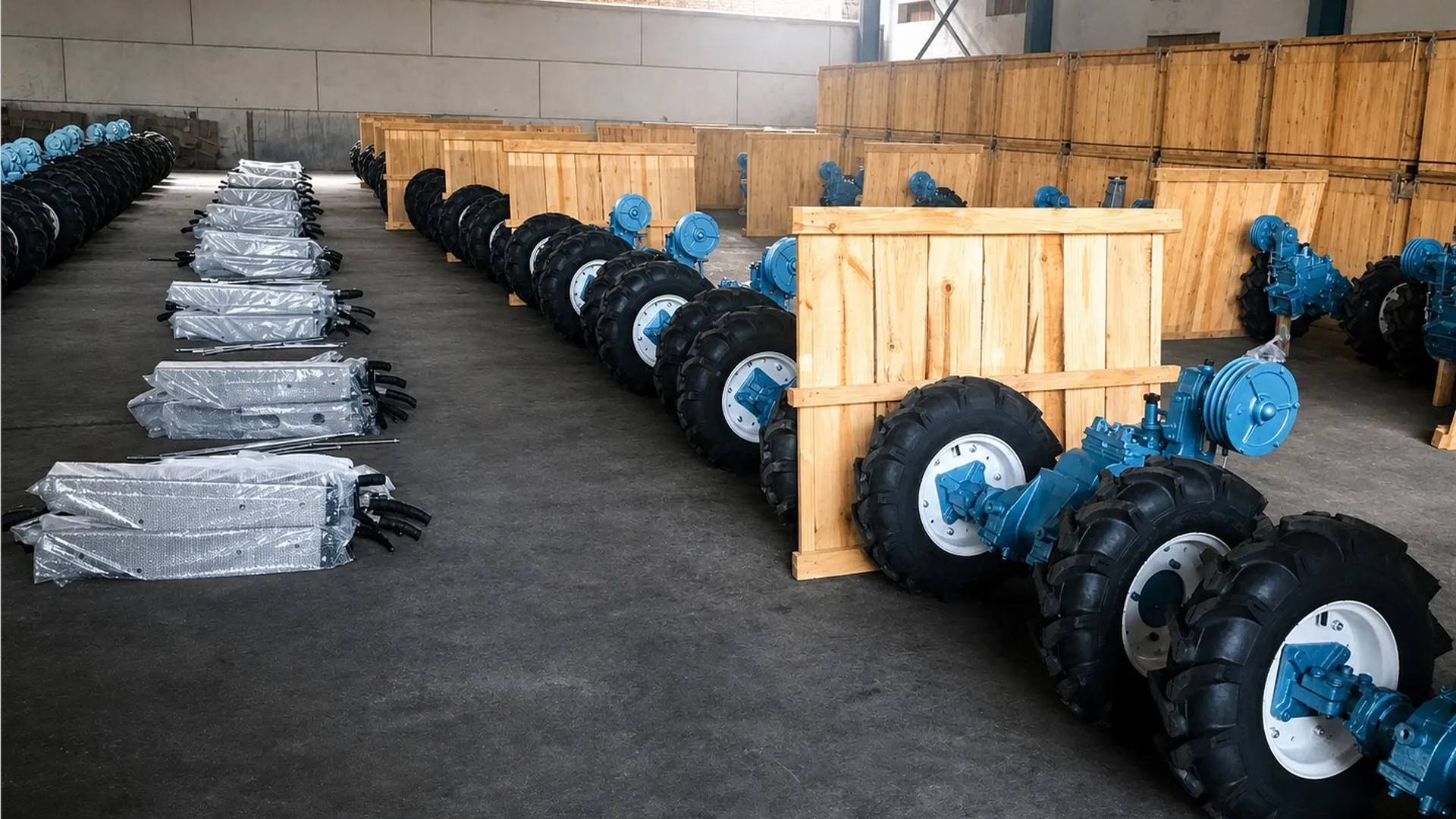
A rotary tiller for a power tiller is an interface question, not a catalogue line
A rotary tiller for a power tiller is not a part you select off a shelf; it is a tool that has to be confirmed against the machine it will be mounted on. On a walk-behind machine — sold as a power tiller, walking tractor, two-wheel tractor or hand tractor depending on the market — the tiller is an implement carried on the machine's rear mount and driven from the machine's own engine. The machine is the power source and the chassis; the tiller is the working tool that hangs off it.
That one sentence is what "compatibility" actually means here, and it is why a rotary tiller package cannot be ordered from a picture. The tiller has a drive coupling, a mounting bracket and a weight, and all three of those meet the machine at fixed points. In a farm-machinery reference on power-tiller equipment, the TNAU Agritech farm-machinery entry for a power-tiller-operated auger digger describes an implement whose drive is taken "from the engine pulley of the power tiller directly" and whose frame attaches to "the hitch bracket assembly in the rear" — the implement is defined by the machine it belongs to, not by the job alone.
This is the opposite of the four-wheel tractor world most "rotary tiller" pages are written for. There, the rear three-point linkage is standardised: ISO 730 sets the hitch dimensions — pin diameters and lower-hitch-point span — for categories 1N through 4, so an implement built to Category 1 hangs on any Category 1 tractor and a genuine cross-brand chart is possible. A two-wheel tractor has no equivalent public chart, which is why the buyer, not the catalogue, has to confirm each line.
What follows is the whole job of this article. The implements and attachments hub is where the rest of the implement range is grouped.
A rotary tiller is confirmed at the coupling, the mount and the weight — three interfaces — before a single number about horsepower is worth arguing over.
Why an M80 rotary tiller package is not automatically a GN12 package
The two platforms differ where the implement meets them. The M80 is the lighter, more manoeuvrable platform: a 7–10 hp engine range, an aluminium gearbox, six forward and two reverse speeds, and a chassis weight of 179 kg without the engine. The GN12 is the heavier walking tractor: a 12.5 hp-class water-cooled single-cylinder diesel, a cast-iron gearbox, the same six forward and two reverse speeds, and 470 kg without the engine.
Those differences — a different order of mass and a different gearbox material — are what the mounting and drive points are built around. That is why this article treats the package as a set of items to confirm against the exact machine — model and build, interface, width, rotor, weight and packing — and never as something a model name alone can settle.
M80 | GN12 | |
|---|---|---|
Engine class | 7–10 hp | 12.5 hp-class, water-cooled diesel |
Gearbox | Aluminium | Cast iron |
Speeds | 6 forward / 2 reverse | 6 forward / 2 reverse |
Weight without engine | 179 kg | 470 kg |
Working width (published) | 480 mm standard, up to 600 mm | 480 mm or 600 mm |
The two platforms are broken down further in the M80 power tiller configuration guide and the GN12 walking tractor configuration guide; the point for this article is narrower. A tool that mounts on one of these platforms is not automatically a tool that mounts on the other, and the placement of a name in a catalogue is not evidence either way.
For trade buyers, the two-wheel tractor class is already the backbone of smallholder mechanisation in the markets they serve — FAO's review of mechanisation patterns treats two-wheel tractors as a standing category in exactly these regions — which is why getting the implement attachment right is a recurring purchasing problem rather than an edge case. Extension guidance makes the same connection in plain language: walk-behind tractors are bought as a machine with their own implement set, not as a machine that later takes generic tools.
One disclosure, because it decides how you read the checks below. This article is published by SUNTEC, which manufactures the M80 and GN12 platforms used as examples. We sell one side of this transaction, so every check is written to be answered by any supplier and to work against us as well — and every answer belongs in writing before an order is placed, not in a brochure.

The six inputs to confirm before a rotary tiller package is ordered
Everything that goes wrong with an implement order goes wrong at one of six inputs. Confirm them in order, get each answer in writing, and the package can be checked before it ships instead of after it lands. None of the six is exotic; they are simply the questions a picture cannot answer.
# | Input to confirm | Why it decides the package | What a usable answer looks like |
|---|---|---|---|
1 | Machine model and build | The mount and the drive belong to a specific platform and build, not to a power class | The exact model and build, not "12 hp class" |
2 | Drive and mounting interface form | Sets how the tiller takes power from the machine and how it hangs on the mount | Whether the drive is a belt, a shaft or a dedicated drive, and the mount points it uses |
3 | Working width | Sets how much soil the rotor takes per pass and whether the machine reaches the work | A quoted width in millimetres for the configuration being ordered |
4 | Rotor speed and blade count | Sets the tilth produced, the power the rotor draws and whether the gearbox is matched | The rotor speed and the number of blades or flanges on the quoted tiller |
5 | Weight and counterweight | Decides whether the machine holds working depth or spins on the spot | The tiller weight, plus how the machine is ballasted and shod for the ground |
6 | Transport and packing | Decides how the package ships and whether it arrives ready to fit | Whether it travels mounted or crated, and the packing unit and quantity |

A catalogue answers "what is a rotary tiller". These six inputs answer "does this one become a working machine on my platform". Only the second question is worth a deposit.
Input 1 — machine and build. "A 12 hp tiller" is not an answer, because the mount is not sized by horsepower. Ask for the model and the build the tiller was designed for, and write that against the model and build of the machine on the floor. This is the same instruction the marketplaces surface when they tell a buyer to provide the model number to the supplier for verification before purchase — the model, not the class, is the key.
Input 2 — drive and mounting interface form. This is where the four-wheel tractor assumption breaks. A two-wheel tractor does not offer a standard three-point linkage; the implement takes power from the machine's own drive and hangs on the machine's own mount. Get the supplier to state the interface in the form the tiller uses — belt, shaft or dedicated drive — and the mount points it engages. If the answer is a picture with an arrow, ask for it in words.
Input 3 — working width. The rotor's width is the single number that couples the implement to the field. Too narrow and the machine leaves strips; too wide and it cannot pull the tool through at any useful depth. On these platforms the working width is published as 480 mm or 600 mm, and the customer specification sheets behind the two platforms record the 600 mm configuration. Confirm which width the quoted package is built at, and confirm it by the number, not the model name.
Input 4 — rotor speed and blade count. Blade count and rotor speed are the working parts of the implement, and they are also the parts that most often differ between two tillers that look identical. Ask how many blades — and, on some platforms, how many flanges carry them — and what rotor speed the tiller is set for. These two numbers decide the tilth and the power the rotor draws, and a tiller matched to the wrong rotor speed is a tiller that either leaves clods or stalls the machine.
Input 5 — weight and counterweight. A tiller is dead weight hanging behind the machine, and on a lightweight platform that weight is the difference between a machine that holds depth and one that rides up. Ask for the tiller weight and for how the machine is set up to carry it — the wheel and tyre choice, and whether ballast is needed for hard or dry ground. How soil resistance drives the power and weight a machine needs is a separate calculation, and it is worth settling before the weight is fixed.
Input 6 — transport and packing. A rotary tiller package crosses a border before it reaches a field. Ask whether the implement ships mounted on the machine or crated separately, how it is protected in transit, and what the packing unit and quantity are per container. These answers decide freight cost, damage risk and whether the buyer can unload and assemble the package without a workshop.
For the broader version of the same exercise — every implement type, not just the rotary tiller — the step-by-step implement compatibility checklist sets the platform, mounting and drive interface, working dimensions and order scope side by side.
Working width: the one input with a published answer
Of the six inputs, working width is the one that already has a number on the table, and it is worth separating from the rest because it is where buyers most often assume a generic part.
On the platforms used here, a rotary tiller package is quoted across a working-width range of 480 mm and 600 mm. The 480 mm and 600 mm figures are the two widths the manufacturer has confirmed for public listing. Separately, the customer specification sheets currently on file record the 600 mm configuration for the heavier machine — an 18-blade or 24-blade rotor at that width — while the lighter platform lists a 480 mm standard configuration with 14 blades and up to 600 mm with 16 blades. Those two statements describe different things: the published range, and what the current sheet actually records. Confirm which one the quotation is built on.
That distinction is not pedantry. Working width is a multiplier on the soil the rotor has to break in a pass, so a package quoted at 600 mm will draw more from the machine than the same package at 480 mm — and on wet ground that difference decides whether the wheels hold or spin. The lighter platform's blade counts and the heavier platform's blade counts are recorded in the platform sheets rather than inferred, which is why the question "which width and how many blades" has to be answered together. Where the working width meets soil conditions — paddy versus dry land, light versus heavy clay — is a second question, and it changes how deep the same width can be worked in one pass. Ask for the working width and the blade count together, in millimetres, and the quotation answers a field rather than a brochure.
What the quotation has to state so the package can be checked
An order that a supplier can answer without guessing has six lines in it, one per input. Written out, it reads less like a request for a machine and more like a specification.
- Machine: the exact model and build the tiller will mount on.
- Interface: the drive form and mount points the tiller must use.
- Width: the working width in millimetres for the package quoted.
- Rotor: the blade count and rotor speed for that width.
- Weight: the tiller weight, plus the wheel and ballast set-up for the intended ground.
- Packing: mounted or crated, the packing unit, and the quantity per container.

Send those six lines and the reply is checkable against the machine in front of you. Send "a rotary tiller for a 12 hp power tiller" and the reply is a guess dressed as a product. The difference matters most on a first order, because a package that arrives with the wrong mount is not a package that can be adjusted field-side; it is a package that goes into the yard until the next shipment. How a package is planned as a working set — the field work first, then the platform and its interfaces, then the attachment set — is set out in the power tiller attachment package planning guide.
For the two platforms used as examples here, the configuration questions behind these six lines — engine reference, gearbox, weight and the implement set each carries — are grouped on the GN12 walking tractor product page and the M80 power tiller page. They are the same six lines, written against one machine.
The short version
A rotary tiller for a power tiller is confirmed at three interfaces — the coupling, the mount and the weight — and then against the working width, the rotor and the packing. The catalogue tells you what a tiller is; only the six inputs tell you whether this one becomes a working machine or dead stock in a yard.
So the order of the work is fixed. Name the machine. State the interface. Fix the width and the blades. Settle the weight. Agree the packing. Only then price it. A rotary tiller package built on those six answers is one a distributor can fit, demonstrate and resell; a package built on horsepower alone is one that waits for the second shipment.
If you would rather work through your own configuration with the people who build the machines, send the machine model, the interface and the six inputs and we will answer them line by line.