
Power tiller reverse gear is a maneuvering gear, not a working gear
Ask what a power tiller reverse gear is for and most specification sheets answer with a number sitting in the same column as everything else: 6F+2R. Six forward, two reverse. It reads like capacity, but the two halves of that number do completely different jobs. The forward steps are the working gears. The reverse steps are positioning gears — they move the machine out of a place it cannot drive out of forward.
That is the design, not a shortfall. In the operator's manual Honda publishes for its walk-behind tiller, the transmission is described as offering "three forward speeds neutral and one reverse speed", and the reverse instruction is blunt: "Use the reverse gear only when it is necessary to move the tiller away from an obstacle." Nothing in that machine's gear table lists reverse against tilling, ground breaking or weeding. Reverse gets one line in the list of jobs, and that line is moving the machine.
The complication for a buyer is that the word reverse is used for three different features, and they are not interchangeable.
Term you will see | What actually reverses | What it is for |
|---|---|---|
Reverse gear (transmission) | The drive to the wheels, so the machine travels backwards | Backing up: turning in tight ground, hitching, unloading, parking |
Reverse tine rotation | The direction the tines turn while the machine still travels forward | Tillage behavior — how the rotor meets hard or trashy ground |
Counter-rotation (counter-rotating tines) | Tine rotation opposite to wheel travel | Tillage quality and keeping the implement in the ground |
Two of those three are directions of tine drive, which is where the confusion in the field comes from. In the operator's manual for its 340–390 series front-tine tillers, MTD warns against engaging both directions of tine drive at once — "Never engage both the forward and reverse tine drives at the same time" — because doing so "could damage the belt drives and cause the engine to stall". Only the 390 series carries the second, reverse tine drive; the lower models have a forward drive only. That is an instruction about how the rotor turns, not about which way the machine travels, and it is the clearest illustration of why the distinction matters.
A data sheet that says "reverse" without saying which of these it means has told you almost nothing. A machine can have reverse tine rotation and no reverse travel at all, and a walking tractor can have two reverse travel steps and no reversing rotor. Ask which one is being described before you compare numbers.
What one gear step actually changes
Every forward step in the box is the same trade: speed against turning force at the wheels. A ratio turns the engine's output into a slower, stronger drive in first and a faster, weaker drive in top. The work of tilling happens in the slower end of that range, because draft rises with depth, width and speed; the faster end exists so the machine can move between plots without being driven at working speed all day.
Reverse is normally the shortest ratio in the gearbox, for exactly the same reason it exists: the maneuver has to be slow, and it has to stay controllable for its whole length. On a walk-behind machine the person steering is the person walking backwards, so a reverse that is quick is not a feature — it is the reason reverse has a reputation for accidents in this machine class.
Mechanically, a reverse is cheap to build. It needs one extra gear to change the direction of rotation and a way to slide that gear into mesh. A granted US patent describing a reversing gear transmission for the tines of a walk-behind tiller sets the arrangement out plainly: a gear that is "internally splined so as to be slidable on the splined shaft", sliding until it "impart[s] rotation to the output gear". Whether the reversed output ends up driving the wheels or the tine rotor, that sliding mesh is the standard trick.

Because reverse is engaged by sliding a gear rather than by a synchronizer, it usually has to be selected with the machine stopped, and sometimes with the clutch released so the teeth can line up. The Honda manual gives the field procedure for that in one sentence: "If the shift lever will not engage the desired gear, squeeze the clutch lever and move the tiller slightly to reposition the gears." A lever that refuses to go in while the machine is stationary is normal behavior on this type of gearbox — it is not automatically a fault.
What the count of gears does not tell you
6F+2R answers one question — how many steps exist — and leaves the useful ones open. How far apart are the six? Is the bottom step a creeping gear for a heavy first pass, or the same speed as second on a competitor's box? Is the top forward step a working gear or a road gear? Are the two reverse steps two speeds, or one speed available through two ranges?
Those answers live in a gear table, not in a count. The published manual for this machine class dedicates a column to it: each gear position is listed against the work it suits, from tilling and ground breaking through to loading the machine onto a truck. That table is the artifact worth requesting from a supplier — a count is a marketing number, a table is a specification.

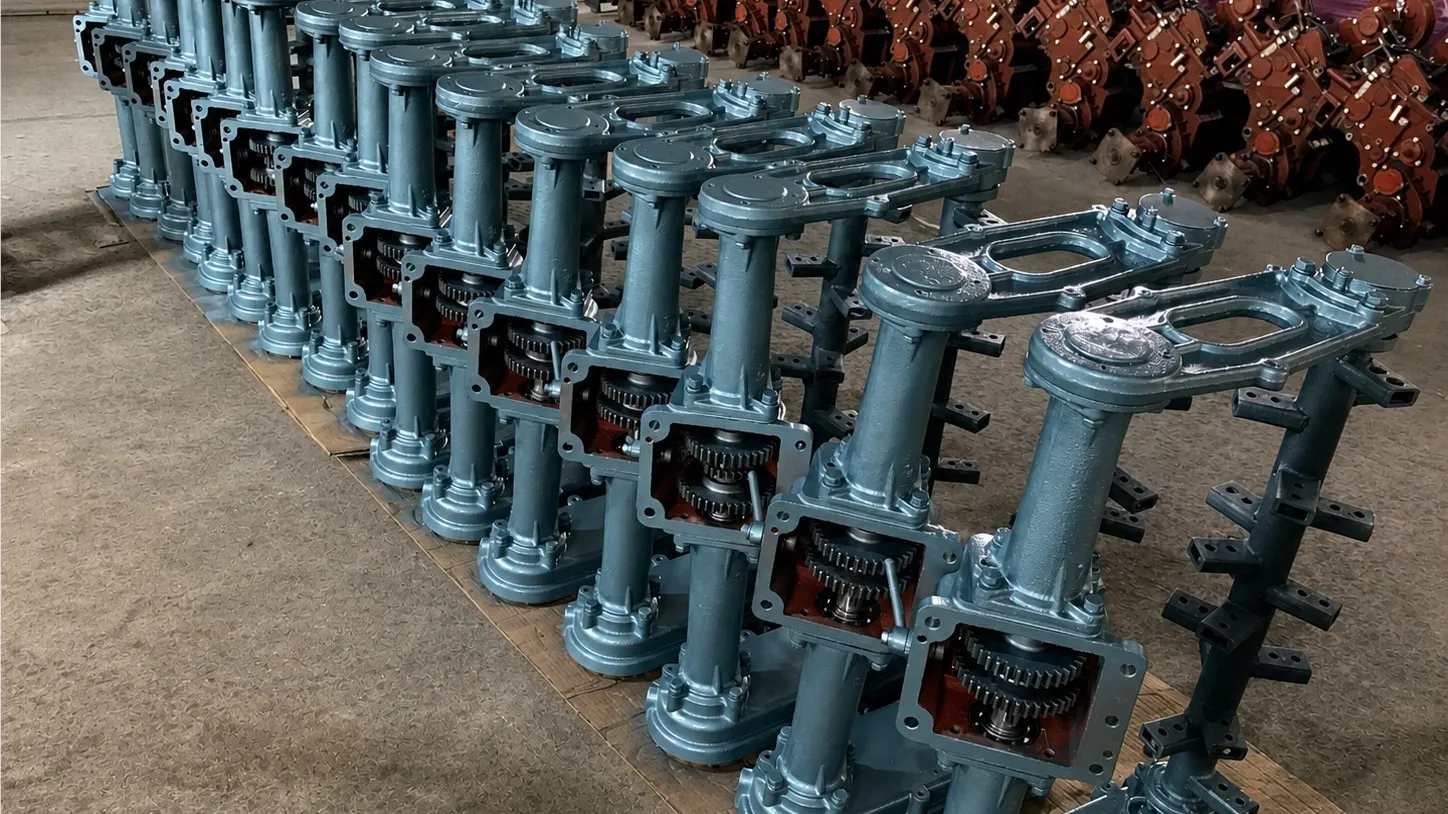
A single gear in the train carries its own numbers for the same reason. The stamp on this one is the part's own identification, and the principle is the same at a smaller scale: the ratio a pair of gears forms is fixed by the numbers on those two gears, not by the total count of steps on the data sheet.
Where reverse earns its place in field work
Reverse use in the field is not spread evenly through a working day. It clusters in a short list of positioning jobs. A task sheet on operating a tractor in reverse, published by the National Safe Tractor and Machinery Operation Program and hosted by the University of Nebraska Medical Center, lists them in farm language: "Hitching to equipment, backing equipment, unloading crops, and even storing machinery is done in reverse." Every one of those jobs exists on a two-wheel machine as well.
- Turning at the end of a run. When the headland is wide enough for a sweeping turn, reverse stays out of the day. When it is not — a bund-bounded paddy plot, a terraced strip, a plot with a wall or a ditch on one side — the next pass is lined up by backing up.
- Hitching and unhitching. A trailer or an implement has to be brought onto the hitch, and the fine positioning that gets a pin through a hole is slower in forward than in reverse.
- Loading and unloading. Getting a machine onto a truck bed or out of a shipping crate is a backing maneuver, at very low speed, often with someone guiding.
- Backing out of a corner. Between rows, under a shed roof, out of a narrow gate: the machine has to leave the way it came.
- Parking and storing. Machines are usually parked nose-in, which means every one of them comes out in reverse.
Two operational habits follow from that list, and they are the reason the reverse steps matter more than their number suggests. The first is that reverse must be usable at low engine speed without stalling, because the whole maneuver happens at walking pace with the operator watching the space behind, not the controls. The second is that it must be easy to cut instantly — the same manual that limits reverse to obstacle-clearing also tells the operator to stay "prepared to release the main clutch lever quickly" while walking the machine backwards.
There is a safety rule that belongs with these habits, and it is about the gear lever's neutral position. The UK Health and Safety Executive's guidance on working safely with agricultural machinery puts "Make sure the controls are in neutral" in the middle of its safe-stop sequence, between the handbrake and switching the engine off, precisely because operators get hurt reaching into a machine — a tine area, a blockage, a wrapped shaft — while the transmission is still engaged. Neutral is not a storage position. On a walk-behind tiller it is the control that makes the machine safe to touch.
And one line should stay absolute: you do not till in reverse. Reverse travel is for getting the machine into position, never for doing the work of the forward steps.
The turn you cannot make is time you pay for
Field capacity is not the same thing as working width multiplied by speed, because a field has ends. The turns at those ends are unpaid time, and on small plots they are a large share of the day. Ag Proud's machinery-efficiency explainer puts a number on what that costs: measurements of tillage implements and similar equipment "show that time for turns, etc. reduces actual field capacity to about 80% of theoretical capacity." A fifth of the working day can go into turning and repositioning before anything goes wrong.
That is where a usable reverse gear pays. On a long rectangular plot a turn is one sweep and the gearbox is barely involved. On a plot whose headland is narrower than the machine's turning circle, the only way to line up for the next pass is to back up — and if the gearbox will not do it, the operator does it by hand: walking the machine backwards in neutral, or lifting and dragging the tail. The difference between those two outcomes does not show up in any specification column, but it is the difference between a machine one person can run all day and a machine that needs two.
Not every bad turn is a gearing problem, though. In wet or puddled ground, or on a slope where the wheels break traction, the machine can have the right gear and still refuse to rotate on its axis. That is a wheel question rather than a gearbox question, and it is worth settling before anyone blames the transmission — the options on the compact end of the market are covered in this guide to spike wheels and wheel extensions.

The distinction matters commercially, because the two problems are sold as different parts. A turn that fails for want of grip is answered by the wheel set; a turn that fails for want of a reverse step is answered by the transmission. Diagnosing them in the wrong order is how an operator ends up buying a machine that has more forward steps than the field needed and no more turning ability than the one it replaced.
Reading a gear count on a data sheet
Both SUNTEC platforms are offered as 6F+2R machines: six forward steps and two reverse steps on the M80 and on the GN12 alike. Spelled out, that configuration buys three things in the field — a low working range that can hold tillage speed under load, a faster forward step for moving between plots, and two reverse steps so that a maneuver does not have to be run at a speed the operator cannot control. What a power tiller reverse gear has to deliver inside a configuration like that is narrow: a step slow enough to walk behind under load, and easy enough to leave. The working width is stated separately from the gear count, in the 480 mm and 600 mm figures the customer specification sheets record for these platforms, with the 600 mm configuration recorded in the sheets for the heavier machine.

What the count does not settle is the spacing inside those ranges, so the questions worth asking a supplier are specific:
- The gear table. Speed or ratio per step, with the work each step suits — the format the published manuals use.
- The reverse ratio, not the reverse count. Two reverse steps that are nearly identical are one reverse speed with extra lever movement.
- How reverse is selected. One gate on a single lever, or a separate control; and whether it engages with the machine stationary and the engine at idle.
- The configuration the quote is built on. Gear count, working width, wheel set and implement fit together, and a quoted configuration should state all four.
For a distributor or importer, those four answers are also what decides which configuration goes in front of a buyer. A market of long rectangular plots and larger holdings can be served with a single gearbox specification; a market of narrow bunded plots, terraces and smallholdings is where the second reverse step and the lowest working gear stop being specification detail and become the difference between a machine one person can run all day and a machine that needs two.
Those four answers are what turn a gear count into a comparison. The same discipline — reading a sheet against a real job rather than against another sheet — is what the guide to reading power tiller specifications applies to the rest of the specification, and it sits inside the wider machine configuration section, where the gears, wheels and weight of one platform are discussed together. For the two platforms themselves, the configuration notes for the M80 power tiller and the GN12 walking tractor show how the same 6F+2R basis is configured differently for light work and for heavier field duty.
Matching gears to a field: a short procedure
Gear selection is a field decision, not a brochure decision, and it takes about a minute to make consciously.
The field or the job | The control to reach for | What to check before you commit |
|---|---|---|
Long rectangular plot with room to swing at the ends | A mid-range forward step | The engine is not laboring — if it is, the step is too high for the depth |
Bund-bounded plot or terrace strip with a narrow headland | Lowest forward step, reverse between passes | Reverse engages and holds at idle; the turn geometry actually fits the headland |
Moving between plots on a farm track | A faster forward step | The wheel set suits the surface; this is a travel step, not a working step |
Trailer or implement work | A low forward step | The load can be started from rest without the wheels slipping |
Wet, puddled ground | Low steps with the wheel set chosen for grip | Whether grip or gearing is the limiting factor — change the wheel first |
Hard, dry, cloddy ground after harvest | A low step, shallower first pass | The engine is not being asked to break ground at a speed and depth it cannot hold |

The same logic is what a field-conditions selection guide formalizes: the field comes first, and the machine specification is written to match it. The gear count is one line of that specification.
Reverse is a wear item too
The reversing gear and the selector are among the few parts of a compact tiller that get used almost entirely at low speed and high effort, which is exactly the combination that wears them. Four symptoms are worth recognizing before they become a breakdown: a lever that will not engage with the machine stationary, a gear that jumps out under load, a whine that appears in reverse only, and a selector that needs two hands to move. None of them means the gearbox is finished — they are the symptoms of a worn selector, a stretched detent or a misadjusted linkage.
Servicing these boxes is narrower than people expect. Where a transmission runs as a gear drive in an oil bath, wear life is longer and maintenance is quoted lower — as the John Deere RT30 rotary tiller range puts it, "enclosed in an oil bath, gear drive components feature higher wear life, decreasing maintenance costs". What an owner actually touches, on any of these boxes, is the oil and the selector mechanism rather than the gears themselves. An owner who checks the oil level and keeps the selector linkage adjusted has done most of what the gearbox asks for.
When something does need replacing, the order of operations matters more than the part: identify the machine and the exact position in the gear train before anyone quotes it. The procedure for that is in this note on how to identify a power tiller part before you ask for a quote — a lever position misread as a gear number is how a correct machine ends up with the wrong part.
The short version
A power tiller reverse gear does not make the machine work faster. It makes the work possible: it turns the machine around at the end of a run, puts it on a hitch or a truck bed, and gets it out of the corner it was parked in. The forward steps do the tilling; the reverse steps decide whether the operator spends the day driving or dragging.
So read a gear count the way it deserves to be read — as the opening of a question, not the answer to one. Ask for the gear table, ask what reverse is selected against, and ask which of the three "reverses" a machine actually has. Then match the steps to the field the machine will work, because a plot with no headland is a plot where the reverse steps get used every single pass.
If you would rather work through your own field sizes and gear tables with the people who build the machines, send us the plot dimensions, the ground conditions and the work the tiller has to do.