
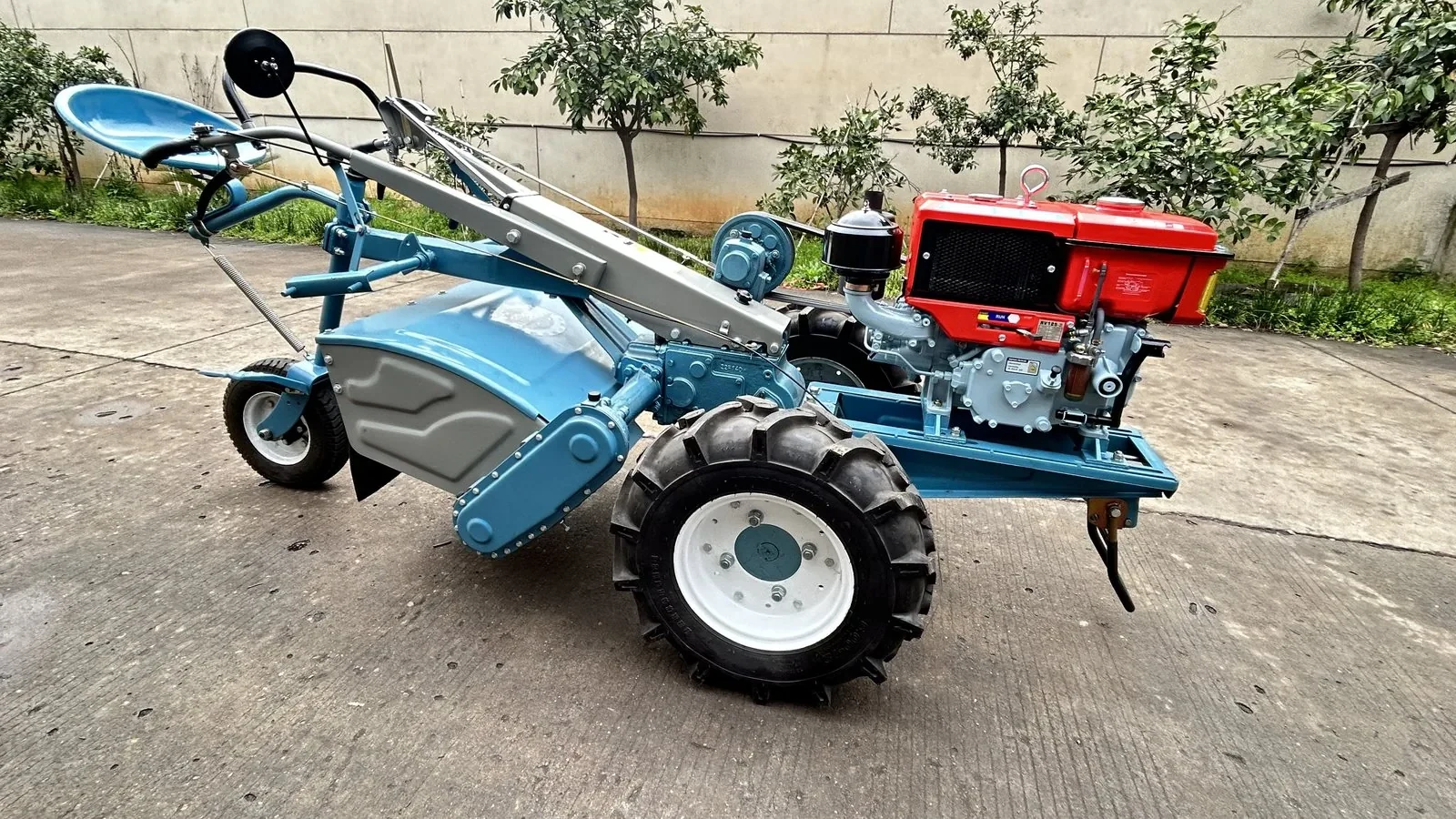
A customer does not ask for 600 millimetres. He asks how many days the machine will take on his two hectares, whether it will pass between the tea rows, and whether the wheels will hold in wet paddy. Power tiller working width is the number that answers all three — and on most specification sheets it is a single column with no explanation of what changes when it moves.
It is also the number most often answered badly, because three different measurements travel under the same name. Ask two suppliers for the working width and you may get the width of the rotor, the overall width of the machine, or the distance across the wheel centres. On the same machine those three figures differ by hundreds of millimetres. Confuse them in a quotation and the machine that arrives will not pass the gate the customer described.
This guide separates the three, shows what the 480 mm and 600 mm pair actually changes in a field, converts width into passes and hectares, and ends with the line a quotation has to carry so the width can be checked on delivery. It is written for the distributor or importer who has to put a number in a document, not for someone choosing a garden tiller — and where the two audiences overlap, the difference is stated rather than blurred.
Power tiller working width: what the number actually measures
Working width — also written as tilling width, or power tiller tilling width on supplier pages — is the width of soil the rotor cuts in one pass, measured across the outer tips of the blades. It is not the width of the machine, and it is not the width of the strip the operator sees when he steps back: loose soil spills outward, and the edges of a pass are always rougher than the middle.
Three numbers on a specification sheet decide three different things, and a power tiller width quoted without saying which one is being quoted is an open specification.
What is measured | Where it appears on the sheet | What it decides | SUNTEC M80 | SUNTEC GN12 |
|---|---|---|---|---|
Rotor or working width | tilling configuration | Soil moved per pass, engine load, pass count | 480 mm standard (14 blades), 600 mm maximum (16 blades) | 600 mm recorded (18 or 24 blades); 480 mm or 600 mm is the confirmed public range |
Overall width | dimensions | Gate, terrace and row access; transport | 710 mm | 980 mm |
Wheel track | track settings | Whether the wheels run in the tilled strip | 390–780 mm | 570–810 mm |
Two things follow immediately from that table, and both matter commercially.
The first is that the rotor is never the widest part of the machine. On the lighter platform the rotor reaches 600 mm while the machine is 710 mm across; on the heavier one a 600 mm rotor sits inside a 980 mm machine. A buyer who selects a width because "it will fit through the gate" is reasoning about the wrong number — the gate has to clear the wheels, the handlebars and the engine, not the hood.
The second is that the working width a customer experiences is smaller than the nominal figure. Passes overlap, because no operator tiles a field edge-to-edge, and the overlap is soil worked twice. Effective width is nominal width minus that overlap, and it is the figure the pass and capacity arithmetic in a later section is built on. The rest of the specification sheet is read the same way, number by number and with the same question — what does this decide? — which is the method set out in the guide to power tiller specifications.
A word on units, because it is where this query usually goes wrong. Most English-language writing about tiller width is in inches and describes front-tine or rear-tine garden machines, where 20 inches (508 mm) is a normal width and 24 inches (610 mm) is a large one. A 600 mm rotor on a 12.5 hp two-wheel tractor is not a large garden machine. It is a smallholder field machine with a diesel engine, a gearbox and six forward gears, ordered for a market rather than for a garden. Millimetres are the unit its specification sheet uses, so millimetres are the unit this article uses.
Why 480 mm and 600 mm are the two figures you will actually quote
Across the compact two-wheel platforms SUNTEC supplies, the confirmed public tilling range is 480 mm or 600 mm. The distinction worth teaching a sales team is between that range and what a specification sheet actually records: the heavier platform's customer sheet lists the 600 mm configuration — 18 blades or 24 blades at the same width — while the lighter platform lists 480 mm with 14 blades as standard and 600 mm with 16 blades as its maximum.
Those two statements describe different things. One is what can be supplied; the other is what the current sheet on file was built around. A quotation that does not say which one it is priced against has left the most consequential line in the document open.
What does the step from 480 mm to 600 mm actually buy? A quarter more width, and therefore a quarter more soil moved in every pass at the same depth and the same forward speed. That is the whole of the benefit, and it is a real one: on a ten-metre strip it removes about four passes from the job, which is four turns, four headland manoeuvres and four chances to leave a ridge.
It is also the whole of the cost. A rotary tiller is not a plough. It does not have to drag itself through the soil; it breaks the soil by turning blades into it, and the FAO's manual on integrated soil management and conservation practices describes such implements as needing "little tractive force ... but only energy to operate the implement", which is why a light chassis can carry a surprisingly wide rotor. But the energy to operate the implement scales with the volume of soil the blades meet, and a wider rotor meets more of it on every revolution. The engine's share of the work goes up by the same quarter, at the same depth, in the same soil.
That trade is the reason 480 mm and 600 mm are not a good-better pair. They are two answers to different fields, and the rest of this article is about which field is which. It is also why the pair sits inside a wider set of decisions about power, weight and terrain that the power tiller buying guide treats as one topic rather than six.
Worth saying plainly, because it is the context most distributor markets actually operate in: this is not a niche machine class. In Bangladesh, draught animals have been replaced by two-wheel tractors, which now carry out 80 percent of land preparation, according to the FAO's 2016 review of agricultural mechanization. A dealer in a market like that is not selling a garden tool with a wide hood. He is selling the primary tillage fleet, and the width he quotes is the width that fleet works at.
Blade count is the other half of the width
A rotary tiller working width quoted without a blade count is half a specification, and the arithmetic shows why. Divide the width by the number of blades on the rotor and you get the spacing between them — the distance each blade has to travel before the next one arrives at the same soil.
Configuration | Width ÷ blade count | Blade spacing |
|---|---|---|
Light platform, standard set | 480 mm ÷ 14 | 34.3 mm |
Light platform, maximum set | 600 mm ÷ 16 | 37.5 mm |
Heavy platform, 18-blade set | 600 mm ÷ 18 | 33.3 mm |
Heavy platform, 24-blade set | 600 mm ÷ 24 | 25.0 mm |
Read down that column and the design logic becomes visible. Widening the rotor from 480 mm to 600 mm on the lighter platform adds two blades, so the spacing barely moves — 34.3 mm to 37.5 mm. The rotor is not simply stretched; it is re-bladed to suit its width. Take the same 600 mm width on the heavier platform and the choice of blade set moves the spacing by a quarter, from 33.3 mm down to 25.0 mm.
That is a real decision, not a catalogue detail. Finer spacing means more cuts per revolution at the same rotor speed: a finer tilth, better residue chopping, and more load on the engine for the same width and depth. Wider spacing means fewer, larger bites — easier on the engine and on fuel, coarser in the seedbed. When a customer says the machine "does not break the clods properly" on a clay field, the answer is sometimes a different blade set rather than a different machine.
Which is why the width line and the blade line belong in the same sentence in any request. The interface questions that surround a rotor — drive form, mount points, blade type, rotor speed — are worked through in the guide to the rotary tiller package for the M80 and GN12; what matters here is that rotor width alone does not specify a rotor.

A blade set is matched to its width: on the same 600 mm rotor the choice between 18 and 24 blades changes the spacing from 33 mm to 25 mm.
Turning width into passes, and passes into hectares
This is the part of the conversation that competitors skip, and it is the part a distributor can win the account with. Width on its own says nothing; width divided into a field says everything.
The starting point is the standard field-capacity relationship: theoretical capacity is working width multiplied by forward speed, and effective capacity discounts that by a field-efficiency factor for the time lost to turns, stops and adjustments. The discount is the part that matters — a capacity figure with nothing taken out of it is a ceiling, not a plan.
Overlap is not a rounding error. A USDA-Agricultural Research Service field study of mowers measured pass-to-pass overlap between 0.5 percent and 16 percent of working width, averaging about 5 percent; in its controlled trial neither speed nor operator experience moved the overlap much on its own, and it rose when inexperienced operators ran at the higher speeds (Shinners et al., Overlap loss of manually and automatically guided mowers, Applied Engineering in Agriculture 28(1), 2012). A mower is not a tiller, but the mechanism is the same and the operator is the same person. Five percent is a fair planning assumption for a walk-behind; 0.5 percent is a hope.
Put the assumption to work on a ten-metre strip — a small plot, or one terrace bench:
480 mm rotor | 600 mm rotor | |
|---|---|---|
Effective width at 5% overlap | 456 mm | 570 mm |
Passes to cover 10 m | about 22 | about 18 |
Passes to cover 20 m | about 44 | about 35 |
Capacity at 3 km/h on the effective width | 0.137 ha/h | 0.171 ha/h |
After 80% for turns, stops and adjustments | 0.109 ha/h | 0.137 ha/h |
Hectares in an eight-hour day | 0.88 ha | 1.09 ha |
Engine hours per hectare | about 9.1 | about 7.3 |
Those are planning figures with the assumptions declared: a walking pace of about 3 km/h, overlap of 5 percent, and a field efficiency of 0.8. Every row below the first is worked from the effective width in the first row, so the 0.8 here is narrowed to the time lost to turns, stops and adjustments — the 5 percent overlap has already been taken out of the width, and deducting it twice would understate both machines by the same amount and invite an argument about the table instead of the field. Change any of the assumptions and the numbers move — that is the point. The distributor who can put this table in front of a customer, with his own assumptions in it, is having a different conversation from the one quoting a width and a price.
Two things in the table deserve emphasis. The first is that a 25 percent wider rotor removes about 20 percent of the passes, not 25 percent — because a quarter more width in every pass divides the pass count by 1.25, and one minus 1 ÷ 1.25 is a fifth. Overlap does not enter that ratio at all: both rotors lose the same 5 percent of themselves, so it cancels. The second is that the difference between 0.88 and 1.09 hectares a day is what actually decides whether a customer finishes before the rains or hires a second machine. If his constraint is the calendar rather than the soil, width is the lever; if his constraint is the soil, it may not be. The arithmetic of hours, passes and hectares for a given deadline is worked through in the guide to matching a machine to a daily workload.
The width the engine can carry
Every width has a power bill, and the bill arrives at the rotor shaft. A quarter more width is a quarter more soil per pass, so at the same depth and the same speed the engine is doing a quarter more work. There are only two ways to pay for it.
The first is depth. Working depth is the input that costs most per centimetre, and it is the one to trade first, because a shallower first pass followed by a second pass is often cheaper in engine hours than one deep pass at a width the machine cannot hold. The FAO's farmer field school material is blunt about the hierarchy: "primary tillage requires the greatest power", and depth in primary tillage is limited by what the machine can actually pull rather than by what the operator would like (FAO, Farmer Field Schools Guidelines — Module on Tillage).
The second is speed. Slower is always available and always costs time; a customer who says he will "just go slower" is describing a narrower effective width and a longer season.
Here is where the most-quoted shortcut in English needs handling with care. Practitioners in the four-wheel world commonly reckon on roughly one foot of rotary tiller width per five PTO horsepower. It is a reasonable rule for a tractor that drives a tiller through a power take-off while carrying its own weight on four wheels. It does not transfer to a walk-behind, where the rotor is driven from the same engine through belts and a chain and the machine is not simultaneously pulling an implement. Apply that rule to a 600 mm rotor and it returns about 10 hp — roughly the top of the 7–10 hp range the lighter chassis carries, and less than the 12.5 hp class of the heavier one. So the rule does not fail by a factor; it fails in kind. On a walk-behind there is no power take-off, the rotor is driven through belts and a chain from the same engine that moves the machine, and the limit that arrives first is traction — how much of the engine's output the wheels can put into the ground at the depth wanted, on a chassis of 179 kg without engine against 470 kg on the heavier platform. Two machines that far apart in weight cannot share one horsepower-per-foot constant, which is why tiller width per horsepower is a question to answer with a specification, not a rule of thumb. The sizing method itself, input by input, is in the guide to power tiller horsepower.
On the platforms described here the pairing is fixed at the factory: a 7–10 hp compatible range on the lighter chassis with a 480 mm standard rotor and 600 mm maximum, and a 12.5 hp class on the heavier chassis whose recorded configuration is 600 mm. What that means for a customer is simple: the width is not a free choice to be made after the engine, and the engine is not a free choice to be made after the width. They arrive together, and the way they arrive together is set out in the M80 configuration guide.
The width the gate and the row can carry
There is a second ceiling on width, and it has nothing to do with soil. It is geometry: the machine has to get to the field, into the field and back out of it.
On the lighter platform the overall width is 710 mm and on the heavier one 980 mm, against a maximum rotor width of 600 mm on both. So the practical question is never "will the rotor fit through the gap" — it is "will the machine". A terrace with a 750 mm access path takes the lighter platform and not the heavier one, whatever rotor is fitted. A shed door, a raised path between paddies, a gap between tree rows: each is a hard number, and each is measured once, in metres, before any specification is discussed.
Orchards and row crops add a second version of the same constraint. There, the width that matters is the distance between rows, and the pass has to fit inside it without stripping bark or burying a young trunk. A 480 mm rotor is not a downgrade in that setting; it is the width that lets the machine work the strip at all, and it is why narrow settings keep their place in a range that also offers 600 mm.
Headlands deserve a line of their own because they are where width quietly stops paying. A wider rotor reduces the number of passes across the field and changes nothing about the space needed to turn at each end. On a small rectangular plot with a tight headland, the wider machine can spend its advantage on manoeuvring. The six measurements that settle this — access width, turning space, corridor, slope, shape and headland — are set out in the guide to measuring field access and turning space, and they are worth taking before a quotation rather than after a delivery.

The cut ends where the hood ends; the wheel stands outside it. Whether that is an advantage or a strip of unworked soil depends on the track setting.
Where the wheels run, and what that does to the pass count
This is the part of power tiller width that almost nothing written in English covers, and it is the part a customer notices within one pass.
A two-wheel tractor's drive wheels run behind the rotor, and the track setting decides whether they run inside the tilled strip or outside it. On the lighter platform the track adjusts from 390 mm to 780 mm; on the heavier one it is set at 570, 630, 690, 750 or 810 mm. Compare those against a 480 mm or 600 mm rotor and three different situations appear.
Track against rotor | What happens | What it costs |
|---|---|---|
Track narrower than the rotor | Wheels run in soil the rotor has just loosened | Full-width coverage in one pass; wheel slip and compaction in the tilled strip, worst in wet soil |
Track equal to the rotor | Wheels run on the edge of the cut | Clean coverage, but no margin for steering error |
Track wider than the rotor | Wheels run on undisturbed ground | Better traction; two strips of unworked soil under the wheels, recovered only by overlapping the next pass |
The middle row is the setting most quotations should be aiming at, and the outer rows are both legitimate. A paddy customer fighting wheel slip wants the widest track his rotor allows, and should be told that he will pay for it in overlap. A dry-land customer working beds wants the narrow track, and should be told that the wheels will compact the strip he has just loosened — which matters more on the second pass than the first.
The commercial consequence is that track width belongs in the same quotation as rotor width, because it changes the effective width the pass arithmetic assumed. It also explains a question dealers get every season: why the same machine covers a plot in a different number of passes on two farms with the same rotor. The answer is usually the track setting, and sometimes the tyre — the two wheel tractor working width a customer feels is the rotor width minus whatever the wheels take back.
Which width to stock, market by market
For a distributor, width is a stocking decision before it is a selling decision, and it is made from the soil map of the territory rather than from what a supplier happens to be promoting.
A territory of terraces, orchard strips and narrow access paths wants the narrow configuration in volume, with a proportion of wider rotors for the open plots behind the village. A territory of flat paddy and open dry land wants the wider configuration as the default, with the narrow rotor held for the awkward fields that always exist. Most territories are both, in which case the honest plan is two widths rather than one, and the question is the ratio between them — not which single width to import.
There are three practical reasons to hold both rather than one. The first is that a rotor is a fitted assembly, not a machine: the same chassis serves both widths, so the second width is a stock line rather than a second model. The second is that blade sets wear and are replaced, which makes the blade count a repeat-purchase line in its own right, and a customer who has bought both widths buys both blade sets. The third is credibility at the counter: a dealer who can say "for that terrace, take the 480" is being useful, and a dealer who only stocks 600 mm has to argue.
Both platforms in the SUNTEC range are built around this logic. The lighter M80 power tiller carries 480 mm as standard and 600 mm as its maximum on a 179 kg chassis without engine, which suits the mixed small-plot territory where access is the binding constraint. The heavier GN12 walking tractor is recorded at 600 mm on a 470 kg chassis and is the machine for sustained tillage and defined transport work. Which of the two anchors a territory, and what width ratio to hold around it, is a conversation about the fields rather than about the catalogue.

A width decision is a stock decision: the chassis is the same, the rotor and its blade set are what change between one market and the next.
What the width line in a quotation has to say
Everything above compresses into one artefact: the width line in a specification or request. Five items make it checkable, and four of them are routinely left out.
- Nominal width in millimetres, with the unit written — 480 mm or 600 mm, not "48" or "wide".
- Blade count for that width, because the same 600 mm rotor with 18 or 24 blades is two different machines in the soil.
- Where the width is measured — across the outer blade tips, as supplied — so that a customer measuring the hood on arrival is comparing like with like.
- Track setting at delivery, since it decides whether the wheels run in the cut and therefore the effective width.
- Whether both widths are wanted in the same order, which is a packing and parts question as much as a specification one.
Written out, a width line reads like this: "600 mm rotor, 18-blade set, measured across blade tips, track set at 810 mm, second rotor at 480 mm with 14 blades to follow in the same shipment." That sentence can be checked against a machine on a pallet. "600 mm tiller" cannot.
Straight answers to the counter questions
"How wide is a power tiller?" On the compact two-wheel platforms described here, 480 mm or 600 mm. On the garden machines that dominate English-language search results, 20 inches (508 mm) to about 32 inches (813 mm) — a different machine class, usually petrol, usually belt-driven to a pair of tines, usually sold to a household rather than a farm. Both answers are correct for their own machine. Neither is correct for the other.
"Is a wider rotor always better?" No. It is better when the field is open, the soil is workable and the calendar is the constraint. It is worse when access is narrow, when rows are close, when the engine is already near its limit at depth, or when the wheels cannot be set to match. Width is a rate, and a rate is only useful if the rest of the machine can sustain it.
"Can I fit a wider rotor later?" Ask for the width and the blade set together at order time, and ask whether both widths are available for the chassis. On these platforms the rotor is a factory-matched assembly rather than an open menu, and a rotor bought later has to match the drive and the hood as well as the chassis.
"Does the width change fuel consumption?" At the same depth and speed, roughly in proportion to the soil moved, because the work done is proportional to the volume of soil broken. Reduce depth or speed and the difference narrows. The engine does not care about the width; it cares about the load.
"Why is there no price on this page?" Because commercial terms — price, minimum order, lead time, packing and payment — depend on configuration, destination and volume, and are quoted per enquiry rather than printed. What can be fixed in advance is the specification, which is what this article is about.
"Does a wider machine till deeper?" No. Power tiller working depth is set by the rotor, the skids or wheels that control it, and the power and traction available to hold it. Width changes how much soil is broken per pass, not how deep the blades reach.
Where to go next
If you have a customer's fields in front of you, the fastest way to close the gap is to send the width with everything it interacts with: plot size and shape, access width, soil, intended depth, blade set, track setting, and the market the machine will work in. That is exactly what the power tiller RFQ builder collects, so the reply you get back is a configuration with its reasoning attached — two widths, two blade sets, one chassis — rather than a price against a model name.