
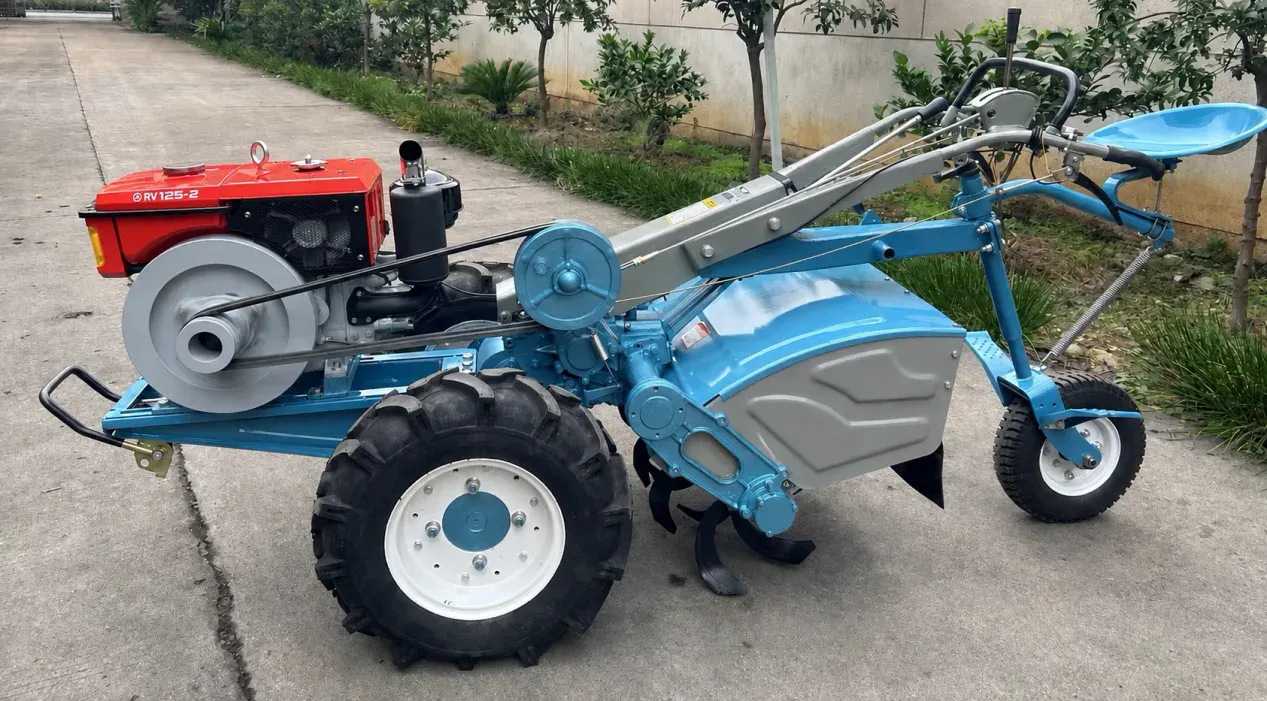
A distributor's phone call usually opens the same way. A customer has four hectares of paddy, or two hectares of dry land behind the house, and wants to know the power tiller horsepower he needs. The catalogue on your desk lists 7, 9, 12 and 18 hp as if they were shoe sizes. None of those numbers answers him, because the question contains three facts that are not in the catalogue yet: what the soil is like, how deep the customer wants to go, and what will be bolted to the back of the machine.
Power tiller horsepower is the last number in a chain, not the first one. It falls out of four measurable inputs and one implement decision, and a dealer who can walk a customer through those five items will outsell one who quotes the biggest engine the customer will pay for. That is the whole method this guide sets out: how the load divides, which five inputs move the answer, what the figure on the datasheet actually measures, and how to turn the result into a configuration you can put in writing.
It is not a niche question in the markets most distributors serve. In Bangladesh, draught animals have been replaced by two-wheel tractors, which now carry out 90 percent of land preparation, according to the FAO's 2016 review of agricultural mechanization. This is the primary tillage fleet in those economies, not a garden tool, and the distributors who supply it are being asked to size engines all season. For the wider set of topics this article belongs to, see the power tiller buying guide.
Why horsepower is the last question, not the first
Two machines can share an 8 hp engine and behave nothing alike. The same confusion runs through almost every discussion of two wheel tractor horsepower, because the number is compared across machines that spend it in completely different ways. One drives a 480 mm rotary tiller through dry, sandy soil at walking pace and never labours. The other pulls a single-furrow plough into wet clay and dies in the furrow. Same horsepower, different job — and the difference is not the engine, it is where the engine's output is being spent.
That is why the practical question is never "how much horsepower", but "how much of which kind of work". Ask a farmer what he wants the machine to do this season, and the answer usually narrows the range faster than any specification table:
- Rotavating his own plot twice a year, plus carting sacks to the road.
- Hired work: preparing other people's fields for cash, in whatever soil they have.
- One specific operation he is currently paying someone else for — puddling, ridging, or moving produce.
The third answer is the most valuable to a dealer, because it has a number attached to it already: what the customer currently pays per hectare, or per trip. That is the business case for the power class, and it is the conversation to have before the catalogue opens.
Two loads hide behind one horsepower figure
Every job a walking tractor does pushes engine output down one of two paths. Getting this distinction straight is what separates a confident recommendation from a guess.
Rotary work spends power on the shaft. The engine drives a rotor through belts and a chain, and the tines break the soil by rotating into it. The machine barely has to pull. The FAO's manual on integrated soil management describes rotary cultivators as "implements powered through the tractor power take-off shaft", and draws the consequence: "little tractive force is needed by the tractor but only energy to operate the implement and they can thus be used with very lightweight tractors" (FAO, Manual on integrated soil management and conservation practices).
That single sentence explains a fact that confuses buyers all over the world: how a 7–10 hp walk-behind can drive a 480 mm or 600 mm rotary tiller that would look absurd on a four-wheel tractor of the same rating. Nothing is being towed. The power goes into turning soil, and a light chassis is an advantage, not a limitation.
Draught work spends power on pulling. A plough, a ridger, a bed-former or a trailer has to be dragged, and the engine's output becomes tractive force at the wheels. Here depth is not a setting, it is a consequence: "the depth of primary tillage depends on the tractive force available", as the same FAO manual notes. And primary tillage is the heaviest operation in the sequence — "primary tillage requires the greatest power", in the words of the FAO's tillage module for farmer field schools.
Load | Where the power goes | What limits it first | Effect on the power class |
|---|---|---|---|
Rotary tillage | Rotor shaft, via belts and chain | Rotor width, depth, soil strength, forward speed | Light chassis can carry a wide rotor; 7–10 hp is a normal class |
Plough, ridger, bed-former | Drawbar pull at the wheels | Grip and machine weight, then engine torque | Needs weight and low gearing more than headline power |
Trailer transport | Drawbar pull, plus braking | Traction, brakes, route gradient | Governed by braking and grip, not by engine size |
Stationary or shaft-driven work | Pump, thresher, sprayer | Implement's own demand | The implement sets a floor the engine must clear |
The practical consequence for a distributor is a rule of thumb that survives contact with the field: rotary work lets you size the engine to the rotor; draught work forces you to size the machine to the soil. If your market's main job is rotavating paddy and dry land, a compact platform with a matched rotor covers most of the demand. If it is ploughing heavy clay or hauling loads up inclines, the same engine will feel weak, and the answer is a heavier chassis rather than a bigger sticker. The mechanics of matching a rotor to a machine are covered in the guide to the rotary tiller package for compact platforms.
The five inputs that move the power tiller horsepower answer
With the two load types separated, sizing becomes an interview. The power tiller power requirement a customer actually needs falls out of five inputs, and each one can be asked in plain language.
Input | What it changes | How far it moves the answer | What to ask the customer |
|---|---|---|---|
Plot and area | Hours per season, not power | Moves the number of passes and the machine count; can push a buyer up a class when area is large | How many hectares, in how many separate plots, how far apart? |
Soil and moisture | Rotor and drawbar resistance | The single largest swing — the same plot in wet clay can demand a class the customer did not plan for | What grew there last season, and when is it wettest? |
Working depth | Energy per cubic metre moved | Each extra centimetre costs disproportionately more than the one before | Seedbed only, or true primary tillage? |
Forward speed | Energy per hectare, sharply | Doubling speed roughly quadruples energy demand, not doubles it | How many days does he have for land preparation? |
Implement | Sets the floor and the load type | A planter or a heavy plough can rule out a class on its own | What else will be hitched on, this season and next? |
Two of these deserve a warning because they are where quotes go wrong.
Speed is the counter-intuitive one. The FAO manual is explicit that "with increased working speed, the draught force increases quadratically and hence, also the energy requirement", adding that doubling forward speed doubles performance but requires four times the energy and fuel. A customer who says he will "just go slower" is describing a smaller engine, and a customer who says he needs to cover 40 hectares in ten days is describing a larger one — even though neither of them mentioned power.
Soil moisture is the other. Every soil has a moisture band in which it tills most easily, and outside that band the same machine works much harder — wet clay smears and sticks, dry clay comes up in slabs that will not break. Because the work is seasonal, the machine is often asked to operate outside the good band. That is a reason to buy headroom, and it is much easier to justify to a farmer than a horsepower number on its own. If your market farms at altitude, add one more question: ask whether the published rating was measured at sea level, because a naturally aspirated diesel gives less at 2,000 m than the plate says.
Area, meanwhile, is usually misread as a power question when it is a capacity question. A machine of a given width and speed covers a given area per hour. More hectares at the same power means more hours, more fuel and a later finish — not a stronger engine. If the customer's constraint is the calendar rather than the soil, the answer may be two machines of the same class rather than one machine of a higher class. The arithmetic of hours, passes and hectares is worked through in the guide to matching a machine to a daily workload, and the soil side of the same equation is covered in soil resistance, machine weight and implement load.
What the figure on the datasheet actually measures
Here is where a great many dealer conversations quietly go wrong. The power tiller hp figure printed on a specification sheet is usually a maximum output at a stated engine speed, measured on a test bench at the flywheel. It is a legitimate figure. It is just not the same quantity as "the power this machine will deliver to a rotor for six hours in clay".
Three distinctions are worth teaching your sales staff, because they cost nothing and they build trust fast.
Maximum versus continuous. A 12.5 hp-class single-cylinder diesel commonly publishes 12.5 hp maximum at around 2,400 rpm, with a continuous rating roughly 1.5 to 2 hp lower — 10.5 to 11 hp in the sheets we hold for this power class. Continuous output is the figure that survives a long day at load; maximum output is what the engine can do in a short pull. When a customer compares two machines by headline horsepower, he may be comparing two different duty ratings.
Where it is measured. Between the flywheel and the tines sit a belt drive, a clutch, a gearbox and a chain. Each takes a share, and the share is not identical between machines. A well-built 10 hp machine can deliver more useful work at the rotor than a poorly matched 12 hp one, which is why power tiller engine size — the cc figure buyers like to compare — predicts very little on its own.
At what engine speed. Rated speed matters because a rotor needs a specific tip speed to cut rather than bounce. A machine geared to reach the right rotor speed at part throttle will feel stronger and burn less fuel than one that needs full revs to do the same work.
None of this is exotic. It is the difference between reading a label and reading a machine, and it is exactly the ground on which a distributor can be more useful than a marketplace listing. The vocabulary used across these sheets is set out in the guide to power tiller specifications.

The plate on an engine gives a model and a rating; the duty rating behind it is what decides whether the machine holds that output all day.
What two power classes look like in practice
Abstract classes become concrete when you can put two machines side by side, and the two platforms SUNTEC supplies happen to sit either side of the most common dividing line in smallholder markets.
The lighter platform, the M80 power tiller, is built around engines in the 7–10 hp range. Its chassis weighs 179 kg without an engine, and its rotary configuration runs from a 480 mm, 14-blade standard up to a 600 mm, 16-blade maximum. That combination — modest power, light chassis, rotor that can be widened — is the shape of a machine for small plots, terraces, orchards and mixed dry-land work where manoeuvrability matters more than drawbar pull.
The heavier platform, the GN12 walking tractor, is a 12.5 hp-class machine on a 470 kg chassis (again, without engine), with six forward and two reverse gears. Its published rotary configuration records 600 mm with 18 or 24 blades; the client's own specification sheet lists only that 600 mm build, while 480 mm and 600 mm are both part of the confirmed public range. Read the two numbers together and the real difference between the classes appears: about 3 hp more, and roughly 290 kg more machine underneath it.
That weight is not padding. It is traction, and traction is what lets the heavier class do the draught work the lighter one should not be asked to do. It is also why "just fit the bigger engine" is not a configuration strategy.
Where more horsepower stops helping
Every experienced dealer has seen a machine that spins its wheels while the engine runs happily at full song. That is the traction ceiling, and it is the reason horsepower is a poor proxy for capability on a two-wheel machine.
A walking tractor can only pull as hard as the driven wheels can grip. Grip depends on the weight carried on those wheels, the tyre or steel wheel in use, and the surface. Add power beyond that point and the extra output goes into wheel slip, trenching and fuel — not into the furrow. In wet paddy, the same machine that pulls well on dry land will spin; fitting cage wheels or steel wheels changes the limit, not the engine. On a slope, or with a trailer, the limit arrives even earlier, and it arrives at the brakes before it arrives at the engine.
Width behaves the same way. A rotor that is wider than the engine can drive at the required depth simply forces the operator to go slower or shallower, which is why factory rotor options exist as a matched set rather than an open menu.
This is also where the most-quoted figure for tiller width per horsepower in the English-language literature has to be handled carefully. On four-wheel tractors, practitioners commonly reckon on about one foot of rotary tiller width per five PTO horsepower. That figure comes from a machine that drives the tiller through a power take-off while also carrying its own weight on four wheels, and it does not transfer to a walk-behind, where the rotor is driven directly and the machine is not simultaneously pulling an implement. Quote it to a customer sizing a compact two-wheel machine and you will talk him into the wrong class in either direction. Use it only when the customer is actually buying a four-wheel tractor and a PTO tiller — at which point the honest advice may be that he is shopping in a different category altogether, as set out in power tiller versus mini tractor.

A light chassis is an asset for rotary work and a hard ceiling for draught work — the same machine, read two ways.
A sizing worksheet you can run at the counter
The method above compresses into six questions. Ask them in order, write the answers down, and the power class usually announces itself before the fifth one.
Step | Question | What the answer rules out | What to record |
|---|---|---|---|
1 | What is the primary job this season? | Machines sized for the wrong load type entirely | Rotary, draught, transport, or stationary |
2 | What soil, and when is it wettest? | Light machines for heavy wet clay; heavy machines for sandy plots | Soil description plus the month of hardest work |
3 | What depth, and is it seedbed or primary tillage? | Underpowered machines sold on width alone | Depth in centimetres, number of passes |
4 | How wide can the machine physically work? | Rotors that cannot be trailed through gates or between terraces | Narrowest access point, headland space |
5 | How many days are available? | One machine where two are needed, or vice versa | Hectares, days, hours per day |
6 | What else will be hitched on? | A class that cannot carry the next implement | Every implement, this season and the next |
Two notes on using it. First, steps 2 and 3 are where the customer will be vaguest, and where a photograph of the field on a phone is worth ten minutes of description. Second, the worksheet's output is a shortlist, not a promise: it tells you whether the conversation belongs in the light class, the 12.5 hp class, or outside compact two-wheel machines altogether. Anyone who converts it directly into a guaranteed performance figure is guessing on your behalf.
Step 6 is the one that most often decides the sale, because an implement can outvote every other input. CIMMYT's training manual for two-wheel tractors and their equipment, which describes this machine class as the 8–20 hp band, states plainly that the main power source for its versatile multi-crop planter is a two-wheel tractor of more than 12 hp. A customer who buys a light machine this season and a planter next season has bought twice.
Run the worksheet on two customers and the shortlist separates itself. Customer A has 1.5 hectares of dry land behind the house, sandy loam, wants a 12 cm seedbed twice a year, works alone with no deadline beyond the rains, and will hitch nothing but a rotary tiller. Steps 1 to 6 return: rotary load, light soil, shallow depth, wide-open access, plenty of days, no other implement. That customer is shortlisted in the 7–10 hp class, where a 179 kg chassis with a 480 mm or 600 mm rotor is built for that kind of load. He gains nothing from the heavier class except weight and fuel his soil does not need.
Customer B has three hectares of paddy and 0.5 hectares of dry land, wants a 20 cm primary pass in wet clay behind a single-furrow plough, has ten days because the transplanting window will not move, and intends to add a trailer for sacks to the collection point. Steps 1 to 5 already push him up: draught load, the worst moisture band, a deeper pass than Customer A's, a hard calendar. The 12.5 hp-class machine on its 470 kg chassis is the honest answer, and the trailer in step 6 confirms it rather than decides it.
The point of the pair is the shape of the reasoning, not the two model names. Same district, same season, two different classes — and in both cases the answer came from the field answers, not from the catalogue.
What to stock for a mixed market
The worksheet also has a commercial reading, and it is the one distributors rarely do explicitly.
Most markets do not want a single power class. The same district will contain terrace plots that a light machine serves best, flat paddy that suits the heavier class, and a handful of customers who need a four-wheel tractor and should be referred elsewhere. A dealer who stocks only the light class loses the paddy work; one who stocks only the heavy class sells more machine than half his customers can use and inherits the complaints that follow. Two adjacent classes, with rotors and a small implement set held in proportion, cover most of the demand and keep the parts and service conversation in one place.
That stocking decision is also a service decision. Fewer classes mean fewer spare part lines, simpler training for the mechanic, and a smaller set of implements to keep in stock — which is why the mix should be chosen from the soil map of the territory, not from what a supplier happens to be promoting. Ask what is genuinely shared between the classes in a range, and what is not, before committing to a floor plan.

A stocking decision is a soil-map decision: two adjacent classes cover most of a mixed territory, and each one needs its own implements behind it.
Questions to put to the supplier before quoting
Everything above converts into a short list of written questions. Ask them once, keep the answers, and reuse them for every customer in that market.
- On what basis is the horsepower quoted — maximum output at rated speed, or continuous output?
- At what engine speed is that figure measured, and at what point on the driveline?
- What rotor width and blade count does that rating refer to, and what changes if the wider option is fitted?
- What is the minimum power each implement in the range is intended for, in writing?
- Is the rating measured at sea level, and how should it be adjusted for the altitude and ambient temperature of my market?
- Which parts are common across the classes in the range, and which are specific to one?
If a supplier cannot answer the first three, that is itself information about how the catalogue was assembled. A distributor who asks them consistently will find that the answers also make his own quotations faster, because the questions he needs to ask his customer have already been answered upstream. The same discipline is what a good datasheet should carry in the first place.
Straight answers to the counter questions
"How much horsepower does a power tiller need?" There is no single number, and any supplier who answers with one has not asked enough. It needs enough to drive the rotor the field requires, at the depth and speed the calendar requires; 7–10 hp and a 12.5 hp class cover a large part of smallholder demand between them, and the five inputs decide which side a given customer lands on.
"Does a bigger engine till deeper?" Not by itself. Depth is limited by traction and by the rotor's design, and the FAO's own wording is that primary tillage depth depends on the tractive force available. A bigger engine on an unchanged chassis mostly buys the ability to hold a depth in harder soil, or to work faster.
"How much horsepower does a five-foot tiller need?" That question comes from the four-wheel PTO world, where the answer is roughly one foot per five PTO horsepower. On a walk-behind, width is a factory-configured rotor rather than a free choice, so the question inverts: the rotor is fixed and the engine is matched to it — 480 mm or 600 mm on the compact platforms described above.
"Are all power tillers the same machine with different engines?" No. Walking tractors, riding tillers and four-wheel tractors are three different machines with three different load paths. Even within walk-behinds, the transmission — belt to the rotor, gear to the wheels, chain to the tines — changes how much of the engine's output reaches the soil. That is one reason power tiller terminology varies so much between markets.
"What is the difference between a tiller and a cultivator?" A tiller works soil to depth with driven blades; a cultivator is a shallower, usually drawn tool for inter-row work or seedbed finishing. They are different loads, which is why the power question has different answers for each.
"Can a 7–10 hp machine pull a plough?" Sometimes, in light soil at shallow depth, with a single-furrow implement and the right wheels. In wet clay, no. Ask the supplier for the implement's minimum power in writing rather than deciding from the machine's badge.
Where to go next
If you have a customer on the phone and a worksheet half filled in, the fastest way to close the gap is to turn those six answers into a configuration request rather than a single horsepower number: soil, depth, width, days, implements, and the market the machine will work in. That is what the power tiller RFQ builder is for — it collects exactly the inputs this article argues should decide the class, so the reply you get back is a configuration with its reasoning attached instead of a price against a model name.