
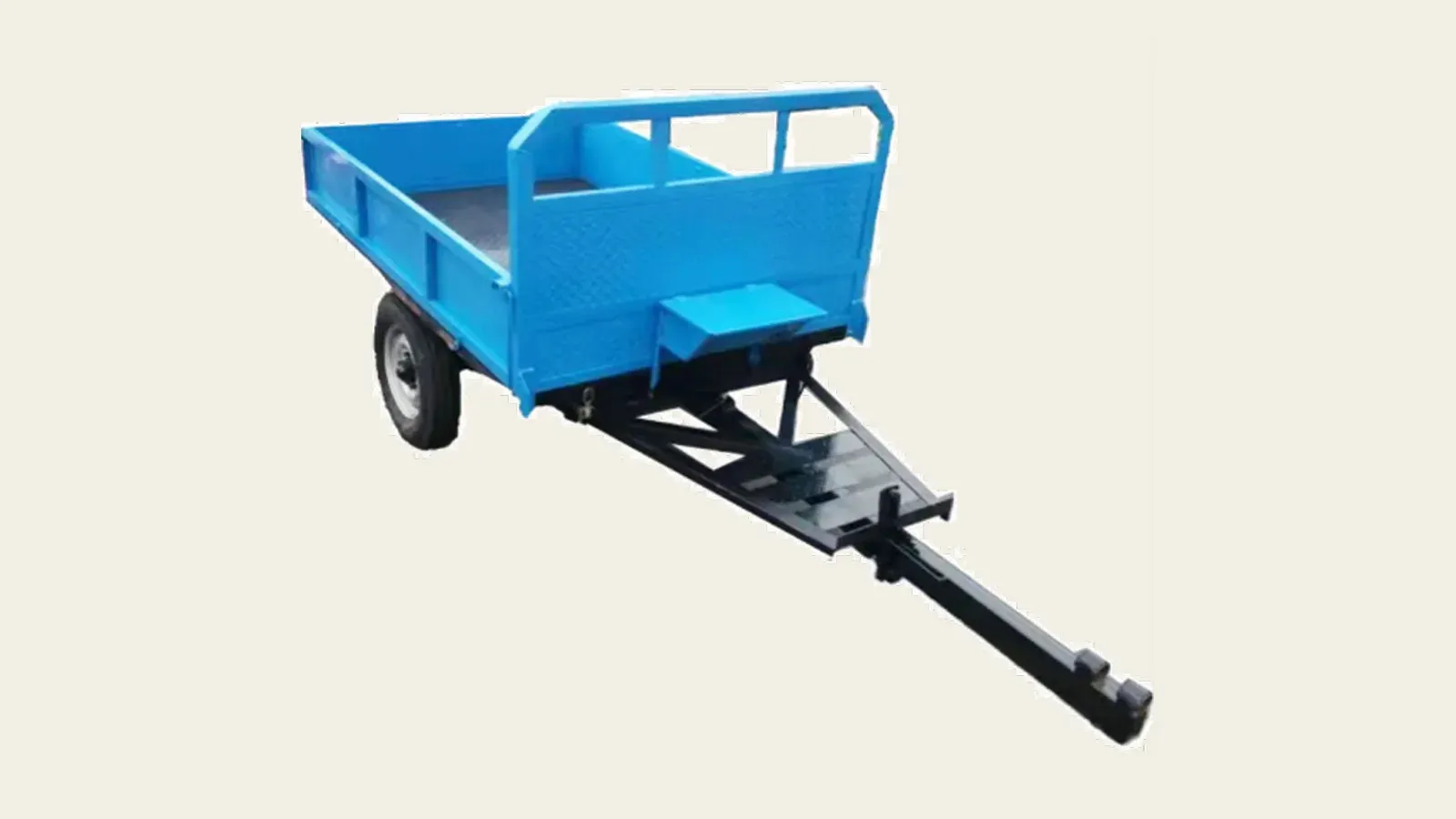
Every small farm has a load that is too heavy for a wheelbarrow and too small to justify a lorry: a few dozen sacks of paddy at the field edge, a stack of fertiliser bags at the store, firewood for the drying shed. A two-wheel tractor that already earns its keep tilling can move those loads with a trailer behind it, which is why walking tractor trailer transport comes up in almost every configuration meeting a distributor has with a grower.
The answer is not a simple yes. A two-wheel tractor can pull far more than it can stop, the trailer's coupling has to match the machine physically, and the surface between the two points decides more of the outcome than the engine does. This guide sets out when a power tiller for farm transport is the right tool, the two physical limits that decide how much it can carry, the conditions where the combination stops making sense, and the items you should have in writing from a supplier before an order is placed.
What short-distance farm transport actually covers
Short-distance transport means movement between two points on or immediately beside the farm, on tracks, bunds and dry field roads, repeated across a season rather than run once. It is the layer of work that sits between the field and the first buyer: FAO's agricultural engineering reference on transport describes transport as the passage from one stage of the post-harvest system to the next, and notes that where roads and tracks are poor, produce moves in small quantities "over very bad roads or footpaths", which "entails long transport times and high costs per unit of product transported, leading to a substantial decrease in incomes."
That is exactly the distance band a walking tractor with a trailer is built for. The loads are ordinary and repetitive:
Job | Typical load | What decides whether a trailer helps |
|---|---|---|
Harvest evacuation | Bags of paddy, maize or wheat from field to drying floor or collection point | Firm surface and a repeated route; peak-season labour is the real bottleneck |
Input delivery | Seed, fertiliser, water for mixing and spraying | Distance from the store to the plots, and how far the track goes |
Manure, fodder and straw | Bulky, low-density material | Bed volume rather than load rating |
Tools, spares and harvest equipment | Light but awkward items to a remote block | Frequency of trips; whether the machine is already going that way |
One clarification is worth making early, because the same words describe two different purchases. "Trailer transport" also means hiring a flatbed lorry to move a tractor between farms, to a dealer, or to a show. That is a transport service bought by the trip, and nothing about trailer design changes its cost. This guide is about the other thing: the trailer that hangs off the machine's own drawbar and moves material inside the farm gate.
Traction sets what you can pull; brakes set what you can stop
Two limits bind a trailer combination, and they are not the same limit. Most buying conversations collapse them into engine horsepower, which is the least informative of the three numbers.
The first limit is traction. The pull a two-wheel tractor can put into a drawbar is roughly the weight carried on its drive wheels multiplied by how much grip the soil gives those wheels. The machine itself is not heavy — the MUBOTA M80 chassis is 179 kg without an engine, the GN12 chassis 470 kg without an engine — so the weight available for grip is modest, and every kilogram of payload is bought with wheel equipment and ballast rather than with horsepower. On a dry, firm track the coefficient of friction is generous; in puddled clay it collapses, and a load that moves easily in February will not move in July. This is the same soil-resistance problem that runs through power, weight and implement matching, and the same reason steel traction wheels exist for wet-field work: they change the coefficient, not the engine.
The second limit is braking, and in practice it is the one that binds first. The CIMMYT training manual for two-wheel tractors and their equipment, used for operator and extension training, states in its trailer module that most 12–15 hp two-wheel tractors can carry a trailer of up to 1,000 kg — a training figure for that machine class on a firm, level route and within the trailer's own rating, not a SUNTEC trailer rating — and that "the only limiting factor for the trailer capacity is its brake drum diameter and size of the shoes" (CIMMYT, 2022). The same manual is blunt about the consequence: trailer brakes "are designed to halt the trailer with its maximum designated carrying capacity only," so the rated capacity is a braking figure, not a suggestion.
That framing matches the general safety position for farm trailers. The UK Health and Safety Executive's guidance on workplace transport in agriculture asks that trailers have adequate brakes designed for the maximum loads and speeds at which they will operate — which on a two-wheel tractor means the combined braking of a light machine and a much heavier trailer.
Put the two limits together and a practical rule falls out. On this class of machine the trailer's momentum is usually larger than the tractor's own, so every kilogram of payload is a stopping problem before it is a pulling problem. A seller who quotes payload without quoting the brake specification has quoted half a number.
When a power tiller for farm transport is the right tool
1. You already drive the route, on a firm surface. The economics of a trailer are trips multiplied by load, so a fixed route that runs on a farm track, a dry field road or a bund top is the ideal case. If the same journey is already being made with a wheelbarrow or a hand cart, the trailer is replacing labour rather than adding a new task.
2. Harvest peak, when labour is the constraint. Moving the crop from field to drying floor on the day it is cut is where delay costs quality. The CGIAR climate-smart agriculture programme AICCRA describes the two-wheel tractor tipper trailer in similar terms: it reduces communities' transport cost and time, improves the timely transport of goods, and lets growers sell directly to the market for a higher price.
3. The load is bulky rather than heavy. Straw, husks, empty sacks, tools and harvested fodder are volume-limited: a trailer with a proper box bed and drop sides carries them at well under its weight rating. This is the case where the trailer is doing work no amount of engine power would substitute for.
4. The machine is already there, and can earn between seasons. A two-wheel tractor that only tills is idle for part of the year. AICCRA also describes the tipper trailer as a source of year-round income for operators who hire out their services — which matters to a distributor's customer as much as to the farm.
Where a power tiller for farm transport stops making sense
When most of the trip is public road. FAO makes the division of labour explicit: for road transport, tractors with trailers are generally used in the field, while goods moved on the road go by truck. Registration, lighting, insurance and driving-licence rules for agricultural combinations differ from country to country and are the buyer's to check locally; a machine specified for a farm track is not automatically a road vehicle. If more than a short link of the journey is highway, a pickup or a hired lorry is the cheaper answer.
On steep or side-sloping ground. The CIMMYT manual's trailer-driving rules are unambiguous: never drive across a steep slope, and go down steep slopes in reverse to avoid tipping forward. They sit in the same list as "never exceed the maximum carrying capacity of the trailer", which tells you the manual already assumes a loaded trailer rather than a bare machine. A loaded trailer still raises the centre of gravity, lengthens the combination and pushes on the drawbar on every descent, so the margin those rules protect is worth keeping wide.
When the load exceeds the trailer's brake rating. The rated capacity is set by the braking system, so exceeding it removes the only thing keeping the load controllable. This is also why "it pulled it fine" is not evidence: pulling is the easy half.
In wet-season clay, or where the machine already slips unladen. If the bare tractor is losing grip in a puddled paddy, adding a trailer adds drag without adding traction. The answer there is machine setup, not payload — see paddy field versus dry land machine setup.
For one or two trips a year. Standing capital that works twice a year is worse than hiring per trip, whatever the trailer costs.
Get the machine side right first
A trailer is only as good as the numbers it has to match. On the SUNTEC platforms those numbers are published and worth writing down before any trailer conversation starts.
- Wheel track. The M80 chassis takes track settings from 390 mm to 780 mm; the GN12 chassis offers 810, 750, 690, 630 and 570 mm. The trailer's track should relate to the setting the machine actually runs — a trailer noticeably wider than the machine will not follow it through a gate or between bunds, one noticeably narrower will drop into the ruts the machine has just cut, and on a single-axle trailer that geometry also decides how the bed sits behind you when the load shifts.
- Tyres. The M80 runs 5–12 pneumatic tyres. On wet ground the tread pattern matters more than the nominal size, which is why wheel equipment is a separate decision from trailer selection.
- Gears. Both platforms carry six forward and two reverse gears. Reverse is how a trailer is placed at a drying floor or backed into a shed, and it is the gear the training guidance names for descending a steep slope.
- Brakes. The M80 uses an internal expanding brake. Its condition and adjustment are half of the combination's stopping power, so a machine going into transport work deserves a brake check before the trailer arrives, not after.
- Ground clearance. The GN12 chassis has a minimum ground clearance of 210 mm, which sets what it can cross on a rutted track with a loaded trailer behind it.
- Weight and power class. 179 kg and 470 kg without engines, with 7–10 hp on the M80 and a 12.5 hp class engine on the GN12, are the figures that decide how much of the trailer's weight the machine can usefully put to work.
The full configuration picture for each platform lives on the product pages — GN12 walking tractor and M80 power tiller — and the machine-to-implement matching logic is the same one this article sits under, in the field conditions cluster.

A rear mounting frame with a loop drawbar on it. Whether a given trailer couples here, and with what hardware, is a supplier question rather than a visual one — get it in writing.
The confirmation list: what to get in writing before you order
SUNTEC's published product copy lists a small-trailer connection as a documented configuration item for the GN Series, and states that compatibility, connecting hardware and supply scope are confirmed in the quotation. That is the honest position for this class of equipment, and it is why this article gives you a question list rather than a table of numbers: nothing here substitutes for the written confirmation that comes with a quotation.
Item to confirm | Why it decides the fit | Confirm with |
|---|---|---|
Coupling type and its dimensions | The trailer only works if the coupling matches the drawbar on your machine; a mismatch is a workshop job at best | Supplier, against your machine's drawbar |
Drawbar length and coupling height | Sets the turning geometry and whether the trailer rides level when loaded | Supplier |
Trailer track width and tyre size | Stability in ruts, and whether the trailer follows the machine through gaps | Supplier, against your track setting |
Rated capacity, and the basis of the rating | A capacity figure without a stated basis (brake size, tyre, speed) cannot be checked | Supplier |
Brake type and how it is actuated | Determines the safe load and the slope limit far more than engine power does | Supplier |
Bed dimensions and volume | Volume-limited loads are bought by the cubic metre, not the kilogram | Supplier |
Unladen weight | Feeds directly into the towing machine's traction and braking budget | Supplier |
Tipping mechanism or fixed bed | Hand unloading changes the labour case the trailer was bought to fix | Supplier |
Lights and reflectors, if any part of the route is public | Road-use requirements vary by market and are not a supplier default | Your market's rules |
Packing dimensions and weight per unit | Trailers are bulky for their weight, so they drive the loading plan | Supplier |
Spare parts: hubs, bearings, brake shoes, tyres | A trailer without a parts supply is a one-season asset | Supplier |
Two habits make this list work. First, ask for the capacity number together with its basis, because the two only mean something as a pair. Second, run the whole list past the same person who is matching the machine configuration — the trailer and the implement package share the same attachment points and the same compatibility checks, and splitting them between two conversations is how mismatches survive to delivery.

A trailer adds volume to an order long before it adds much weight, which is why its packing dimensions belong in the same conversation as the machine's.
Checks before the first load, and at the start of each season
The pre-hitch routine in the CIMMYT manual is short enough to actually follow: check tyre pressures, check that all wheel bolts are present and tight, and make a visual inspection of the body and fittings. After hitching, drive slowly in first gear and test the brakes before putting any load on. If the brakes do not hold, the load does not go on.
Three habits carry most of the safety margin afterwards:
- Load over the axle, not on the drawbar. Weight piled at the front of the bed adds to the drive wheels but makes the machine heavy to steer and awkward to lift on the turn; weight behind the axle lifts the drawbar and takes load off the drive wheels. Keep the mass centred, and secure the load so nothing shifts on a rut.
- Never exceed the rated capacity. The trailer's brakes are rated to stop that load and no more, and downhill is where the difference shows.
- Reduce speed before the slope, not on it. The manual's advice to descend steep ground in reverse, and to avoid the top gears unless the road is very good, is about keeping the combination under control rather than about engine capability.
At the start of each season, check brake adjustment, tyre pressures, hub bolts, bed corrosion and coupling wear, and look over the drawbar for cracks. These are the failures that turn a useful tool into an incident, and none of them announce themselves in advance.
What to send with a quotation request
The fastest way to get a usable answer is to describe the job rather than the product. A supplier who knows the route, the load and the machine can tell you whether a trailer is the right answer at all — and a supplier who answers with a capacity figure and no questions has not understood the job.
Send: the machine model and engine, the wheel track setting you actually use, a one-line description of the route (surface, longest distance, steepest section), the load type and typical weight per trip, whether any part of the route is public road, and the annual volume you expect. Add the two questions that decide the purchase — what the rated capacity is, and what that rating is based on.
If the answer is that a trailer fits, the field conditions selection guide covers how the machine itself should be matched to terrain and workload, and the route deserves measuring before the order — field access and turning space sets the realistic limit on how long a trailer the farm can actually turn around. From there, a configuration discussion is a matter of matching three things in the same conversation: the machine, the trailer, and the route it will actually run on.
To start that conversation, send the job description through the quotation request form — target market, machine platform, route and load are enough for a configuration answer rather than a price list.