
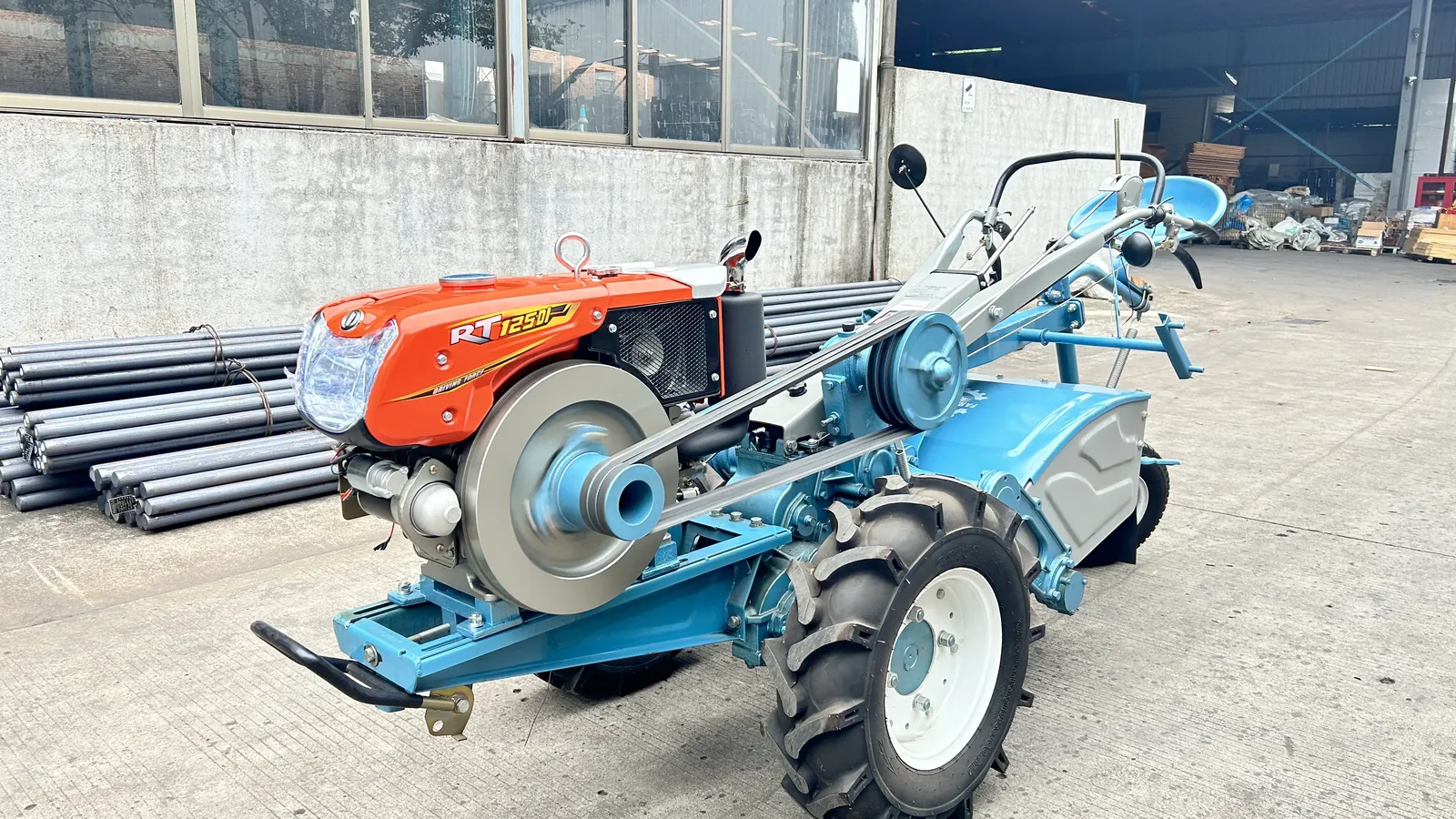
A power tiller plough package is not a plough with a few extras thrown in. It is a set of parts that only works when three numbers agree: the width the body cuts, the depth it reaches, and the load the machine can drag through that particular soil. Get the first two right and the third wrong, and the package becomes a heavy ornament. Get all three right and a single-furrow body will outwork a wider one that the machine cannot hold in the ground.
That is the whole argument of this page, and it is the opposite of how ploughs are usually sold — as a line item with a width and a price attached. The rest of what follows is the working detail behind each of the three numbers, plus the platform questions that decide whether a package fits the machine you are quoting.
A note on spelling before we start: mouldboard plough and moldboard plow are the same implement. Buyers in the United States and in most export catalogues write plow; buyers in South Asia write MB plough, and British-influenced markets write plough. One machine, one page.
What actually arrives in a power tiller plough package
A single-furrow plough looks like a bent piece of steel until you take it apart. What you are actually ordering is a small assembly in which each part has one job, and each part can be specified wrongly on its own.
- Beam or frame. Carries the body and sets its angle to the ground. The beam's length and mounting determine where the body sits relative to the machine's rear drive, and therefore how the whole unit balances when the share bites.
- Share. The cutting point that separates a slice of soil from the furrow floor. It is the fastest-wearing part on the implement, and a blunt share is the single most common reason a plough that "used to pull fine" starts dragging.
- Mouldboard. The curved surface that lifts the slice and turns it over. Its shape decides whether the soil crumbles, slides, or sticks.
- Landside. The flat face that runs against the furrow wall behind the share. It absorbs the side thrust the mouldboard generates, which is why a worn landside makes the plough steer crooked rather than cut badly.
- Coulter. A vertical disc or knife ahead of the share that cuts the slice's leading edge. It matters most in turf, cover crop and heavy residue.
- Skimmer or jointer. An optional small body that peels a shallow band of residue off the top and drops it into the furrow before the main slice covers it. Without one, long residue tends to be pushed ahead of the mouldboard instead of buried.
- Hitch parts, fasteners and a spare share. The least glamorous line in the quotation and the one that decides whether a distributor can support the package in year two.
Just as important is what a package usually does not contain. Depth control is a property of the hitch and the machine, not of the plough; draft sensing does not exist on a walk-behind unit; and nothing in the crate gives you a stock of wear parts unless you order them. Those gaps are where a buyer who compared only the width number gets surprised.

Implements and drive assemblies travel as separately crated items, not as one sealed box — which is why the parts list matters as much as the body width.
The same logic applies to rotary implements in this range; the rotary tiller package that ships with the M80 and GN12 platforms breaks down into a similar set of separately specified items.
Mouldboard, disc or reversible: which plough the soil asks for
Three plough types turn up in almost every quotation for small-scale tillage, and the choice between them is decided by soil and field condition before it is decided by price.
The mouldboard body cuts, lifts and inverts a slice, so surface residue, weeds and sod end up underneath. Penn State Extension describes the effect plainly: a moldboard plow inverts the soil to bury residues, terminate cover crops and perennial sod, and kill weeds. That inversion is the reason the implement exists — and also the reason it can be the wrong tool, a point we come back to in the last section. It works best in soil that is friable enough for the slice to slide up the mouldboard rather than stick to it.
The disc plough does the same job with a rolling disc instead of a fixed board. It is the answer for ground that a mouldboard cannot handle: sticky clay that smears, hard or stony soil, and root-infested land where a fixed board would jam. The trade-off is on the soil side rather than the machine side. The NSW Department of Primary Industries notes that disc ploughs invert soil to bury weeds and trash, but that regular use reduces soil aggregates to small particles and produces a compacted layer or plough pan that restricts air, water and roots.
The reversible or turnover plough carries two bodies back to back and is rotated at the headland, so every pass throws soil the same way. On sloping ground or where a dead furrow in the middle of the field is unacceptable, that is the only clean answer. The cost is mechanical: two bodies, a turning mechanism, and more mass at the rear of a machine that is already light at the front.
Field condition | Body that fits | What it costs you |
|---|---|---|
Friable loam or silt, adequate moisture, moderate residue | Mouldboard, single furrow | Needs a consistent depth to keep the slice sliding |
Sticky clay, hard-setting or stony ground, roots | Disc | Progressive aggregate breakdown and a pan if run at one depth for years |
Sloping ground, or a field that must stay level | Reversible / turnover | Two bodies and a turning mechanism to carry and maintain |
Long straw, heavy cover crop, pasture renewal | Mouldboard with coulter and skimmer | More parts to specify, and a share that wears faster in abrasive soil |
Narrow terraces and bed work | Single-furrow, short beam | Slower per hectare; one furrow per pass |
The row that catches most buyers is the second one. A disc plough is not a gentler plough; it is a plough that tolerates worse ground, and it pays for that tolerance in soil structure.
For the wider question of when a powered implement beats an inversion one at all, the rotary tiller versus plough comparison works through the same machines from the other direction.
How furrow width and depth are set on a walk-behind plough
Depth on a plough is measured to the bottom edge of the share, not to the top of the beam or to the height of the frame. In North American row-crop practice, mouldboard plowing normally runs at 8 to 12 inches, measured to the mouldboard share's bottom edge. That figure is a useful reference point, not a target to copy: it belongs to tractors with draft control and several times the mass of a walk-behind unit.
On a two-wheel machine, depth is limited by something much more basic. Every extra centimetre of depth increases the volume of soil the share has to separate, and the machine has no implement hydraulics to absorb the difference — the operator does, through the handles. This is why a plough that holds depth comfortably behind a heavier chassis can porpoise behind a light one.
Width behaves the same way in the other axis. On a single-furrow body the cutting width is essentially the share's working width, and the next pass is meant to run with one wheel in the open furrow, landside against the furrow wall. That single sentence explains a specification that otherwise looks arbitrary on a datasheet: track width has to be adjustable, and it has to be adjustable to a value the plough can actually use. A 390–780 mm track range or a set of five track positions exists for reasons like this one.

Five parts with one job each, and the two dimensions that set the load: depth is measured to the share's bottom edge, width across the cut.
Two relationships are worth carrying into any conversation about settings. Field work on mouldboard shares at two depth bands and two speeds found that increasing depth from 10–20 cm to 20–30 cm raised drawbar power, and increasing speed from 3.5 to 5.3 km/h raised it again while lowering energy efficiency. Deeper and faster is not a free improvement; it is a purchase of seedbed quality paid for in traction.
The draught chain: from the share edge to the tyre
Draught is the force needed to pull the plough, and it does not appear from one place. It accumulates along a chain, and the chain is only as strong as its weakest link.
- Soil resistance. Clay, moisture content and compaction set the baseline. The same body needs materially more force in wet clay than in dry loam.
- Share condition. A blunt or badly matched share raises the force needed to separate the slice. The same study above found that share geometry alone changed power requirements and furrow accuracy at identical depth and speed.
- Depth, then width. Both scale the volume of soil moved, and both raise draught roughly together.
- Speed. Pushing the same work faster costs disproportionate power.
- Machine mass and traction. This is the link buyers forget. Draught has to be transmitted to the ground through the tyres or wheels, and a light machine runs out of grip before it runs out of engine.

The chain only closes if the last link can carry what the other four ask for.
The order of magnitude is worth knowing even without a number for a specific model. When a mouldboard assembly replaced the head of a traditional ard plough in FAO's Ethiopian trials, the implement's draught requirement rose by 10–40 per cent over the maresha it replaced — for the same work, in the same soil, with the same animals in front. An inversion body is simply a more demanding shape than a tined one.
The practical consequence for a distributor is unglamorous but decisive: budget a spare share with the first order. A wear part that is not on the shelf converts a working plough into a complaint within one season, and no amount of body width compensates for it. The relationship between soil resistance, machine weight and implement choice is worked through in more detail in the note on soil resistance and machine weight.
M80 or GN12: matching the package to the platform
This is where the three numbers stop being theory. The two platforms SUNTEC currently publishes differ in the property that matters most for a plough — mass — and they differ by a factor of more than two.
MUBOTA M80 | GN12 | |
|---|---|---|
Engine class | 7–10 hp | 12.5 hp class |
Mass without engine | 179 kg | 470 kg |
Gears | 6 forward / 2 reverse | 6 forward / 2 reverse |
Track settings | 390–780 mm | 570 / 630 / 690 / 750 / 810 mm |
Ground clearance | — | 210 mm |
Rotary tilling width | 480 mm standard / 600 mm max | 480 or 600 mm (sheet records 600) |
Two footnotes belong with that table, because both are routinely misread.
First, the 480 / 600 mm range is rotary tilling width, not plough width. SUNTEC's specification sheets carry rotary figures: 480 mm with a 14-blade rotor as the standard M80 configuration, 600 mm with up to 16 blades as the wider M80 option, and on the GN series the sheet records one configuration only — 600 mm with an 18- or 24-blade rotor. The 480 mm option on that platform comes from a later confirmation, not from the spreadsheet: SUNTEC confirmed on 2026-08-28, in written page feedback, that 480 mm is also available on the GN platform, which is why the table above carries both figures while the downloadable sheet still shows only 600 mm. That is a rotary figure and it should never be pasted into a plough quotation as a cutting width. How the machine's specification sheet is put together, and where each number comes from, is set out in the guide to power tiller specifications.
Second, mass without engine is the number that decides plough depth, not engine horsepower. A 179 kg chassis carrying a 9 hp engine and a 470 kg chassis carrying a 12.5 hp engine are not a small step apart; they are two different traction classes. The lighter machine is the right answer for narrow terraces, bed work and repeated passes where manoeuvrability is the constraint.

The lighter platform, here with its rotary cultivator fitted: 179 kg without engine is the figure a plough quotation has to work with.
The heavier one is built for ground where the share has to be held down and pulled steadily, which is exactly where a plough earns its place. If the field description points toward the heavier platform, the GN12 walking tractor is the model the quotation should be built around.
What to check at the hitch before the order leaves
The rear of a walk-behind tractor is a casting with a specific bolt pattern, a specific height and a specific offset — not a universal interface. Four checks catch most of the mismatches.
The mounting face. Look at what the implement actually bolts to, and at what height that face sits above the ground line. A plough is a lever; ten centimetres of mounting height changes its angle of attack and therefore its depth behaviour before anyone touches a setting.

The rear end is cast, bolted and specific. The plough has to be built for this face, not adapted to it.
Track setting against furrow width. As above, the working pass expects one wheel in the open furrow. If the track cannot be set close enough — or wide enough — the plough will fight the machine all day.
Traction hardware. Rubber tyres, steel traction wheels and wheel extensions solve different problems, and a plough on wet ground is the case where the difference is most visible. If the ground is soft, the wheel question arrives before the plough question.

Steel cage wheels are a traction decision, not an accessory: on soft ground they change what the machine can pull before the plough does.
What the machine weighs with the package fitted. Adding a plough body, beam and ballast at the rear moves the centre of gravity and changes how much of the machine's mass is available as grip.
The compatibility checklist behind these four points, including what to send a supplier before ordering, is laid out in confirming implement compatibility before ordering.
Five questions that separate a package from a plough
A distributor quoting a plough line can settle most of the risk with five questions, none of which is about price.
- What body width is quoted, and what depth will it hold in my soil? Ask for both together. A width without a depth is a shape, not a specification.
- Is the share a stocked wear part with a known mounting pattern? If the answer is "we will check", the package has no second season.
- Which track setting does this plough need? The supplier should be able to name it, not compute it later.
- What is the machine's mass with the package fitted, and is ballast available? This is the draught chain's last link, and it is usually left blank.
- Which parts are in the crate, and which are ordered separately? Coulter, skimmer, spare share, fasteners — the answer defines what "package" means.
If a supplier can answer all five from stock data rather than from memory, the package is real. If three of them come back as "depends", the buyer is being sold a component.
When a plough package is the wrong purchase
Inversion tillage is an aggressive operation with measurable consequences, and there are fields where the honest recommendation is not to plough.
The clearest case is residue. A mouldboard pass leaves very little surface protection — the same Minnesota Extension guidance puts residue cover at under 15 per cent of the soil surface in the months after planting, with the highest erosion potential of any tillage option and high fuel, time and labour requirements. On erodible slopes and light soils, that is a cost the buyer pays later.
The second case is puddled paddy preparation, where the job is to churn saturated soil into a level, sealed root zone rather than to invert a slice. A rotary implement does that work; a plough does not.
The third is repeated work at a single depth, which is how plough pans form in the first place — the same risk the NSW guidance flags for disc ploughs and Penn State flags for inversion tillage generally. Varying depth between seasons, or rotating the implement, is cheaper than subsoiling a pan out later.
None of this makes a plough obsolete. It makes it a decision rather than a default, which is the same conclusion the implements overview for these two platforms arrives at from the other end.
Putting the plough line into a quotation
Four lines carry everything a factory needs to quote a plough package without guessing:
- Field and soil. Soil type, stone and root risk, and the moisture window you expect to work in.
- Body and width. Plough type plus the cutting width you want, and the depth you intend to hold.
- Platform. M80 or GN12, with the track setting the plough will run at and the traction hardware fitted.
- Parts. Whether the crate includes a coulter, a skimmer and a spare share, and what you want stocked.
Unit price belongs to the configuration, not to the implement name — body width, platform and the parts list move it, so it is quoted against a described package rather than published as a figure. What can be answered from published data is answered on the platform pages themselves, starting with the M80 power tiller.
Those four lines are also the core fields of the power tiller RFQ builder, which turns them into a structured brief and leaves anything you cannot answer yet marked as open, rather than filling the gap for you.
Send the four lines above and the reply can be a configuration instead of a catalogue page.