
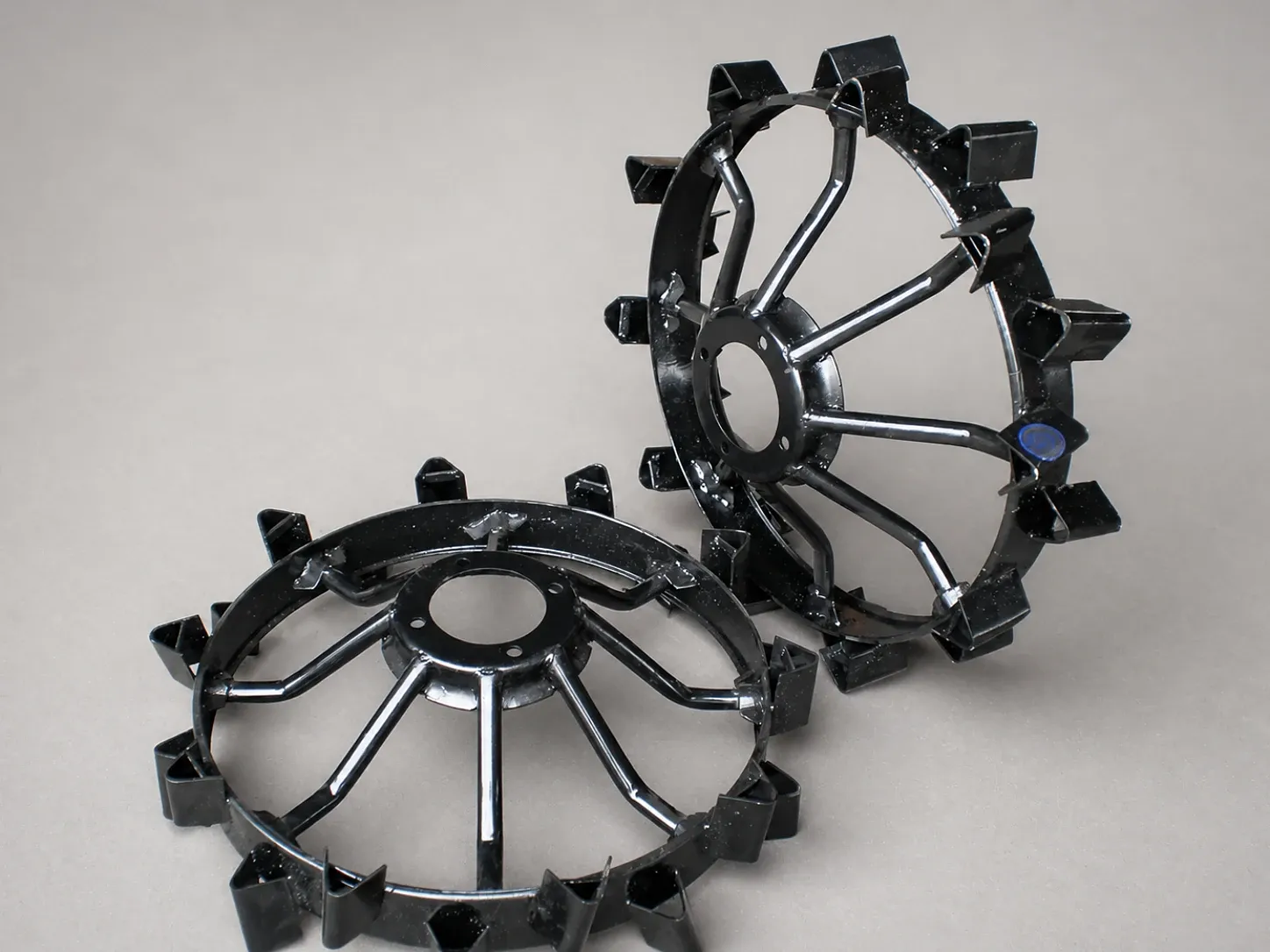
A rubber-tyred walking tractor that works well on dry ground will spin in a puddled paddy. The fix is a set of steel traction wheels — sold as spike wheels, anti-skid wheels, cage wheels or iron wheels — and the difference between a set that works and a set that wastes a season is rarely the price. It is whether the wheel form matches the water and soil condition, whether the lug geometry can clean itself, and whether the hub actually bolts to the axle the buyer has.
This guide is written for the distributor or fleet buyer who has to specify that set for someone else's field, and for the operator who has to make it work once it arrives. It covers the traction mechanism, how to match a wheel form to a wet-field job, the numbers worth asking about, and the checks that belong before the order rather than after it.
Why a rubber tyre quits in a wet field
A pneumatic tyre develops grip by pressing a rubber lug into soil and letting the soil shear against it. That works while the soil can carry the load. In a puddled paddy, or in clay after two days of rain, two things happen at once:
- The tread fills. Wet clay packs into the gaps between the lugs and the tyre becomes, in effect, a smooth drum. Once the voids are full there is nothing left to shear against the soil.
- The tyre floats instead of penetrating. A wide, low-pressure tyre spreads load over a large contact patch. On soft ground that is usually an advantage — it is exactly how you avoid sinking — but it also means the lugs never reach firm soil, so the wheel turns and the machine does not move.
The measurable result is slip: the wheel travels less distance than its circumference says it should. Slip is not a cosmetic problem. Every percent of slip is engine power converted into mud rather than into pulling a rotary tiller or a trailer, and it is the standard against which traction is judged in agricultural machinery testing — traction trials commonly record performance up to roughly 15% mean wheel slip before the numbers stop being useful. A paddy wheel study on a micro-tiller, run in soil at 36% moisture content, measured exactly this trade-off: torque, drawbar pull and slip ratio move together, and both maximum torque and drawbar pull rise as the load carried on the wheel rises (Biomimetics, 2022).
That last point explains why steel wheels work. An open steel wheel does three things a tyre cannot:
- It penetrates. Narrow rim, high contact pressure, so the lugs reach the firm layer below the slurry instead of riding on top of it.
- It self-cleans. An open centre and widely spaced lugs let mud pass through and fall away instead of packing solid.
- It converts torque into a mechanical push. The lugs act as paddles against undisturbed soil rather than relying on friction between rubber and wet clay.
What a narrow spike wheel does not do is give you flotation — a wide cage buys flotation by giving up penetration. If the field is deep enough that the machine belly-ploughs, a spike wheel will dig in harder, not float. Traction and flotation are opposite requirements, and confusing them is the most common specification error in wet-field wheel buying. If the problem is sinking rather than spinning, the answer is a different machine setup, not a more aggressive wheel — paddy field versus dry land machine setup covers that decision.
What "spike" and "anti-skid" actually describe
The trade names overlap, and different catalogues use them loosely. For procurement purposes it helps to sort them by what the rim does, not by what it is called. One naming caution up front: a spike wheel and a wheel extension are not the same component. An extension moves the wheel outboard to change track width; a spike wheel changes what the rim grips. If the requirement is track width rather than grip, read spike wheels and wheel extensions explained before ordering anything.
Form | What the rim looks like | Best wet-field role | Main limitation |
|---|---|---|---|
Spike / lug wheel | Narrow steel rim, short angled teeth or blocks welded around the circumference | Puddled paddy, deep mud, pulling a trailer through wet tracks | Harsh on hard surfaces; ruts on soft bunds |
Chevron anti-skid wheel | Steel rim with V-shaped cleats, sometimes a partial disc | Wet clay and heavy loam where a full cage would sink | Cleats wear at the tips; less self-cleaning than an open cage |
Cage wheel | Open rim built from cross bars or vanes, hub on spokes, no disc | Standard paddy and puddling work; the general-purpose wet-field choice | Poor on the road; can wrap with straw and roots |
Iron disc wheel | Solid or near-solid steel disc, sometimes with a shallow tread | Firm wet soil, transport on wet tracks, low-sink situations | Flotation, not grip; slips badly in slurry |
Half-cage / dual-fit | Cage on one side, disc or partial cover on the other | Mixed fields, alternating wet and firm ground | Compromise on both; check the fitment carefully |
Two practical notes on that table. First, the term anti-skid wheel is used in the trade both for a chevron-cleat steel wheel and, more loosely, for any steel wheel fitted to stop a machine spinning — so when a supplier quotes "anti-skid wheels", the drawing matters more than the words. Second, cage width and lug height change the behaviour more than the pattern does: a narrow cage bites deep and ruts, a wide cage spreads load and floats. Ask for both numbers.
Matching the wheel form to the job, not to the crop
A paddy is not one condition. It changes across the season, and the wheel that suits puddling is often the wrong wheel for hauling sacks out of the same field four months later. On a power tiller the same field changes job several times a season, and the wheel has to follow the job.
Field job | Condition at the time | Wheel form that usually fits | Why |
|---|---|---|---|
Puddling and wet preparation | Standing water, soil worked to slurry | Cage wheel or wide-spaced spike wheel | Needs mud discharge more than bite; a closed rim would ball up |
Secondary tillage in wet clay | Saturated but not flooded | Chevron anti-skid or narrow cage | Cleats cut and drain; keeps the machine tracking straight |
Transplanting-season transport | Soft tracks, light loads | Half-cage or iron disc | Enough grip without cutting the track to pieces |
Harvest hauling | Firming soil, heavy trailer loads | Disc or chevron; cage only if the track is still wet | Load carrying matters more than penetration here |
Nursery and seedbed work | Shallow water, very soft surface | Wide cage, lowest ground pressure available | Flotation and a light footprint |
Road transfer between plots | Hard surface | Rubber tyres, not steel | Steel lugs on asphalt or concrete damage both wheel and surface |
Puddling deserves its own line because it is where most wet-field wheel decisions are actually made. Wet preparation churns the soil to a slurry and holds water on the surface; IRRI's wet-preparation guidance puts the water coverage needed for land leveling with a two-wheel tractor at seven to eight days per hectare — which is to say the surface the wheels work on stays under water for more than a week around that step (IRRI Rice Knowledge Bank). In that medium, an open wheel that lets slurry pass through will always outperform a closed one that carries it around.
There is also a soil-type dimension that no catalogue table captures. Heavy clay holds water and turns to grease — it rewards a narrow, aggressive lug. Sandy loam drains and firms up quickly — it punishes over-aggressive lugs with ruts and rapid wear. And a field that is wet for three weeks a year does not justify a dedicated paddy wheel at all; a set of bolt-on extensions or a pressure adjustment may cover it. Soil resistance, power, weight and implements is the companion read on how soil condition drives the whole implement chain.
The numbers that decide whether a set will work
Five figures separate a wheel that works from one that spins. None of them are exotic, and all of them should be on the drawing or the datasheet.
1. Wheel load and ballast. Traction rises with the load carried on the wheel — the paddy wheel study measured maximum torque and drawbar pull climbing as on-wheel load increased. On a two-wheel power tiller the useful lever is ballast on the machine frame or in the wheel centres, in the amount the manufacturer permits. More weight helps until the machine starts sinking, at which point it becomes the problem.
2. Slip target. Ask what slip the wheel is expected to run at in the target condition. Under 15% is the working reference used in traction testing; a wheel that only pulls its implement at slip far beyond that reference is mis-specified, not merely aggressive.
3. Lug height, count and angle. Tall, widely spaced lugs bite and self-clean; many short lugs ride and pack. Lug angle sets how the wheel releases the soil at the top of its rotation — the practical test is whether mud throws clear or rides around and drops back under the wheel.
4. Rim width and track setting. Narrower wheels sink more and grip more; wider wheels float. Track setting then decides whether the machine fits between bunds and whether it runs in the previous pass's ruts. Both are fitment questions, and both are on the implement compatibility checklist.
5. Ground clearance. A steel wheel that is larger in diameter than the original tyre lifts the whole machine — usually good for clearance over stubble, but it also changes the working angle of a mounted rotary tiller or plough and can put the implement out of its designed depth range. If a wheel change is on the table, the implement geometry has to be checked with it.
One more figure is worth knowing even though it is not a wheel dimension: tyre inflation pressure, for the days the machine runs on rubber. Traction trials comparing ballasted and unballasted tractors — run on a concrete test track, which the authors say still has to be repeated on agricultural soil — found that lower tyre pressure raised the net traction ratio at working speeds below about 6 km/h, because drawbar pull improved (AgriEngineering, 2025). The direction is worth knowing; the surface it was measured on is not a paddy. In other words, before buying steel, check whether the wet-field problem can be solved by correct rubber pressure and sensible ballast. Often it can — for a season or two.
What to verify on the hub before the order
Most wet-field wheel disappointments are fitment failures, not traction failures. The wheel is right and it still will not mount, or it mounts and fouls something. What to measure off the machine — bolt count and spacing, bore, dish, the tyre it replaces, the track positions your platform offers — belongs to the spike wheels and wheel extensions explained fitment check. What follows is the other half: what to get on paper from the wheel maker, and the one check that still has to be made with the wheel on the machine.
- The numbers that must appear on the drawing. Bolt pattern and pitch circle diameter, offset and dish direction, and the axle or keyway dimensions where the drive is keyed. A quotation without them is a description, not a specification.
- Hub bore and spigot fit. The centre bore carries load; if it is loose on the hub spigot, the studs will fret and shear.
- Fastener grade and torque, plus whether the wheel uses the original studs or a supplied set.
- Weight per wheel. It affects handling, transport cost, and how much ballast you still need.
- Whether a matching pair is supplied as a matched set — same diameter, same lug pattern, same balance.
- Clearance, with the wheel offered up to the machine rather than on paper: fender or guard, steering clutches, implement mounting frame, and the operator's feet.

A distributor who cannot answer these from a drawing will usually answer them from a photograph of a wheel on a machine — which tells you nothing about the hub. Ask for the drawing.
Operating practice that keeps a steel wheel working
The wheel is half the result; the other half is how it is used.
- Set the work depth first. A tiller set too deep converts every bit of available traction into slip. Raise it, take a lighter pass, and let the wheel run.
- Work in the direction that keeps the wheels out of the previous rut where the field allows it. Running in your own ruts doubles the sink.
- Keep speed low in slurry. Slip rises sharply with speed in soft ground, and so does the spray pattern that buries the operator and the machine.
- Do not run steel on hard road for anything beyond a short crossing. It wears the lugs flat, damages the surface, and can be illegal on public roads in some markets.
- Clean and inspect after each wet season. Mud held against the rim is where corrosion starts; cracked welds at the spoke-to-rim joint are the failure mode to look for, and they are visible before they break.
- Check the bunds. A cage wheel that is correct for the field can still cut a bund to pieces on the turns. If bunds are the field boundary, turning practice matters as much as wheel choice.
What to ask a supplier
Put these six questions in the enquiry and the answer will separate a wheel supplier from a wheel trader:
- Which wheel forms do you offer for wet-field work, and what is the lug height, lug count and rim width of each?
- What wheel load is each form rated for, and what ballast does the machine allow?
- Can you supply the hub drawing — bolt pattern, pitch circle diameter, bore, offset and weight per wheel?
- Which of these forms do you recommend for puddling, and which for harvest hauling in the same field?
- What is the surface finish, and how is the weld at the spoke-to-rim joint inspected?
- What changes to the implement setup are needed when the wheel diameter differs from the original tyre?
A supplier who answers those in writing is describing a product. A supplier who answers only with a price and a photograph is describing a hope.
If the wheels are being specified as part of a wider implement order — rotary tiller, plough, trailer hitch — the whole set should be checked against the machine's mounting points and hydraulic or mechanical limits at the same time. The implements and attachments selection guide covers how the pieces are meant to fit together, and the terminology article on walking tractor and power tiller vocabulary is a useful cross-check when a quotation uses a name your own catalogue does not.
SUNTEC builds two-wheel power tillers and walking tractors of this class, so where the wheel is being specified with the machine rather than for one already in the yard, the platform side — track settings, tyre size, mounting points — is on the GN12 walking tractor platform page. The wheel set itself is still confirmed against your hub drawing, not against a catalogue name.
Wet-field traction is a systems problem: soil condition, wheel form, wheel load, implement depth and operating speed all pull in the same direction or against each other. Get the wheel form right and the other four become adjustable. Get it wrong and no amount of ballast will save the pass.