
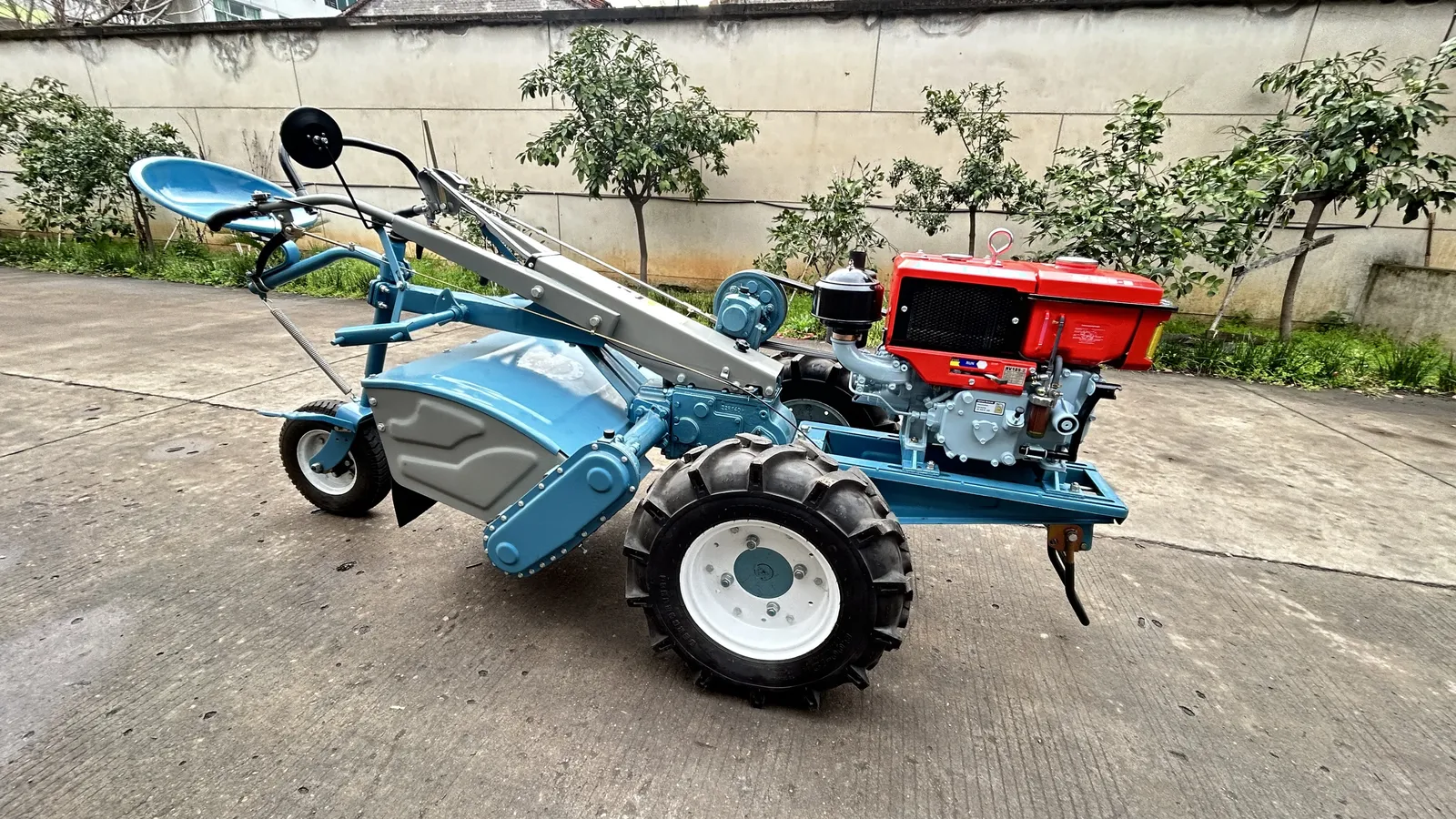
A power weeder works between rows. A power tiller works the whole block. That one distinction settles most power tiller vs power weeder arguments before anybody mentions horsepower, and it is also where most catalogue copy quietly stops — which is why buyers keep asking whether a weeder is simply a small tiller.
It is not, and the reason is mechanical rather than commercial. Because the two machines look like the same machine at two sizes, they get sold as if they were, and then a distributor discovers in the field that the one he stocked cannot enter the crop he sold it for.
One disclosure before the detail: we build and export power tillers, not power weeders, so the tiller is the machine we have a commercial interest in. The weeder gets its full case below, including a section on when it is the better purchase, because a distributor who sells the wrong class loses more than one order.
Power tiller vs power weeder: the short answer
One works the row; the other works the block. A power weeder sells a weeding pass: shallow, fast, between plants that are already standing. A power tiller sells a land-preparation pass: deeper, slower, over the whole surface, before the crop or between crops.
Three questions decide which one a market needs, and none of them is horsepower:
- Can the machine straddle the rows? Wheel track against row spacing. If the wheels fall on the crop, the machine is not a weeder in that field, whatever the catalogue says.
- How deep does the job go? A weeding pass works a few centimeters. A pass meant to make a seedbed, bury residue or puddle a paddy goes considerably deeper and pulls far harder.
- Is there a crop in the ground? A weeder is a crop-time tool. A tiller is a soil-time tool.
This page is one article in the power tiller buying guide for distributors, so it stays on the class decision.
Same chassis, different tool: what each machine actually is
Both machines are single-axle walk-behind units, and FAO treats the power tiller as a two-wheel tractor (FAO, The State of Food and Agriculture 2022, ch. 2). The drive train is identical in outline: engine, clutch, gearbox, a shaft turning a tool behind or under the axle, and handlebars the operator walks behind.
What changes is everything downstream of the shaft.
The tool. A power tiller carries a full-width rotary cultivator: a horizontal shaft with rows of curved blades or L-tines across the machine's whole working width, inside a hood or shield that controls how the soil is thrown. A power weeder carries a narrower set of tines arranged to disturb the strip between rows, often with shields that keep soil and cuttings out of the crop line. The rotor in the photograph below is the tiller version — note the width of the shaft and the number of tine stations: that width is the machine's working width, and it is fixed by the rotor, not by the engine.

A rotary cultivator rotor: tine rows across a full shaft. This is the part that defines the tiller's width and its work rate — and the part a weeder replaces with a narrower, differently shaped tine set.
The hood and shield. The tiller's hood is a working surface and a safety device: it stops the blades throwing soil over the operator, and it limits how tall a standing crop can be before the hood pushes it down.
The width. Here the difference becomes commercial. A tiller works the block in strips: the widths we build are 480 mm and 600 mm, and every additional strip is another pass. A weeder works one or two inter-row corridors at a time by design.
The gearing. The two jobs want opposite operating points, which is why the same engine feels adequate on one machine and marginal on the other.
If the confusion in your market is between a walk-behind machine and a garden rear-tine tiller, that is a different comparison — rear-tine tillers and power tillers are different machine classes. And the naming itself causes trouble: power tiller, walking tractor, hand tractor and two-wheel tractor are the same family under four names, which is worth sorting out before a catalogue is printed.
What a power weeder does that a tiller cannot
A weeder's advantage is not that it weeds better in the abstract — the common power weeder uses all depend on one thing: it can be in the field while the crop is growing, which a tiller cannot.
- It works close to the row. Inter-row cultivation runs a few centimetres deep — SARE's field guide puts low-residue inter-row sweeps at 25 to 50 mm (1 to 2 inches) for the best weed kill and highest moisture retention (SARE, Steel in the Field: cultivator, low-residue). Shallow is the point: the crop's roots are already there.
- It travels fast. Speed is where weeding efficiency comes from: a shallow pass at walking-to-brisk speed covers ground at a rate a tilling pass cannot, because depth, not width, limits forward speed.
- It can come back. Rice guidance is explicit about repeat passes: start when weeds are at the three-to-four-leaf stage, then repeat once or twice at around 20-22 and 30-32 days after transplanting (IRRI Rice Knowledge Bank, mechanical weed control). Two or three cheap passes beat one expensive one.
- It leaves the surface alone. No residue is buried, no weed seed is carried down, no soil structure is inverted across the field.
- It cuts the labour bill, though it does not erase it. IRRI rates mechanical weeding above hand weeding on labour — it needs less labour and costs less — but it still puts the mechanical pass itself at six to eight person-days per hectare per weeding, and states that this is more labour than chemical weed control needs. A weeder substitutes for the hoe, not for the sprayer.
The same source is honest about the weeder's ceiling, and a supplier who does not say this out loud will be found out in the first season: mechanical weeding suits row-planted crops, is difficult in hardened soil or where water is limited, struggles to remove weeds inside the crop row, and only works on young weeds — past that stage, the weeds that survive cost yield. A weeder is a system tool, not a weed eraser.
What a power tiller does that a weeder cannot
The tiller's case starts where the weeder's stops: the pass before the crop exists.
- It works the full width. A rotary cultivator breaks, mixes and levels the whole surface across its width, which is what a seedbed is.
- It goes deep enough to change the soil, not just the weeds. Depth is set at the skids or the depth control, and the machine is built to hold it.
- It puddles. For paddy, land preparation is a tillage job: IRRI's sequence is ploughing to dig up, mix and overturn the soil, harrowing to break the clods and incorporate residue, then levelling the field — and the implements it lists are a power tiller with a mouldboard plough, a hydrotiller or a rotovator (IRRI, land preparation). No inter-row weeder does any of that.
- It incorporates. Residue, compost and fertiliser go into the top layer in the same pass that prepares the seedbed, and the pass aerates that layer, which is a large part of why the machine earns its keep outside the weeding window.
- It carries other tools. The same chassis takes a plough or a trailer. That versatility is the reason a smallholder buys a tiller first and a specialist weeder later, if at all.
A distributor's honest framing is that these are two operations in one crop cycle: tillage makes the field, weeding keeps it. Selling one as a substitute for the other is how a customer ends up disappointed by a machine that was correctly built for a different job.
Row spacing and wheel track: the test that decides before you quote
If there is one number to get from a buyer before quoting either class, it is not engine size. It is the distance between his rows, measured against the track width of the machine you are proposing.
An inter-row weeder only works when its wheels run in the inter-row furrow and its tines run beside the crop line. That is a geometry problem with little tolerance. Row spacings vary by crop and region, and they routinely fall inside the track width of a walk-behind chassis. Put those two facts together and the failure mode is obvious: a machine that is perfectly good in one market plants its wheels on the crop in the next one. Cage wheels and adjustable axles exist precisely to move that number, which is why wheel choice is a configuration question before it is an accessory question.

Cage wheels on the same chassis: the track across the rear axle is the number that has to fit between the rows.
Working width then sets the number of passes, and the arithmetic is worth doing in front of the buyer, not in a brochure. At 600 mm per pass, a hectare is 167 passes in a 100 m long field; at 480 mm it is 208. Shorten the field to 50 m and the same hectare takes 333 and 417 passes. Nothing about the engine changes those numbers — they come from width and field shape, which is also why gateway and headland measurements belong in the same conversation.
Depth, speed and engine size: why horsepower tells you nothing on its own
Buyers search for a power weeder by horsepower — seven, nine, ten — and then assume the same number buys the same capability in a tiller. It does not, because engine size is only one term in a three-term equation: draft = depth × width × soil resistance, and the machine's forward speed is set by how much of that draft the engine can pull without stalling.
Run both machines through it and the confusion dissolves. A weeder at 25-50 mm depth over a narrow strip is pulling very little soil, so the same engine can push the machine along quickly. A tiller at seedbed depth across 480 or 600 mm is pulling many times more soil, so the same engine has to be geared down and driven slowly. Petrol or diesel, the equation does not change. Identical power, opposite jobs.
The practical consequence for a quote: horsepower tells you how much metal the engine can turn, not whether the machine will hold depth in your buyer's clay. Which is also why the rotary tiller vs power weeder argument is never settled by a spec sheet — the same number describes two different jobs. If you need the vocabulary for that conversation — power, width, gears, implements, and which of them a buyer should actually compare — it is set out in the specifications guide.
Field conditions: which machine the ground asks for
Field condition | Power weeder | Power tiller | What decides it |
|---|---|---|---|
Paddy, crop established | Useful once rows are visible and water is managed; IRRI's guidance assumes 2-3 cm of standing water and row planting | Weak as a weeder, strong as the machine that puddled the field | Whether the crop is row-planted or broadcast |
Dry-land row crops (maize, vegetables, pulses) | The machine this field was designed for | Preparation only — cannot enter a standing crop | Crop stage and row spacing |
Orchard and plantation | Works the strip between trees if the track fits | Strip tillage and mowing-type work with the right tool | Track width against tree spacing |
Terraced or narrow plots | Narrower machines fit; productivity falls with plot size | Same limit, plus turning space at every terrace end | Plot width and headland |
Heavy clay, dry and hardened | Struggles; IRRI lists hardened soil as a limitation | Breaks it, at the cost of passes and fuel | Soil condition at the time of the pass |
Wet ground after rain | Only where the crop and soil allow | Traction and smearing risk rise sharply | Moisture at working time |
Stony or root-infested ground | Tine damage risk | Blade damage risk; slower going | Stone load, not machine class |
Read it as a filter, not a ranking: most mixed markets need both columns, which is why stocking matters more than the specification sheet.
For the two platforms we supply, the split is by weight of work: a lighter 7-10 hp machine for compact plots and narrower conditions, and a 12.5 hp-class walking tractor for heavier ground and haulage, both on the same confirmed working-width pair of 480 mm and 600 mm — with our own configuration table recording the 600 mm set-up. The full paddy-versus-dry-land logic is worked through separately.
The tool behind the decision: blades, tines and the changeover cost
"One chassis, two tools" is true and also misleading, because the changeover is real work and it is priced in hours.
On tractor-mounted implements, SARE notes that rotors must be selectively removed or adjusted to do inter-row weeding, and calls that at least a two-hour job (SARE, Steel in the Field: rotary tillers, convertible). A walk-behind machine is easier to strip, but the same three things have to change: the tool itself, the shield or hood around it, and the depth setting. The gearing that suits a slow deep pass is not the gearing that suits a fast shallow one. The same source adds the constraint that decides many weeding jobs before they start: blade length limits the height of the crop that will pass unharmed under the solid drive shaft. A shielded rotor does not glide through a waist-high crop.
The other half of the answer is wear. Tines and blades are consumables — they blunt, they chip on stones, and they are replaced in sets rather than singly. A rotor with a full complement of stations is only as good as the number of sharp tines on it, which is why the wear-part line, not the machine, is where a distributor's margin and reputation actually live. The replacement process itself is worth knowing before a buyer asks: how blades are identified and changed is a support question, not a specification question.

A lighter platform with its rotary cultivator fitted: the tool, the hood and the depth setting define the job, and all three are replaceable.
The tool is also a package rather than a single part — shafts, blades, bearings, guards and fasteners travel together, as described in the rotary tiller package for the M80 and GN12 platforms.
What this means for a distributor's stock and spare-parts list
The class decision is a market decision, and it resolves into one of two stocking shapes.
Weeder-shaped markets plant in rows, weed two or three times per crop, and have labour that is available but expensive relative to machine hours. Here the inter-row weeder is the volume product and the tiller is the preparation machine behind it. Tiller-shaped markets prepare land for paddy or for broadcast and transplanted crops, work wet ground, and need haulage and implement versatility more than they need a second weeding pass. Here the tiller is the volume product and a weeder is a niche item for the vegetable growers in the district.
Neither shape is fixed, and the power weeder vs power tiller call is made per market rather than per catalogue. The mistake is to assume that because a market talks about the "power weeder machine" it wants weeders, or that because a buyer asks about a power tiller with weeder attachments he is describing one machine. Those are two machines and, in most cases, two purchases.
There is a supply-side argument for taking the weeder question seriously even in a tiller-shaped market. FAO's analysis of two-wheel tractor uptake in sub-Saharan Africa finds that low ownership coexists with an almost non-existent rental market, and identifies the gap as suppliers not yet having established fully operational, sustainable local supply chains for these machines and their spare parts (FAO, The State of Food and Agriculture 2022, ch. 2). That is a distributor's opening: the machine is easy to ship, the parts network is not, and the dealer who can supply a tine set in week two owns the customer in year three.
Which is why the wear-part conversation belongs in the first meeting, not after the first failure. A tiller buyer needs blades, belts, filters and bearings; a weeder buyer needs tines, shields and depth hardware, and he needs them in the season he sells the machine.

What actually ships and what a distributor actually stocks: machines, drive assemblies and wear parts move as separate crated items, and the parts line outlives the machine sale.
When a power weeder is the right buy — and when it is not
Recommend a power weeder when all of the following are true:
- The crop is planted in rows, and the row spacing fits the machine's track with room on both sides.
- Weeding happens two or three times per crop cycle, not once.
- The soil is workable and not hardened at the time of the pass.
- The weeds are young when the pass happens; a weeder is a timing tool.
- Labour is the binding constraint — the operation is trying to cut person-days per hectare, not to prepare land.
- The buyer already has tillage capacity, or does not need it.
Do not recommend one when any of these is true:
- The crop is broadcast or the rows are irregular enough that a fixed track cannot follow them.
- The field is hard, dry and compacted, or stony.
- The buyer's real problem is land preparation, puddling or seedbed quality.
- The crop will be too tall for the tool and hood by the time weeds appear.
- The buyer expects one machine to prepare land, weed and haul.
In those cases the honest answer is a tiller, or a tiller plus a seasonal weeding contractor — not a weeder sold against its own operating window.
Limits on the tiller side a quote should state
The same honesty applies in reverse — these are the limits a tiller buyer should hear before he signs:
- It cannot weed inside a standing row. Driving a full-width rotor through a crop destroys the crop. A tiller replaces the weeding pass only when the field is bare.
- Crop height is limited by the hood. Any pass over a standing crop has to clear the shield.
- Width per pass is fixed by the rotor. At 480 or 600 mm, a hectare is hundreds of passes; field shape and turning space decide whether that is acceptable.
- An operator walks the whole job. This is not a ride-on machine: daily area is limited by the person, not just the engine.
- Wet ground is a traction problem, not a power problem. More horsepower does not create grip; wheels and ballast do.
- It buries weed seed as well as residue. Full-width tillage moves soil through the profile, which is an advantage for seedbeds and a consideration for weed pressure.

Grip is a separate purchase from power: on wet ground, cage wheels decide whether the machine works or spins.
None of that makes the tiller the wrong machine — it makes it a specific machine, which is the only useful way to sell one.
Six questions that settle the quote
Before quoting either class, get these six answers in writing — five minutes that prevent the return which costs a season:
- What is the crop, and is it planted in rows? What is the row spacing, centre to centre?
- What is the field size and shape, and what is the narrowest gateway the machine must pass?
- What is the soil, and in what condition is it worked — dry, moist, wet, hardened, stony?
- What operation is the machine bought for: land preparation, weeding, puddling, haulage, or several?
- How many passes per crop cycle, and at what crop stage?
- What wears out first in the buyer's conditions, and who supplies that part in season two?
The class question is answered by geometry and timing, not by horsepower: if the machine can straddle the rows and the job is shallow, it is a weeder job; if the job is depth over the whole surface, it is a tiller job.
Answer those six and the choice usually makes itself. If it does not, the next step is a configuration conversation — platform, width and tool — rather than a longer catalogue: discuss a configuration for your market.